







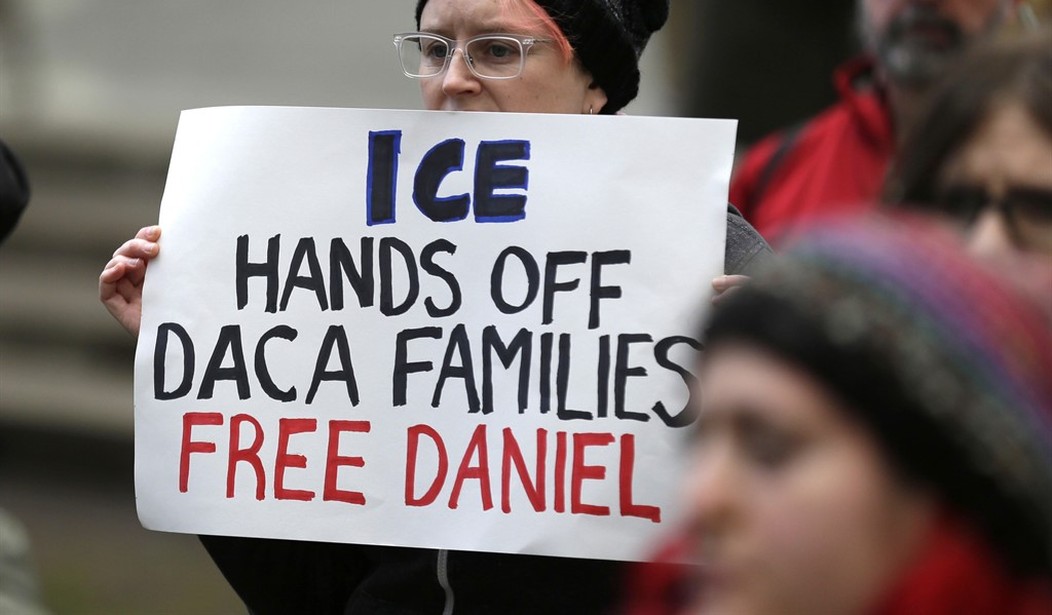
President Donald Trump has been flip-flopping right and left recently -- much of it for the good. He's abandoned his promises to label China a currency manipulator, withdraw from NAFTA, repeal Obamacare and stay out of Syria. But he seems to be digging in on his pledge to create a deportation force to rid the country of people who are illegally here. A decision memo leaked this week to The Washington Post outlines the administration's plans to hire new Customs and Border Protection officers quickly by abandoning the usual safeguards, such as polygraphs and physical fitness tests, in some instances and deploying local police to enforce immigration laws through agreements with dozens of cooperative police departments. The memo also says that the Department of Homeland Security has found some 33,000 beds to supplement its detention facilities.
If ever a policy deserved reversing, this is it. But will Trump have the courage to change course? Immigration hard-liners in and out of the administration are counting on an anti-immigrant backlash to stiffen the president's resolve, but when the roundups start, a far different backlash is likely to occur. The majority of undocumented immigrants in the U.S. have lived among us for more than a decade, are in families that include American citizens, work at jobs that are vital to the economy, pay taxes and spend their incomes in communities, which depend on their contributions. The idea that we can round up 11 million people -- or even a fraction of that number -- without harming American citizens is a pipe dream.
Just ask the people of Utah. In his engaging new book, "There Goes the Neighborhood: How Communities Overcome Prejudice and Meet the Challenge of American Immigration," Ali Noorani describes what happened in that conservative state when some local immigration vigilantes tried to drive out undocumented immigrants from their community. Noorani, who heads the National Immigration Forum, quotes an article from the Deseret News on July 13, 2010: "An anonymous group says it quietly watched Hispanics in their neighborhoods, schools, churches and 'public welfare buildings' to compile a list of 1,300 people it says are illegal immigrants living in Utah. The group sent the list to law enforcement agencies and news media demanding that those named 'be deported immediately.'" But instead, the incident sparked the coming together of an unlikely coalition of ordinary citizens, business leaders, churches and law enforcement officials to push back against the vigilantes. What emerged was the "Utah Compact," which supports national immigration reform, urges law enforcement to concentrate on criminal violations and not enforce civil violations of immigration law, and supports free market principles that maximize individual freedom and opportunity.
Undocumented immigrants make up about 6 percent of the U.S. workforce. Deporting that many workers would deal a blow to the U.S. economy that could well send the country into recession. One of the great ironies of the Trump immigration policy is that it directly contradicts his promise to try to keep jobs in the United States. What happens when farmers can't find people to pick their crops? Or when small towns that depend on immigrants' spending power suddenly find apartments empty and stores without customers? And what about those American industries that have managed to keep jobs in auto parts, textiles and meat processing in the U.S. because of affordable immigrant labor? Take away the access to competitively priced labor and the jobs disappear -- or the American consumer gets stuck with the bill.
Noorani does a masterful job of describing how communities have learned to value the contribution of immigrants and to resist demands to round up undocumented immigrants and instead seek a real-world solution to the problem. A handful of zealots may think it's a great idea to stake out churches and schools to find "illegals," but most Americans aren't willing to see parents separated from their children, to lose co-workers and neighbors, or to pay the taxes necessary to house tens of thousands of people in detention facilities for the months or years it takes to deport them.
President Trump could do the country and himself a favor by saying "no" to a deportation force and concentrating instead on finding a way to fix our outdated immigration system. As Ali Noorani's book demonstrates loud and clear, how we treat the strangers among us says much about who we are as a nation and a people.
Join the Conversation
VIP members get the ability to comment on articles.