





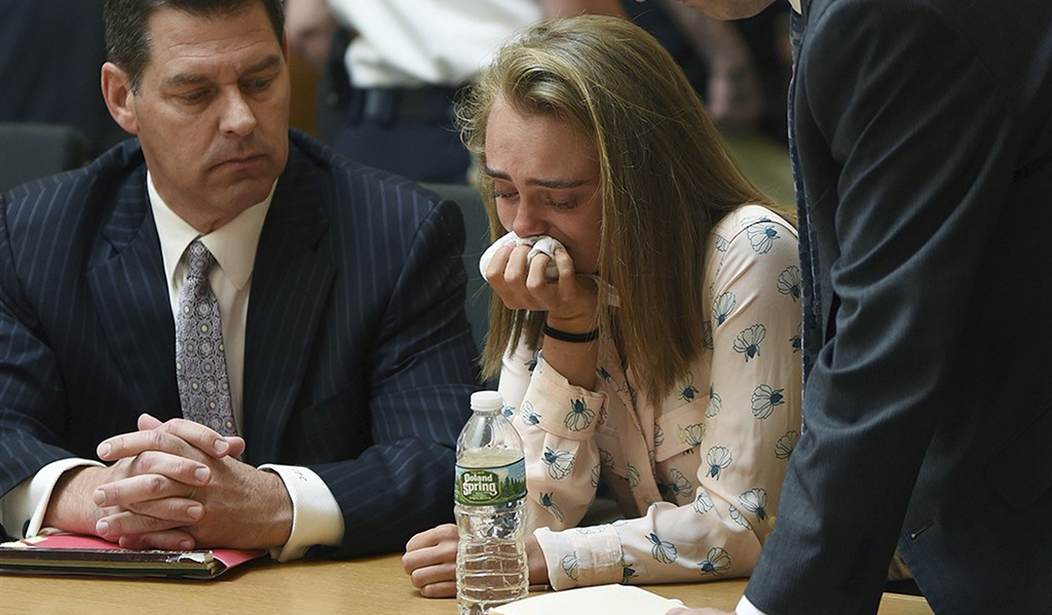
Last week, Michelle Carter was convicted in a Bristol County Massachusetts juvenile court of involuntary manslaughter in the suicide death of her boyfriend, Carter Roy III. Roy suffocated himself to death with carbon monoxide in his truck, during which time Carter urged him on through multiple texts, introduced into evidence by the prosecution.
One has to read all of Michelle Carter's and Conrad Roy III's texts to fully appreciate just how suggestible he was, and how hard she was pushing him to commit suicide. (I warn you -- they are hard to read.) Contrary to the defense's argument that Roy was determined to kill himself without Carter's influence, it is painfully evident how deeply conflicted Roy was about it. In the days and weeks leading up to Roy's suicide, Carter pushed, wheedled and cajoled him, made him promise he would do it, suggested methods and strategies to avoid being discovered, and told him his parents would "get over it." When Roy got out of the truck in the middle of the actual attempt, Carter pressured him to get back in the truck where he would die. Carter's conviction was predicated not only on the pressure she exerted upon Roy, but also the fact that she was aware of his attempt as it was happening and notified no one: not Roy's parents, not the police, not 911.
Carter's attorneys also claimed that she was suffering from mental health issues of her own. The judge found that unpersuasive. I'm not sure it provides any societal comfort, either.
Suicide attempts by young people have been a public concern in the United States for decades. The New York Times published an article in 1987, which revealed that teen suicide rates had tripled since 1950. In the later 1980s and throughout the 1990s, the youth suicide rate dropped, reaching a record low in 2000. But the number of suicides has begun to climb steadily since then, particularly among adolescent girls. And the age at which suicides are attempted is decreasing: The suicide rate among children aged 10 to 14 -- middle school -- doubled between 2007 and 2014. (Research also shows -- perhaps surprisingly -- that suicide in young people is not typically an impulsive decision, but rather thought out, planned and signaled in advance. If there is any good news here, it is that this offers hope for successful intervention.)
According to the Parent Resource Program at the Jason Foundation, suicide is now the second-leading cause of death for young people aged 10 to 24; more teenagers and young adults die from suicide than from cancer, heart disease, AIDS, birth defects, stroke, pneumonia, influenza and chronic lung disease, combined.
Whatever the problem is, it's clear we haven't solved it. In the late 1980s, as now, experts wondered whether broken families, recreational drug use, the sexualization of childhood and excessive technology contributed to teen suicides. There's been little improvement on those fronts in 30 years. And there was no internet in the 1980s, no social media and no cyberbullying.
There is also the issue of normalizing -- even glamorizing -- suicide. This, too, has been a consistent contemporary concern. In the same Times article, one professor of pediatric psychology warned that "adolescents romanticize what they see on television or read about in newspapers."
I couldn't help but think of this, seeing pictures of Carter throughout her trial and watching her react to her conviction. She looked like the proverbial "deer caught in the headlights." It was as if she could not understand why what she did was wrong.
Is that so implausible? In a relatively short time in this country, suicide has gone from being something nearly universally viewed as a tragedy to be avoided, to a "compassionate choice" in many circumstances.
Six states have laws permitting physician-assisted suicide. The Hemlock Society -- which advocates for laws permitting assisted suicide -- changed its name to End of Life Choices and then Compassion and Choices. In 2014 -- the year Conrad Roy killed himself -- Brittany Maynard, afflicted with a stage 4 brain tumor, became the face of suicide in the name of compassion when she ended her life with a lethal dose of drugs. The Washington Post benevolently described this as "abbreviating the dying process." Some countries in Europe -- far ahead of the United States in legalizing both physician-assisted suicide and euthanasia -- now permit suicide in cases of depression.
Media depictions of suicide are reaching younger audiences. The hit Netflix series, "13 Reasons Why" revolves around the suicide of the main character. Notwithstanding its realistic depiction of the main character's slitting of her wrists, critics are deeply concerned that the series glorifies suicide for impressionable teens, with its beautiful stars, cool soundtrack and angsty storyline. (Indeed, a number of teen suicides have been blamed on the series, as well as the book upon which the series is based.)
So, is Michelle Carter a sociopathic monster? Or has she just taken society's messages about suicide to heart?

Join the Conversation
VIP members get the ability to comment on articles.