





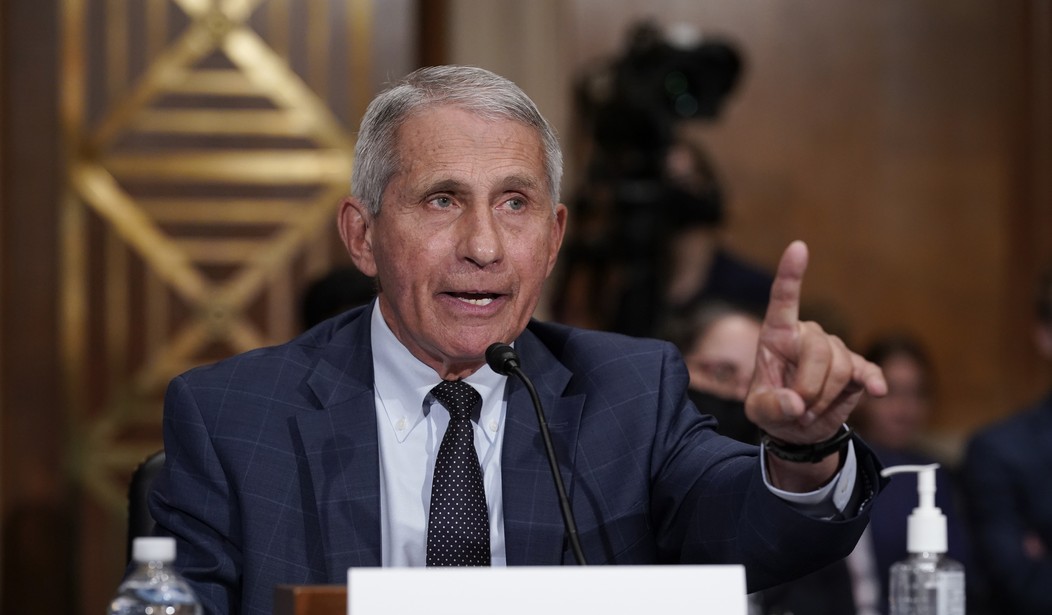
For the past year and a half, we've been told repeatedly to rely on science. First, Dr. Anthony Fauci of the National Institutes of Health told us not to wear masks; only those in medical settings needed them. Fauci then said we should wear masks. Then people were seen sporting several masks. We were told that there would be two weeks to flatten the curve; then the longer shutdowns came for what seemed like a lifetime. Scientists initially said that a vaccine could not be produced within a year; when it was, the vaccines were marketed as COVID-19 prevention by the government, that they would prevent COVID-19 – and there was a rush to get people vaccinated.
Now, with the new Delta Variant, breakthrough cases are happening (though not normally as severe). We've recently been told we should return to wearing masks, even if we are vaccinated. And this week, Fauci said that the vaccines, which have been made available by the Food and Drug Administration under an emergency use authorization, are as good as if they were approved by the FDA, even though they are not approved.
If your head is spinning, you are not alone. It's not just the recommendations and regulations that are constantly changing. The data is suspect, too.
This Monday, the South Florida Sun Sentinel ran an article titled, "Florida COVID-19 resurgence: Here are the numbers to watch." It included the Centers for Disease Control and Prevention's so-called fact that there had been 28,317 new daily COVID-19 cases in Florida. They were sounding the alarm on the high rate of COVID-19 cases. The problem is that, according to a tweet sent out by the Florida Department of Health, the data was incorrect. "The daily case counts for Florida currently posted on the CDC COVID Tracker are incorrect. The current listing states 28,317. The accurate data are as follows: Friday, August 6: 21,500 Saturday. August 7: 19,567. Sunday, August 8: 15,319. The 3 day average: 18,795," tweeted @healthyFLA on Monday, Aug. 9.
As of Tuesday afternoon, the CDC had still not updated its record of COVID-19 cases to reflect the lower numbers provided by the Florida Department of Health. If we can't trust the CDC to accurately track the cases, we should take a step back and rethink: Whom can we really trust and what should we demand?
First, we need to have government institutions that can be relied upon to provide real data. I worked in corporate finance for a $3 billion division. If you can't track items accurately, then your data means nothing.
Second, saying you believe in science can be detrimental to critical thinking and understanding because it primes you to give equal weight to scientific and pseudoscientific information. It's better to believe in critical evaluation, and think, think, think.
Thomas C. O'Brien, Ryan Palmer and Dolores Albarracin recently published a paper in the Journal of Experimental Social Psychology, Volume 96, 2021, titled, "Misplaced trust: When trust in science fosters belief in pseudoscience and the benefits of critical evaluation." They used experiments to determine if people could be hoodwinked by inaccurate science. The answer is YES!
"Participants who trust science are more likely to believe and disseminate false claims that contain scientific references than false claims that do not," they concluded. Just the mention of a scientist or expert leads the person to believe it must be true. However, there is an anecdote. "Reminding participants of the value of critical evaluation reduces belief in false claims," they wrote, "whereas reminders of the value of trusting science do not." So, we need to preface information with the need for critical evaluation, or critical thinking.
According to the Foundation for Critical Thinking, "Critical thinking is the intellectually disciplined process of actively and skillfully conceptualizing, applying, analyzing, synthesizing, and/or evaluating information gathered from, or generated by, observation, experience, reflection, reasoning, or communication, as a guide to belief and action." It notes this on its website criticalthinking.org: "In its exemplary form, it is based on universal intellectual values that transcend subject matter divisions: clarity, accuracy, precision, consistency, relevance, sound evidence, good reasons, depth, breadth, and fairness."
Maybe all those who have "Trust Science" signs, bumper stickers or T-shirts should consider replacing them with items that say, "We believe in critical thinking." The challenge with critical thinking is that you cannot rely on others to do it for you. You cannot simply rely on the so-called experts. You have to do the work yourself.

Join the Conversation
VIP members get the ability to comment on articles.