





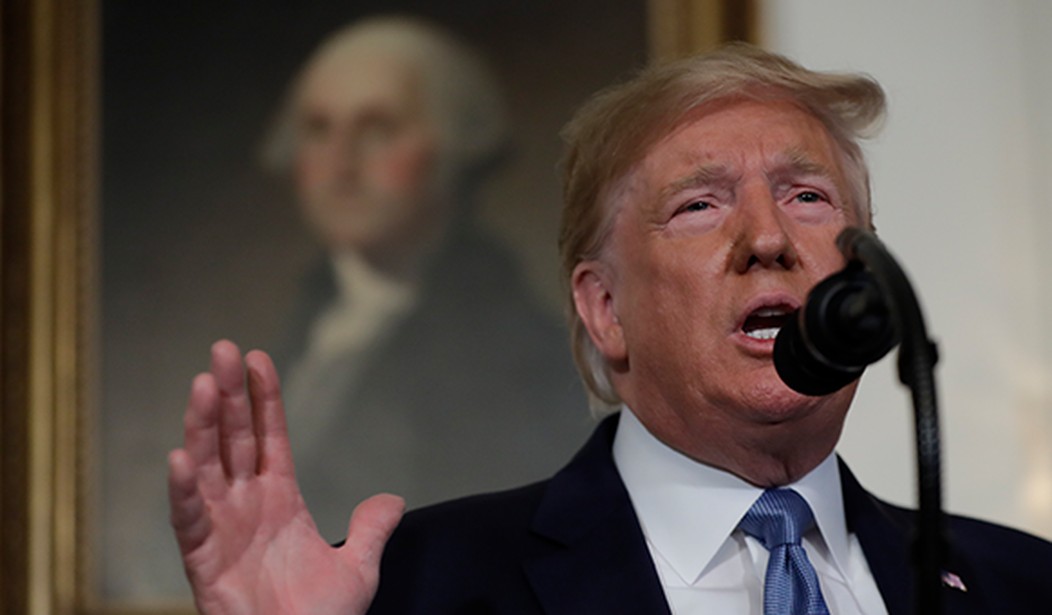
This week, The New York Times caved to online bullying and changed a headline for an article covering President Donald Trump's remarks after the horrible shootings in El Paso, Texas, and Dayton, Ohio. The original headline, "Trump Urges Unity Vs. Racism," was met with outrage on social media by those on the left.
During the day, the hashtag #CancelNYT began trending. The headline was changed to "Assailing Hate but Not Guns." So, if the headline was initially wrong, what did Trump say on Monday in response to the shootings?
Trump noted that the El Paso shooter had "posted a manifesto online consumed by racist hate," and the president called for national unity. "In one voice, our nation must condemn racism, bigotry and white supremacy," Trump said. "These sinister ideologies must be defeated. Hate has no place in America. Hatred warps the mind, ravages the heart and devours the soul." Appears the first headline was accurate.
Trump then laid out action steps that could be taken: "First, we must do a better job of identifying and acting on early warning signs," he said. "Second, we must stop the glorification of violence in our society ... Third, we must reform our mental health laws to better identify mentally disturbed individuals who may commit acts of violence ... Fourth, we must make sure that those judged to pose a grave risk to public safety do not have access to firearms."
He closed with a call for "the Department of Justice to propose legislation ensuring that those who commit hate crimes and mass murders face the death penalty." His call for unity, beefed up by specific action steps, was met with outrage from political opponents and a successful push to change the headline.
So, what led those on the left to call for a different headline? The narrative they believe is that Trump is a racist. The belief in this narrative is so strong that any information in conflict with this belief must be ignored and anything that supports this belief must be true, even if it is not.
As I write in my upcoming book, "Our Broken America: Why Both Sides Need to Stop Ranting and Start Listening," all too often, "we take in information and then attempt to make it fit something we already believe and understand; we search for facts to support what we already believe to be true."
Let's take the left's belief that Trump is a bad/racist person:
Last year, the New York Daily News printed a picture of a child at the border crying behind her mother. For those who follow the narrative, it's Trump's fault.
Then, there was the picture of a child in a cage that trended on Twitter. For those who follow the narrative, it's Trump's fault.
Then a picture of a bus outfitted with children's seats circulated. For those who follow the narrative, it's Trump's fault.
None of these was Trump's fault.
The child was never separated from her mother and was brought to the United States by her mother without her father's knowledge. The child in the cage was part of a protest, and it was a staged cage. The bus was purchased in the Obama administration. All of the assumptions about Trump were wrong. But still, the narrative continues: It must be Trump's fault.
What is not talked about? Actions. The Trump administration forgave $322 million of debt for four historically black colleges and universities: Dillard University of New Orleans; Southern University and A&M College in Baton Rouge, Louisiana; Tougaloo College of Jackson, Mississippi; and Xavier University of Louisiana in New Orleans. Trump signed the First Step Act, comprehensive criminal justice reform. He has created economic "opportunity zones" to revitalize inner cities.
But these actions don't fit the narrative.
The challenge for those on the right is that while the narrative is not true, as noted by the examples above, it's the prevalent way many voters organize information in their mind. Sadly, it has now extended not only to Trump but to those who support him.
On Tuesday, Rep. Joaquin Castro, D-Texas, tweeted the names and corporate affiliations of 44 Trump donors in his district, claiming their donations are "fueling a campaign of hate that labels Hispanic immigrants as 'invaders.'" Castro's twin brother, Julian, is a Democratic presidential candidate.
The Democrats are fueling a campaign of hate against anyone who disagrees with them or doesn't believe their narrative, no matter the facts.
The problem with following a narrative is that the real work gets left by the wayside. We should focus on actions rather than narrative.
Join the Conversation
VIP members get the ability to comment on articles.