
Political disagreement is essential to a functioning democracy. Republicans and Democrats will naturally disagree over taxes, immigration, national security and virtually every issue confronting the country. Vigorous debate is one of our political system's greatest strengths, but there is a difference between aggressively challenging policies and using language that portrays a political opponent as a threat who must be eliminated.
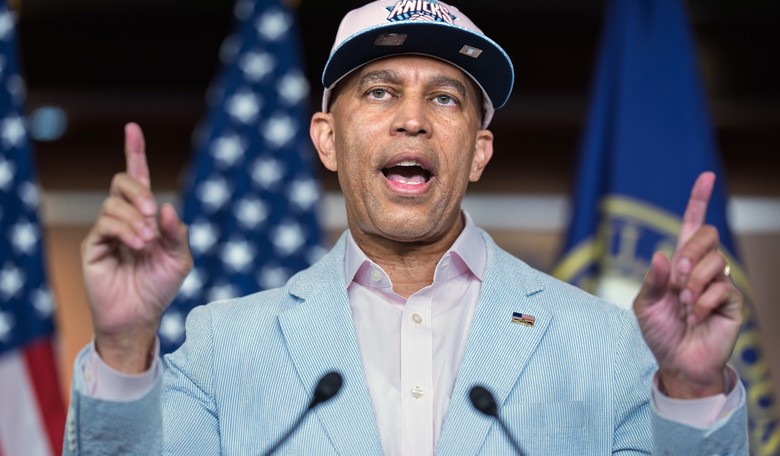
House Democrat Leader Hakeem Jeffries (NY-8) recently crossed a line in responding to President Donald Trump's decision to appoint Stephen Miller as the next White House chief of staff. In a social media post, Jeffries described Miller as a "dangerous xenophobe and reckless extremist who has American blood on his hands." He went on to say that Miller's presence in government should be "eradicated like a malignant tumor" and demanded that the president fire him.
That is reckless rhetoric from someone who is poised to become Speaker of the House of Representatives. Jeffries will lead a Democrat Party increasingly influenced by its progressive wing, while Miller is an unapologetic conservative working to implement the agenda President Trump campaigned on, including securing the border, deporting criminal illegal aliens, and prioritizing public safety.
There is plenty to debate about the administration's immigration policies and how they are implemented. Democrats have every right to challenge those policies, question their legality, highlight unintended consequences, and propose alternatives. That is their responsibility as an opposition party. But calling a political opponent a malignant tumor with American blood on his hands is not a policy argument. It is an attack on the individual, wrapped in language that suggests something far more sinister than a disagreement over government policy.
Recent political violence, including the Butler assassination attempt, the White House Correspondents' Dinner attack, the incident at Trump International Golf Club, and Charlie Kirk's assassination, reminds us that these threats are neither distant nor theoretical.
Just this week, on November 5, a Venezuelan national was arrested near the White House. According to authorities, he allegedly told Secret Service officers that voices in his head had directed him to come to Washington and kill the president. Officers reportedly discovered three firearms and ammunition in his vehicle.
Words do not operate in a vacuum. Leaders should understand that. History offers an important cautionary example. King Henry II reportedly expressed frustration over the Archbishop of Canterbury, Thomas Becket, asking whether someone would rid him of the meddlesome priest. His knights interpreted the king's words as an invitation to act, and Becket was murdered.
People in positions of authority cannot always control how their words are interpreted, repeated, or acted upon by others. At the same time, free speech is fundamental to our republic. Jeffries has every right to express his opinion. Those who disagree should even defend his right to speak. Free speech is easy to defend when we agree with the speaker. The real test comes when we find the words objectionable. But defending someone's constitutional right to speak does not require defending the wisdom, judgment, or morality of what they say.
Strategic communications are not simply about finding the most provocative phrase, generating the biggest headline, or producing the most attention on social media. It is about understanding an audience, establishing credibility, presenting a compelling argument, and persuading people to consider a different perspective.
The best communicators know that persuasion is an art. It requires discipline, judgment, and an understanding of the consequences of language. It does not require profanity, personal destruction, or extreme accusations. In fact, those tactics often undermine the very argument someone is trying to make.
If Jeffries believes Stephen Miller's policies are harmful, he should explain why. If he believes the administration is violating the law, he should identify the violations and pursue appropriate oversight. If he believes the president made the wrong appointment, he should make the case to the American people. That is how leaders build arguments. That is how they persuade. And that is how they earn credibility beyond their own political base.
The next Speaker of the House will occupy one of the most influential positions in American government. That position carries an obligation to elevate the national conversation, not contribute to its deterioration.
We can disagree passionately about immigration. We can challenge Stephen Miller's record, question President Trump's decisions, and hold public officials accountable. None of that requires describing a human being as a malignant tumor who should be eradicated.
The most effective political leaders do not need to dehumanize their opponents to make their case. They make their arguments, present their evidence, and allow the American people to decide. That is not weakness. It is leadership. And in today's political climate, it is something Washington desperately needs.
Dan Rene is a strategic communications counselor and founder of Dan Rene Communications.