
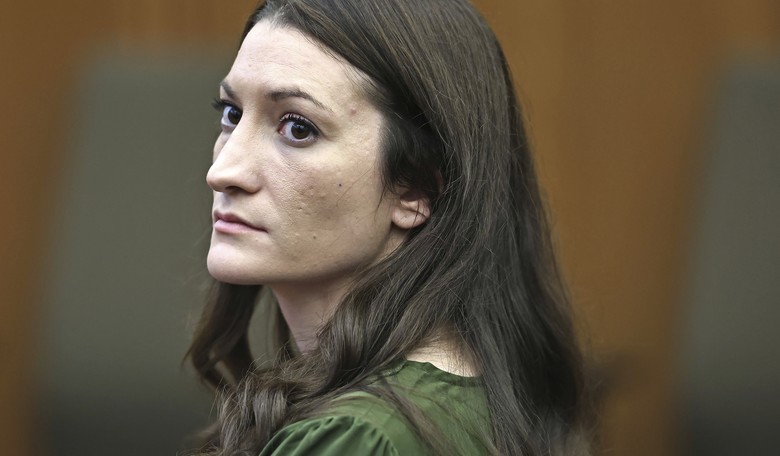
Many legal experts predicted the jury would be deadlocked on a verdict. The Lindsay Clancy case has become a national spectacle, with hordes of white liberal women embarrassing themselves by flocking to the defense of a child killer. Clancy killed her three children in January 2023 with exercise bands, cut her wrists, and jumped out of a second-story window, leaving her with injuries that had paralyzed her from the waist down.
This jury, 75 percent of which is female, is deliberating whether to convict Lindsay Clancy on first-degree murder, second-degree murder, manslaughter, not guilty by reason of insanity, or not guilty. They cannot reach a decision.
When some jurors were wearing pink, the color indicating support for Clancy, you knew trouble was brewing. Now, Judge William Sullivan has issued a “Tuey-Rodriguez” charge, which presses the jury to come to some verdict in this case. If they still fail, usually a mistrial is declared, though Sullivan could order them back into the room. Nick Sortor broke down the conditions of the Tuey charge:
🚨 BREAKING: The Lindsay Clancy jury has ONCE AGAIN sent a note to the judge saying they're DEADLOCKED
— Nick Sortor (@nicksortor) September 2, 2026
The judge is now reading them a Tuey-Rodriguez charge, and will send them BACK to deliberate again
Here's what a Tuey-Rodriguez charge entails, as read by the judge:
- A jury… pic.twitter.com/dnkoTlJzSe
A jury verdict is the principal way facts are decided in a criminal case.
- Absolute certainty cannot be expected.
- Each juror’s verdict must reflect their own convictions, not mere agreement with the majority.
- Jurors should listen with an open mind and give proper respect to others’ opinions.
- It is desirable that the case be decided.
- There is no reason to think another jury would be more intelligent, impartial, or competent, or that better evidence would appear.
- Jurors have a duty to decide the case if they can conscientiously do so.
- The Commonwealth still bears the burden of proof beyond a reasonable doubt.
I feel a bad moon is rising.