
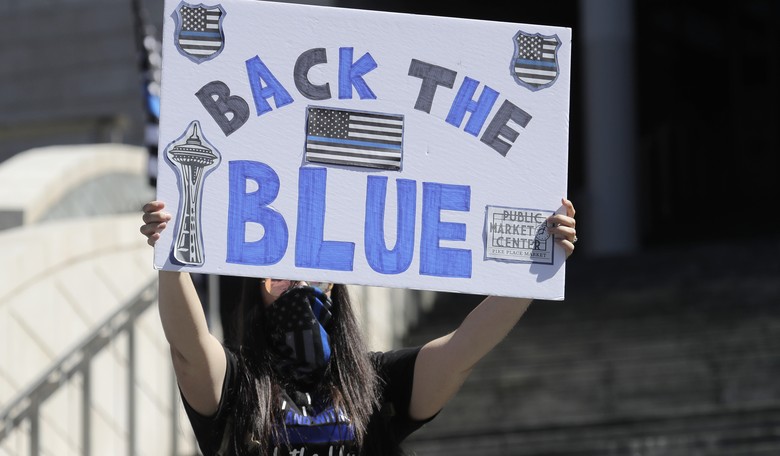
On the heels of the Democrats' "Defund the Police" movement, America is facing serious shortages of police officers around the country. Despite that, the FBI recently reported the biggest one-year drop in violent crime since they started tracking crime rates in 1939. Murder rates fell 18 percent. This is remarkable, given that we're accomplishing this with five percent fewer police officers than we had in 2020.
In a paper shared exclusively with Townhall, the America First Policy Institute (AFPI) spells out what the crisis is, its causes, and what it means for law enforcement and public safety. Then AFPI lays out a roadmap for federal, state, and local authorities to follow to improve the situation and continue lowering crime rates.
The law enforcement hiring crisis is a problem that has been in the making for years. According to the Police Executive Research Forum's 2025 staffing survey, participating agencies employed 5.2 percent fewer sworn officers in January 2025 than in January 2020, and resignations in 2024 remained 18.4 percent above 2019 levels. This crisis is hitting smaller agencies, those that have fewer than 50 officers, especially hard. Those agencies report 60.4 percent more resignations and 66.7 percent more retirements than in 2019.
Recruiting new officers remains a challenge, too. The International Association of Chiefs of Police (IACP) surveyed 1,158 agencies and found more than 70 percent had more trouble with recruiting than they did five years earlier, with agencies operating at about 91 percent of authorized staffing. Roughly 65 percent of these agencies had reduced either services or specialized units due to staffing shortages.
But recruitment is only part of the solution. Retaining officers is equally important because those officers bring judgment, local knowledge, investigative skills, and established community relationships. It costs more money to recruit officers, with replacement costing up to five times the annual salary once recruitment, training, and lost productivity are accounted for. Officers who remain are at greater risk of burnout as they absorb longer hours. Retaining officers doesn't just save money; it also reduces crime and instances of officer use of force. An officer-assignment study in Chicago showed that equalizing officer seniority across districts would reduce violent crime by 4.6 percent and officer use of force by 10 percent.
Four major factors are driving this crisis. First, it's a matter of demographics. The large cohorts funded by the 1994 crime bill are reaching retirement eligibility at the same time. A 2026 study by the U.S. Government Accountability Office (GAO) said that about one-third of federal officers will be eligible for retirement in the next five years, and IACP said nearly 25 percent of state and local commissioned staff were eligible for retirement in January 2025.
The second factor is the political and reputational damage from the 2020 "Defund the Police" movement. Those Democrat-led efforts weakened police morale, discouraged applicants, and accelerated departures from law enforcement agencies.
Third, high turnover rates and understaffing lead to mandatory overtime, irregular schedules, trauma exposure, and the aforementioned burnout. That becomes a vicious cycle where the burnout leads to more turnover and the cascade of overwork begins again.
Last, but certainly not least, pay and process influence recruitment and retention. Officer pay varies widely by state, and often is less than what comparable work pays elsewhere. That means officers leave for better-paying, less demanding jobs. Meanwhile, slow hiring processes, strict transfer rules, and requirements unrelated to job performance push out otherwise qualified candidates.
This staffing matters to public safety, and public opinion demands strong law enforcement agencies. In 2020, 81 percent of black Americans told Gallup they want police to spend the same amount of time or more time in their neighborhoods. Increasing police staffing by as little as 3.2 percent produced a 3.5 percent decrease in victimization cost-weighted crime; this study estimated that for each additional officer on duty, four violent crimes and 15 property crimes are prevented each year. Similar results showed up in an analysis of almost 7,000 municipalities: a 10 percent increase in police employment led to a 13 percent reduction of violent crime and a seven percent reduction in property crime.
But there is good news, and in some municipalities, positive policy changes are yielding good results. Birmingham, Alabama, spent $18.5 million on recruitment and retention with relocation support, take-home vehicles, bonuses, and mental health days. Staffing rose from 73 percent at the end of 2024 to more than 96 percent today. Last year, the academy class had 90 students — the largest in nearly three decades. Last year, Birmingham saw a 44 percent decrease in homicides. Rapid City, South Dakota, reduced vacancies from 35 to eight in one year and saw an eight percent reduction in attrition through referral incentives, wellness benefits, a sabbatical program, and a co-responder model that shifted non-criminal calls to mental health professionals. In San Antonio, Texas, 165 patrol officers joined the force in 2024 and 2025 after the city implemented a five-year staffing plan. Average response times improved from over 6 minutes in 2023 to five minutes, 29 seconds in 2025 and overall crime fell 13 percent. The state of Florida offered a $5,000 after-tax recruitment bonus, giving more than 10,000 awards worth $67.9 million by March of this year, along with pay increases for more than 16,000 officers, academy scholarships and student loan forgiveness.
In its roadmap, AFPI shares exactly what lawmakers can do. At the federal level, they should reauthorize and modernize the Community Oriented Policing Services (COPS) hiring program by raising and indexing the per-officer grant cap, allowing recruitment and retention uses, and preserving access for small and rural departments. The Congressional Research Service notes the statutory $75,000 cap has effectively been $125,000 through annual appropriations and that three years of median officer salary totals more than $228,000. Federal lawmakers and agencies should also expand officer wellness capacity by raising the Law Enforcement Mental Health and Wellness Act's $8.8 million annual ceiling. More than 60 percent of agencies have no formal wellness program, which helps create a culture where seeking help does not damage a career. Federal agencies should also do a better job of promoting Public Service Loan Forgiveness as part of the recruitment process and improve automatic service certification. They should also use clear entry and exit criteria when intervening in local law enforcement issues.
At the state and local levels, lawmakers should make experienced officers portable and streamline reciprocity and lateral entries for qualified officers, reward service and support families, build statewide wellness infrastructure, and maintain merit-based hiring. Agencies should also adopt a multi-year staffing plan, shorten the hiring process, and retain already trained officers through benchmark compensation, protecting wellness and fitness, and the use of co-responders for appropriate non-criminal calls. These agencies should then measure the results of their policies: tracking time-to-hire, academy completion, retention rates at one, three, and five years, as well as response times and community confidence.
Tennessee Gov. Bill Lee talked about these historic crime rate reductions and the path forward for law enforcement and public safety.
"President Trump is delivering historic results on public safety; leaders in Tennessee and across the country have a responsibility to make that progress last," Gov. Lee told Townhall. "Tennessee has worked to make this a state where officers want to build a career, rewarding those who sign on and stay, easing the training burden on local departments, and helping agencies hire and train. In Memphis, we went even further by supporting the Memphis Safe Task Force, which brought federal, state, and local law enforcement together to target violent offenders and drive crime down across the city. AFPI's 'Back the Blue' roadmap takes proven approaches like these from the Volunteer State and gives leaders nationwide a practical guide to recruit, retain, and properly staff their agencies.