







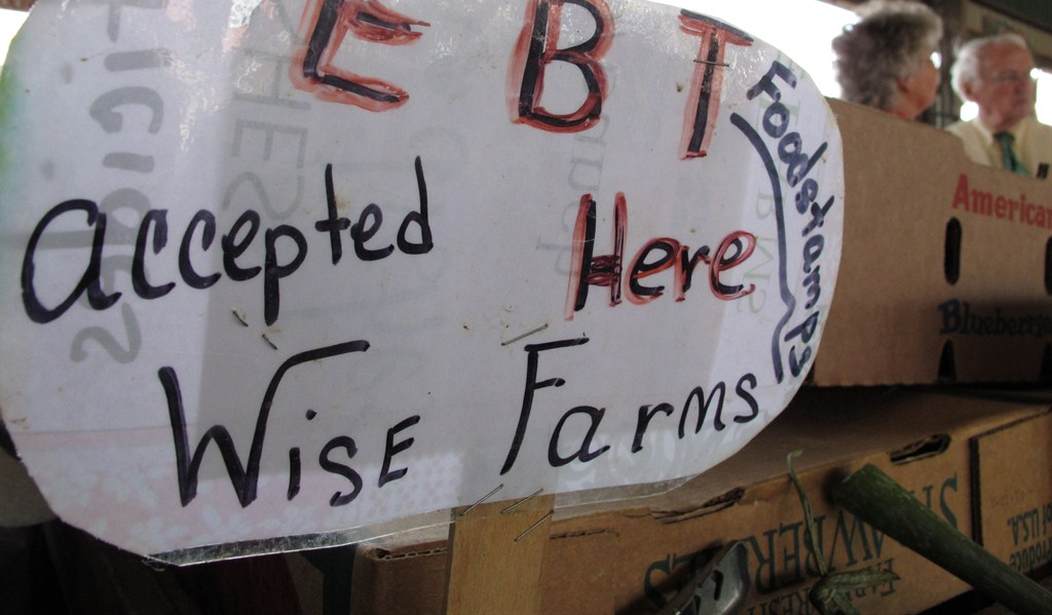
Elected Democrats and movement progressives are up in arms over the meager cuts to the Supplemental Nutrition Assistance Program (SNAP - commonly known as food stamps). Hot Air's Erika Johnsen covered the non-drama over the farm bill yesterday and noted the very meager reforms included in the legislation, but some Democrats are bemoaning the $800 million in yearly cuts to SNAP in apocalyptic terms. The overall SNAP program costs $70 billion per year.
Hipster congresswoman Rosa DeLauro (D-Conn.) said "Congress has lost its way" and described the farm bill as "reverse Robin Hood legislation that steals food from the poor." Rep. Adam Smith (D-Wash.) described the 1% of the food stamp budget being cut as "essential nutritional assistance" in a time when SNAP enrollment and spending is at all-time highs. Jim McGovern said that the legislation "increases hunger."
All of this for a program whose expansion and cost has exploded in the Obama years. Some of this comes with the business cycle - the recession depressed many households' income, pushing them onto SNAP rolls - but when the economy is back at full speed the SNAP program is projected to remain at historical highs.
The Congressional Budget Office finds that spending on food stamps has risen from $30 million to $72 million in the Obama years, and it's not all attributable to the 2008 recession:
About one-fifth of the growth in spending can be attributed to temporarily higher benefit amounts enacted in the American Recovery and Reinvestment Act of 2009. The remainder stems from other factors, such as higher food prices and lower income among beneficiaries, both of which have boosted benefits.
According to CBO’s March 2012 projections, the number of people who receive SNAP benefits will continue to rise slightly from fiscal year 2012 through fiscal year 2014 and then decline in the following years, reflecting an improved economic situation and a declining unemployment rate. Nevertheless, the number of people receiving SNAP benefits will remain high by historical standards, CBO estimates.
That can be clearly seen in the chart that the CBO produced:

What these Democrats are saying is that not a single penny can be cut from a program that has ballooned in enrollment and spending over the last six years and will remain at historical highs in the future. It could be the case that the food stamp program is such an important program and that there was a starvation problem in America prior to this massive expansion, but that's not the argument that's being made - Democrats need to face up to the massive expansion in the food stamp program and defend it on the grounds of historical highs.
The SNAP program is indeed one of the least objectionable low-income assistance programs. The "radical" agenda of the Republicans would have cut the SNAP budget by around 3%, rather than the 1% that the final farm bill contains. Republicans don't want to repeal low-income food assistance - they're in favor of a more limited scope for a valuable program.


Join the Conversation
VIP members get the ability to comment on articles.