


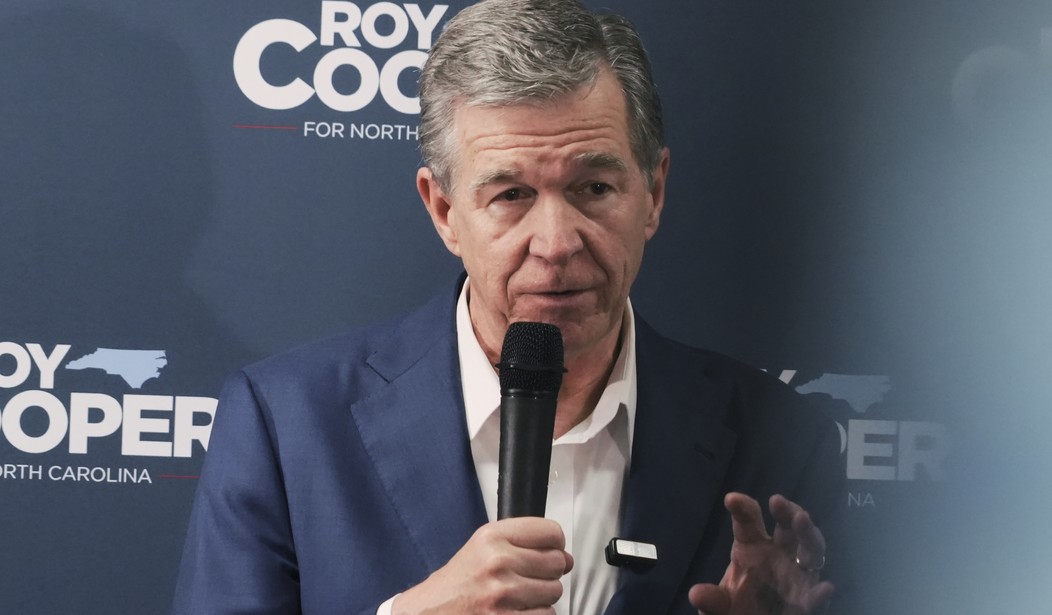
In 2024, former North Carolina Governor Roy Cooper announced plans to open a manufacturing plant for a Chinese-owned battery company that would create 545 “great manufacturing jobs” and robust promises for the community.
But more than two years after Cooper personally announced the deal, the company only recently celebrated its ribbon-cutting. Green New Energy Materials (GNEM) has not publicly confirmed that full production has begun, and has advertised several North Carolina jobs requiring applicants to speak Mandarin.
A Townhall review of North Carolina records, Chinese government documents, Mandarin-language corporate filings, and public job postings found the company Cooper partnered with, GNEM, is fully owned by a Chinese battery-materials company with extensive ties to Chinese Communist Party (CCP) political organizations.
Those ties include an internal Communist Party branch, a company party branch secretary, and programs that use “party building” to influence the company’s business development. The Chinese parent company’s chairman also holds a leadership position in an organization that explicitly says its mission is to carry out the party’s united-front work among private businesses.
Yet Cooper’s administration approved a performance-based initiative package that authorized as much as $3.63 million over 12 years in state reimbursements for the CCP-connected project.
“North Carolina’s momentum in clean energy economy grows stronger every day, bringing great manufacturing jobs that will put money in the pockets of families in Lincoln County and all across the state,” Cooper said when he announced the project in May 2024.
Now, as Cooper campaigns for a Senate seat, he faces questions as he is asking to be trusted with taxpayer dollars yet again, as the taxpayer-funded project has yet to be fully completed more than two years after it was first announced.
The promised manufacturing plan was the company’s first in the U.S., and came with GNEM’s pledge to invest $140 million in the operation and create 545 jobs with an average salary of $57,934, exceeding Lincoln County’s then-average wage of $51,886.
More than two years after Cooper’s announcement, however, the Lincoln Economic Development Association hosted a ribbon-cutting at GNEM’s Denver, North Carolina facility in August. The group said the ceremony followed “two years of preparation” and that the full production was expected to begin in the fourth quarter of 2026. It described the 545 jobs as positions the company would create “as the operation is fully developed.”
GNEM’s own factory page lists “Job Creation 500+” and includes a grammatically inaccurate claim that the facility “has creates 545 jobs,” but the company does not provide proof that all positions have been filled.
Recent job listings for the company, however, require unique qualifications, namely proficiency in Mandarin Chinese, that could be difficult to attain in rural North Carolina.
An electrical engineering position with pay starting at $70,000 required bilingual fluency in English and Mandarin. Meanwhile, a production supervisor position with the same salary also required Mandarin and English fluency “for daily communication and coordination.”
A logistics specialist position with a $55,000 starting salary required applicants to speak, read, and write both English and Mandarin. GNEM said the language skills were necessary to “communicate with overseas suppliers, logistics providers and internal stakeholders.”
The North Carolina plant’s language requirements bring into question how much of the operation will remain dependent upon the company’s Chinese parent corporation.
GNEM is fully owned by Shenzhen Senior Technology Material, according to the parent company’s annual report. Senior is a group specializing in producing separators for lithium-ion batteries, and its website describes the company as a designated research-and-development organization for automotive battery separators under China’s national “863 Program,” a government technology development initiative.
GNEM’s parent company’s ties to the Chinese government stem from its chairman and controlling shareholder Chen Xiufeng, who previously served as a delegate to the Fifth Shenzhen Municipal People’s Congress, according to a Chinese securities filing.
The Shenzhen People’s Congress describes delegates as participants in “the exercise of state power,” including deciding major local issues, supervising government operations, selecting state officials, and creating local laws.
Chen now serves on the presidium of the All-China Federation of Industry and Commerce’s Chemical and Materials Committee, a group that describes itself as a “people’s organization and chamber-of-commerce organization led by the Chinese Communist Party” and serves as a bridge connecting private businesses to the party and government.
But the Chemical and Materials Committee is even more explicit about its purpose in linking businesses to the CCP, with its website saying it was created to implement the Party Central Committee’s strategy for united-front work in the private economy and to “expand the effective reach of united-front work” in the chemical and materials industries. The group’s listed responsibilities include strengthening “political guidance,” deepening ideological education, consolidating political consensus, and uniting private-sector figures “around the party.”
At the committee’s 2023 inaugural meeting, an AIFIC official called its creation “a concrete measure” for implementing the Party Central Committee’s decisions. Chen participated in the event as a member of the committee’s presidium.
Beyond Senior’s Chinese manufacturing ties, there are further points linking the company to the CCP.
A 2023 account from the Nantong Development and Reform Commission named Zhu Jing as secretary of the Communist Party branch at Jiangsu Senior, one of the parent company’s manufacturing operations.
According to the government account, Zhu led visiting businessmen through the company’s “Party-building hall” and shared Senior’s experience using “party building to guide enterprise development.”
A Chinese public college separately reported that Senior’s East China base participated in a “New Energy Red Alliance” Party-building partnership. The school said the program was intended to use Party leadership to advance cooperation and integrate the education, talent, innovation, and industrial chains.
Additionally, the company’s former vice president and R&D director Yang Jiafu previously worked at the Chemical Materials Institute of the China Academy of Engineering Physics (CAEP). The company’s website says Jiafu was recognized as an “advanced individual” in CAEP’s military-to-civilian conversion work.
CAEP is described as the country’s “only nuclear weapons research, development and production organization,” and a central institution for strategic advanced military equipment, according to China’s defense industry regulator.
Cooper has partnered with companies tied to the Chinese government before, including in 2024 when he backed Boviet Solar for a $32.6 million deal to open a factory with the company in the state. In April 2026, the company reportedly sought to terminate the deal following President Trump’s move to bar Chinese-owned businesses from accessing Inflation Reduction Act funds.
GNEM and Cooper’s campaign did not respond to a request for comment.
Editor’s Note: The 2026 Midterms will determine the fate of President Trump’s America First agenda. Republicans must maintain control of both chambers of Congress.
Help Townhall continue to report on the Democrats’ radicalism and inform voters as our nation faces a crossroads. Join Townhall VIP and use promo code FIGHT to receive 60% off your membership.


Join the Conversation
VIP members get the ability to comment on articles.