
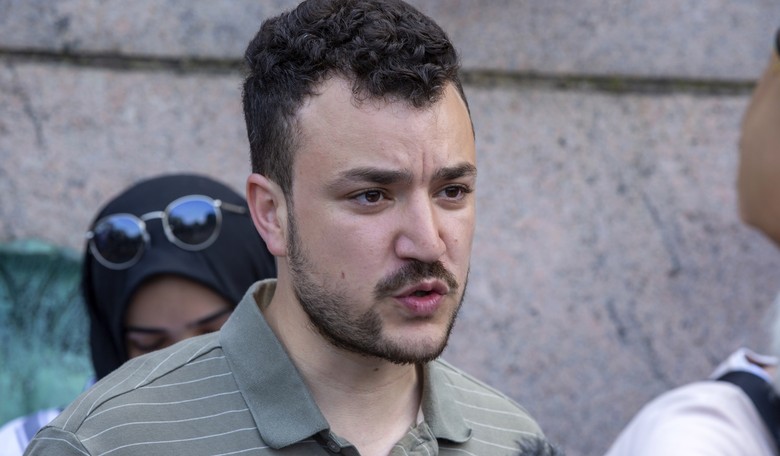
Palestinian activist Mahmoud Khalil asked the Supreme Court on Monday to hear his legal challenge against the Trump administration’s efforts to deport him.
Khalil was a prominent figure in the anti-Israel protests that took place on college campuses across the country. Federal authorities arrested him last year under the Immigration and Nationality Act over his advocacy for the Palestinians.
Since then, Khalil has been battling the Trump administration, which is trying to deport him.
From The Associated Press:
Palestinian activist Mahmoud Khalil asked the Supreme Court on Monday to let federal judges quickly determine the legality of immigration-related detentions so that people cannot be held for months or years without judicial oversight.
In papers filed with the high court, Khalil asked it to overturn a ruling earlier this year by the 3rd U.S. Circuit Court of Appeals in Philadelphia that found federal courts do not have jurisdiction to review the legality of the detentions until immigration courts had fully considered each case.
Khalil, a lawful permanent U.S. resident, was detained by immigration authorities last year because of his participation in pro-Palestinian demonstrations at Columbia University in the spring of 2024.
The U.S. government argued at the time that Khalil’s presence in the U.S. was harmful to the country’s foreign policy interests.
As a result, the former Columbia graduate student spent over three months in detention before a federal judge in New Jersey ordered him freed after finding that the federal government had acted unconstitutionally.
Khalil told a remote news conference Monday that the appeal was “bigger than just my ability to stay here.” He said he wanted to ensure that thousands of immigrants, documented or not, can challenge the Trump administration’s “unlawful” attempts to stop protected speech.
Today, I asked the Supreme Court to affirm that federal courts have the power to hear my case. The government knows all too well that its baseless allegations and smears against me cannot survive the slightest scrutiny in federal court. That’s why it is doing everything it can to keep those courts from looking at my case and to channel it into its kangaroo immigration courts. So the question is simple: can the government weaponize immigration laws to punish someone's speech, then tell federal courts they have no power to step in? If the answer is yes, none of our speech is safe. If the Trump administration can punish someone for pro-Palestine speech, this or any future administration can punish anyone for any speech. Read the petition: https://t.co/h6JEUNBSek
— Mahmoud Khalil | محمود خليل (@mahmoudkhalel) October 19, 2026
The Third Circuit Court of Appeals ruled that Khalil had to bring his claims through the petition-for-review process instead of a habeas case in district court.
Khalil’s petition asks whether the Immigration and Nationality Act bars federal courts from hearing his First and Fifth Amendment claims through habeas, and whether that bar is unconstitutional.
The filing came after Justice Samuel Alito granted Khalil two deadline extensions.
The activist is also fighting his removal order in the Fifth Circuit. The Board of Immigration Appeals ruled against Khalil in April, and he filed his appeal in May.
Immigration agents arrested Khalil on March 8, 2025, in the lobby of his university residence in Manhattan even though he faced no criminal charges. They kept him in a Louisiana detention facility for 104 days until a federal judge ordered his release and determined that his detention was likely unconstitutional.
Khalil became a lawful permanent resident years ago and later gained prominence as a negotiator for pro-Palestinian protesters during the 2024 encampments at Columbia University.
The White House has been trying to remove Khalil under a rarely invoked provision of the Immigration and Nationality Act after Secretary of State Marco Rubio determined Khalil’s involvement in the protests would compromise U.S. foreign policy interests because it fostered a hostile environment for Jewish students.