
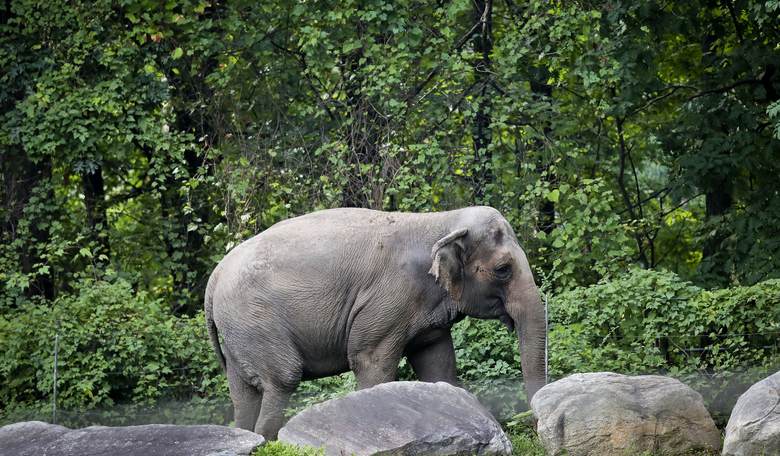
Hawaii’s Supreme Court will determine the fates of two elephants that the Indian government gave to the Honolulu Zoo.
The court will hear arguments next month debating whether the two elephants, named Mari and Vaigai, can go to court to challenge their captivity.
The Nonhuman Rights Project (NhRP), a Florida-based nonprofit organization, filed the lawsuit in 2023 seeking a common-law writ of habeas corpus on behalf of the elephants. Mari has been kept at the zoo since 1982 and Vaigai since 1992. The organization wants the elephants moved to a Global Federation of Animal Sanctuaries—accredited elephant sanctuary instead of being released into the wild.
A group of legal experts in the United Kingdom backing the lawsuit says the animals were “taken from their families and homes in India,” according to court documents.
The organization explains why it is arguing for the elephants’ rights to habeas corpus in a press release.
The NhRP seeks recognition of Mari and Vaigai’s right to liberty through the common law writ of habeas corpus—a legal remedy that has historically served as one of the judiciary’s most important safeguards against unlawful confinement. The organization argues that the common law has long evolved to recognize new rights where justice requires and that Hawaiʻi’s courts have both the authority and responsibility to continue that tradition.
“The common law has never been static and it evolves as courts confront new questions of justice,” said Jake Davis, Senior Staff Attorney at the Nonhuman Rights Project and lead counsel in the case. “Hawaiʻi has the opportunity to recognize that Mari and Vaigai’s profound interest in liberty deserves legal protection, and we look forward to presenting that case before the state’s highest court.”
🚨 BREAKING: The Hawaiʻi Supreme Court agrees to hear oral arguments in our case on behalf of Mari & Vaigai. This is only the 3rd time in US history that a state high court has agreed to hear arguments on behalf of an animal's right to liberty. Learn more: https://t.co/8sPTKvtHRB https://t.co/UUzLYHllqz
— Nonhuman Rights Project (@NonhumanRights) June 12, 2026
The First Circuit court dismissed the petition in 2024, and the Intermediate Court of Appeals affirmed the ruling in January 2026. The courts held that elephants are not “persons” and that the statutory writ supersedes the common-law writ.
This will be the third time a state high court has agreed to hear an animal habeas petition. All three were brought by NhRP. New York’s Court of Appeals rejected a bid for a Bronx Zoo elephant named Happy, in 2022.
The notion that an animal should have the same rights as humans is absurd on its face. It’s the type of lawsuit that many would label frivolous. But there is something deeper at work here.
DO ELEPHANTS HAVE A RIGHT TO LIBERTY? Mari and Vaigai, the two elephants at Honolulu Zoo, have spent decades in captivity. Now, their confinement is at the center of a landmark legal battle. On November 9, 2026, the Hawaiʻi Supreme Court will hear arguments concerning the legality of Mari and Vaigai’s confinement at the Honolulu Zoo. The case, brought through a habeas corpus petition by the Nonhuman Rights Project, raises a fundamental question: Can an elephant’s freedom be protected by the law? Elephants are intelligent, social and highly complex beings. Their lives in the wild are worlds apart from the restricted environments of captivity. This case could mark an important moment in how the law views elephants and their right to live lives that reflect who they are. Mari and Vaigai deserve to be heard. Read the full story by Hawaiʻi Public Radio: https://t.co/2uSn0vHrWc #GMFER #MarchAgainstExtinction #ElephantRights #EndElephantCaptivity
— March4ElesAndRhinos (@EleRhinoMarch) October 7, 2026
The animal rights lobby isn’t just a bunch of hippie-dippie weirdos as they are often portrayed on television. They have a powerful political machine aimed at weaponizing government power to force their views on the rest of us.
Take this elephant case, for example. It might be tempting to believe the organization just wants the elephants moved to a better environment. But it’s about more than that. It’s about setting a precedent that animal owners across the country can leverage against them.
If Hawaii’s Supreme Court rules in the organization’s favor, it could lead to other instances in which animal rights activists file similar briefings on behalf of other animals — including livestock, pets, and other types of animals. It’s about controlling how people own, use, and consume animals.