
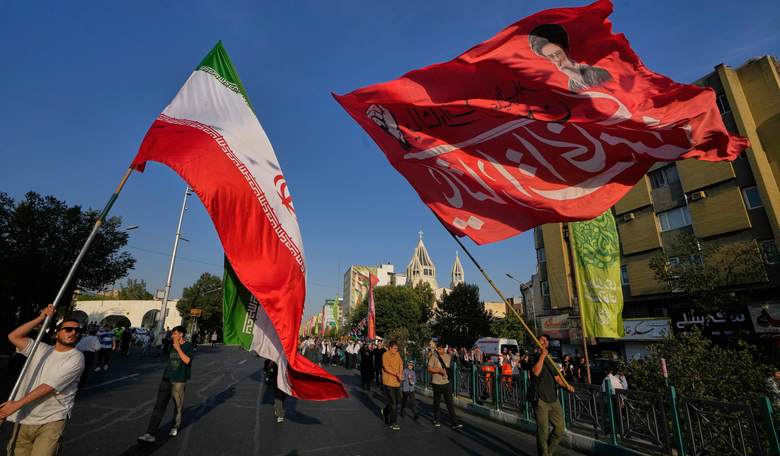
There is something faintly absurd about three countries forming a military alliance to defend themselves against aggression, then rushing to the capital of the country they suspect of encouraging that aggression, pleading for peace. Yet this was the spectacle in Tehran on 26 October, when senior representatives of Saudi Arabia, Turkiye and Pakistan arrived for talks with the Iranian regime.
Tehran hailed the meeting as a success. Iran's security chief, Mohsen Rezaei, spoke enthusiastically about a positive new atmosphere. The four countries agreed to continue talking. That was about it. No binding agreement to halt Houthi attacks on Saudi Arabia. No enforceable guarantees. No evidence of any miraculous conversion to peaceful coexistence. The mullahs must have been delighted.
During my 15 years in the European Parliament, including five years as president of its Delegation for Relations with Iraq, I became thoroughly familiar with Tehran's methods of extending its influence beyond its borders. Iraq provided a disturbing example of how the regime exploited political instability, cultivated armed militias and interfered in neighbouring states. I learned to distinguish between what Iranian officials said across the negotiating table and what their regime was doing elsewhere. The difference was frequently alarming.
The Mecca Joint Defence Agreement, signed by Saudi Arabia, Turkey and Pakistan in August, supposedly provides collective protection against external aggression. An attack on one member is regarded as an attack on all. It sounds reassuringly like NATO. But the three countries have different interests and attitudes towards Tehran. Saudi Arabia has suffered repeated attacks by the Iranian-backed Houthis in Yemen. Pakistan shares a sensitive border with Iran and has little appetite for confrontation. Turkey maintains extensive commercial relations with Tehran while competing for regional influence. Would Pakistan or Turkey really risk military confrontation with Tehran to defend Saudi Arabia against an Iranian proxy? These are awkward questions. Ministers meeting in Riyadh in October agreed to facilitate rapid military deployments to Saudi Arabia. But preparing a military response and possessing the political will to carry one out are entirely different matters.
The Houthis have already provided the alliance with its first examination, under live fire. On the very day the delegations met in Tehran, the Houthis claimed further attacks against Saudi oil installations and Riyadh's international airport. While diplomats discussed peace, missiles and drones remained instruments of regional intimidation.
Nobody with an ounce of common sense wants another devastating Middle Eastern war. Saudi Arabia has every reason to seek peace. So do Pakistan and Turkey. But diplomats have a dangerous tendency to confuse negotiations with progress.
We have seen this performance before. The 2015 nuclear agreement was celebrated across Europe as a diplomatic triumph. Supporters believed inspections would constrain Iran's nuclear programme. Critics warned that Tehran's longer-term ambitions and regional activities remained unresolved. President Trump withdrew America in 2018. Whatever one's assessment of that decision, subsequent years brought escalating tensions and repeated failures to restore a workable agreement.
Then came the Chinese-brokered reconciliation between Saudi Arabia and Iran in March 2023. Embassies reopened. Hands were shaken. A new era of cooperation was confidently predicted. Yet the underlying disputes survived. The Houthis remained a formidable armed movement with longstanding ties to Tehran. Renewed attacks against Saudi Arabia demonstrate the limitations of diplomatic reconciliation when armed aggression continues.
The ill-starred war that erupted in February 2026 has raised the stakes immeasurably. Pakistan and Qatar have already attempted mediation between Washington and Tehran. An interim agreement in June provided brief respite before hostilities resumed. Now the Mecca Alliance hopes that regional influence and military pressure will succeed where previous efforts failed. Perhaps a temporary ceasefire will emerge. That would be welcome. But a ceasefire and a lasting settlement are very different things.
President Trump faced congressional elections on November 3, with the Iranian conflict weighing heavily on his administration. He will want an agreement demonstrating American strength. A settlement allowing Tehran to retain its nuclear ambitions, missile capabilities and regional networks while obtaining sanctions relief would be politically difficult to defend. Israel has its own concerns. Following its inconclusive election, Benjamin Netanyahu's political future remains uncertain. But Israeli anxiety over Iran extends beyond one prime minister. Any Israeli government will demand credible nuclear verification and safeguards against ballistic missiles and Iranian-backed armed groups.
There is another dimension which diplomats seem remarkably reluctant to confront. The Iranian people themselves. For years I have worked alongside Iranian opposition figures campaigning for a democratic, secular republic. Their struggle has exposed the immense human cost of clerical repression. Executions, imprisonment, censorship and persecution of political opponents are hardly foundations for a stable state. Yet whenever international negotiations resume, ordinary Iranians disappear from the agenda. Their rulers become indispensable partners in regional security while the people living under their authority are expected to remain silent. This is a serious mistake. Iran's economic difficulties, political repression and popular discontent are inseparable from its conduct abroad. A regime that fears its own people may find confrontation overseas a convenient means of preserving power at home. The Mecca Alliance must decide whether it intends to become a serious collective security organisation or another diplomatic talking shop. Its members cannot indefinitely promise mutual defence while avoiding the difficult decisions such commitments demand.
Meanwhile, the mullahs have emerged from Tehran with precisely what they wanted. International recognition, renewed diplomatic attention and the prospect of further negotiations, without significant concessions. The diplomats have gone home. The photographs have been published. The congratulations have been exchanged. And the Houthis are still armed. That is the uncomfortable reality behind the Mecca mirage. Peace will never be secured by the number of foreign ministers and generals seated around a conference table. It requires enforceable agreements, consequences for aggression and an end to intimidation by proxy.
Until then, Tehran can afford to smile for the cameras. The price of another diplomatic failure will be paid by the people of the Middle East.
Struan Stevenson was a member of the European Parliament representing Scotland (1999–2014), president of the Parliament's Delegation for Relations with Iraq (2009–2014) and chairman of the Friends of a Free Iran Intergroup (2004–2014). He is an author and international lecturer on the Middle East.