

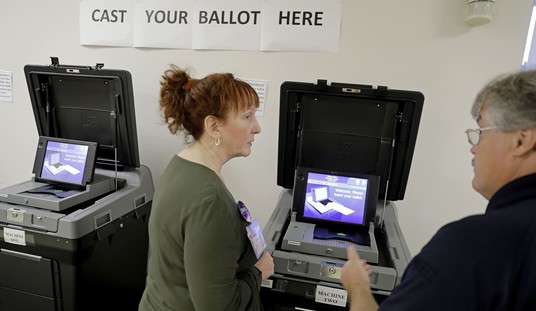
Democrats argue that requiring voter photo IDs—even when the ID itself is given away free—creates practical barriers that prevent eligible voters from casting ballots. “We’re all set for the SAVE America Act,” Sen. Lindsey Graham (R-S.C.) reportedly told President Trump immediately before his sudden death on Saturday. With the House passing the SAVE Act as part of this week's reconciliation bill and President Trump urging its passage in his Thursday night speech, Republicans have launched a full-court press to get the legislation enacted.
Many Democrats align with Sen. Elissa Slotkin (D-MI)’s claim last week that the Act will “literally allow this administration to rig our democracy so that it would be hard for any Democrat in any state to win any election.” Senate Minority Leader Chuck Schumer argues that “The SAVE Act would impose Jim Crow-style restrictions on voting.”
They both warn that proving citizenship would make voting harder for millions who lack ready access to birth certificates or passports.
Democrats claim black voters would face the greatest harm. Yet every country in Africa requires government-issued identification to vote. Fifty-one of the 54 countries in Africa demand people actively submit proof of citizenship to register to vote.
They also say IDs would disenfranchise Hispanic voters. Yet Mexico, all 12 South American countries, and Spain mandate government-issued photo IDs to vote. All these countries verify the citizenship of those registered to vote. Mexico has rules similar to what is proposed in the SAVE Act requiring voters to submit an original birth certificate issued by a civil registry, naturalization certificate, or Mexican passport.
If citizens in those nations can obtain the required identification, why can’t American Hispanics and blacks be able to do the same? All these countries have lower per-capita incomes than the United States.
Eighty-three percent of American adults support government-issued photo ID to vote, including 82 percent of Hispanics and 76 percent of black Americans—the very groups Democrats claim would be harmed. These figures suggest most black and Hispanic Americans do not see obtaining ID as a significant barrier. 10 states already enforce similarly strict photo ID requirements.
Democrats also argue that voter ID laws disproportionately disenfranchise women, yet women support these laws at the same rate as men.
Critics claim voter ID laws disproportionately burden less-educated and lower-income individuals. Yet surveys show the opposite: voters without a high school diploma support photo ID laws by 27 percentage points more than those with graduate degrees, and those earning under $30,000 support them by seven points more than those earning over $200,000. Higher-income, more educated individuals express more concern than the groups they claim to protect.
It’s not just Africa and South America that require voter IDs. Both neighboring countries—Canada and Mexico—require them, and Mexico also requires a thumbprint. All 47 European countries, except parts of the United Kingdom, require government-issued photo identification. Virtually all the countries check citizenship against national databases, though France requires voters to submit documentation. Only the UK, Cyprus, and Ireland demand documents when citizenship is in doubt.
After widespread vote fraud, Mexico enacted major reforms in 1991. The government required biometric photo voter IDs, banned absentee ballots, and mandated in-person registration. Despite stricter registration and the elimination of absentee voting, turnout rose. In the three presidential elections after the reforms, average participation reached 68 percent of eligible voters, up from 59 percent in the prior three. As confidence in the system increased, so did participation.
Countries across Europe and beyond have responded to fraud by tightening their voting systems.
Before 2002, voter fraud plagued elections in Northern Ireland. Amid intense sectarian conflict, observers described the fraud as “widespread and systemic.” Both Conservative and Labour governments responded. Prime Minister Margaret Thatcher's government required voter ID in 1985, but the accepted medical cards proved easy to forge. By 1998, a Select Committee concluded that the system remained vulnerable.
The Labour government closed those loopholes in 2002 by requiring more secure identification and preventing multiple voter registrations. The reforms immediately reduced total registrations by 10 percent, highlighting the extent of fraudulent registrations.
A study of pre-2002 fraud quoted former IRA Belfast commander Brendan Hughes, who described running taxis that shuttled fraudulent voters from one polling station to another. Volunteers changed wigs, clothing, and glasses to vote repeatedly, and Hughes said organizers often recruited young women because election officials were less likely to challenge them.
A 2002 U.K. Electoral Commission survey found that voters believed by a 64 percent to 10 percent margin that fraud in some areas was significant enough to change election outcomes.
Recent surveys show that likely voters support requiring government-issued photo ID to vote by a 4.6-to-1 margin, viewing it as a reasonable way to protect election integrity. Minorities also support these rules: black voters back photo ID requirements by a 69 percent to 14 percent margin, and Hispanic voters support them by a 77 percent to 13 percent margin.
If banning voter ID defines democracy, then Democrats would have to label many other countries in the world as undemocratic.
John Lott is the president of the Crime Prevention Research Center. He served as the senior advisor for research and statistics in the Office of Justice Programs and the Office of Legal Policy in the U.S. Department of Justice during 2020-21.