

Six days after the commencement of Operation Epic Fury, President Donald Trump took to Truth Social to announce, in the context of the ongoing joint American-Israeli military campaign against the Islamic Republic of Iran: "There will be no deal with Iran except UNCONDITIONAL SURRENDER!" In the same post, the president seemed to equate such "unconditional surrender" with "the selection of a GREAT & ACCEPTABLE Leader" to lead Iran, which would enable the country to come back from the "brink of destruction" and emerge "stronger than ever."
Just three days after announcing "unconditional surrender" as his goal, Trump, speaking on March 9 in Doral, Florida, proclaimed that the end of the war would happen "very soon." One might be forgiven for experiencing some whiplash — especially because earlier that same day, Trump told Fox News he was "not happy" with Iran's naming of a new supreme leader, Mojtaba Khamenei. In fact, around the same time he was demanding "unconditional surrender" the prior week, Trump had already called Khamenei the younger "unacceptable."
What exactly is going on here?
Trump is a conservative nationalist, which means his general approach to foreign policy and his specific foreign policy "excursions" are guided by his view of how best to secure the American national interest. Accordingly, since Operation Epic Fury started, Pentagon press briefings featuring Secretary of War Pete Hegseth and Chairman of the Joint Chiefs of Staff Dan Caine have repeatedly emphasized empirical metrics for measuring success, such as Iranian naval vessels sunk, Iranian air force planes shot down, Iranian ballistic missile silos and launch sites destroyed, and so forth.
Trump hasn't said it explicitly, but the Trump administration's goal — and thereby, definition of victory — in Operation Epic Fury seems clear enough: the neutralization of Iran as an active, ongoing threat to the United States and our interests. If nothing else, at least that is how victory in the current campaign should be defined.
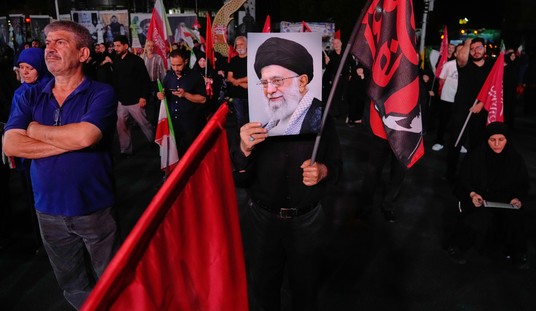

That does still raise at least one pressing question, though, especially in the context of exiled Crown Prince Reza Pahlavi's call to the Iranian people to prepare for "the decisive stage of our final struggle": Where does that most controversial of foreign policy goals, "regime change," fit into the puzzle?
At this point in the campaign, it is uncontested that wholesale regime change is the most desirable outcome. The pursuit of regime change as a goal unto itself is often now disparaged, coming in the aftermath of the failed neoconservative boondoggles earlier this century. But it ought to be axiomatic that there are some foreign regimes that behave in a manner that redounds to the American national interest, and there are some foreign regimes that behave in a manner that is contrary to the American national interest. It is natural and logical that we would wish for the latter types of regime to be heavily reformed or outright replaced — especially with the local populace leading the way.
Perhaps even more to the point: One does not take out a 37-year-ruling despot like Ali Khamenei, as the American and Israeli militaries did in the opening hours of the present operation, and not hope for full-scale regime change. Indeed, all people of goodwill should be hoping for that outcome — for the Iranian people to rise up like lions and throw the yoke of tyranny off their necks once and for all, delivering a long-sought victory for the American national interest in the process.
But it's entirely possible that full-scale regime change won't happen. The people of Iran just witnessed tens of thousands of their countrymen brutally gunned down during the anti-regime uprisings of late December and early January. They are an unarmed populace facing Nazi-esque regime jackboots, in the form of the Islamic Revolutionary Guard Corps and the Basij paramilitary.
All of that, then, raises one final question: Is it possible for there to be victory in Operation Epic Fury, and for the Iranian regime to be neutralized as a threat to the United States and our interests, if there isn't full-scale regime change in Tehran?
In theory, the answer is yes. Venezuela provides a model. But in practice, the answer is murkier.
Delcy Rodriguez, the current leader, is a hardened Marxist-Leninist in the mold of her two immediate predecessors, Hugo Chavez and Nicolas Maduro. But Rodriguez has been fully cooperative with the United States since the astonishing January operation to extract Maduro for the simple reason that she has no real choice in the matter: She remains in power, yes, but only on the condition of an "offer" presented by Trump and Secretary of State Marco Rubio that, to borrow from Vito Corleone in "The Godfather," she "can't refuse." Accordingly, Rodriguez has thus far been fully cooperative in areas such as American oil extraction and the reestablishment of diplomatic relations with the United States.
In theory, a similar arrangement is possible with a decimated, chastened regime in Tehran. And some experts predict that such an arrangement will characterize the regime in Iran a year or two from now. In practice, however, there is the ever-thorny problem that has frustrated and perplexed Westerners for decades when they attempt to reason with zealous Islamists: Radical, 72-virgins-in-heaven-aspiring Muslims do not fear death. A socialist like Rodriguez can, ultimately, be reasoned with; an Islamist like Mojtaba Khamenei (or his successor), probably not.
The cleanest solution to the Iran quagmire at this particular juncture — and the one that most clearly fulfills Trump's "unconditional surrender" victory criterion — is indeed full-scale regime change. That is certainly the outcome that would be best for the neutralization of the Iranian threat and the corresponding advancement of the American national interest. I'm far from certain it will happen. But every alternative scenario only raises additional questions. So, like many others, I pray that the Iranian people seize this unique moment in history and take their destiny into their own hands.
To find out more about Josh Hammer and read features by other Creators Syndicate writers and cartoonists, visit the Creators Syndicate website at www.creators.com.