
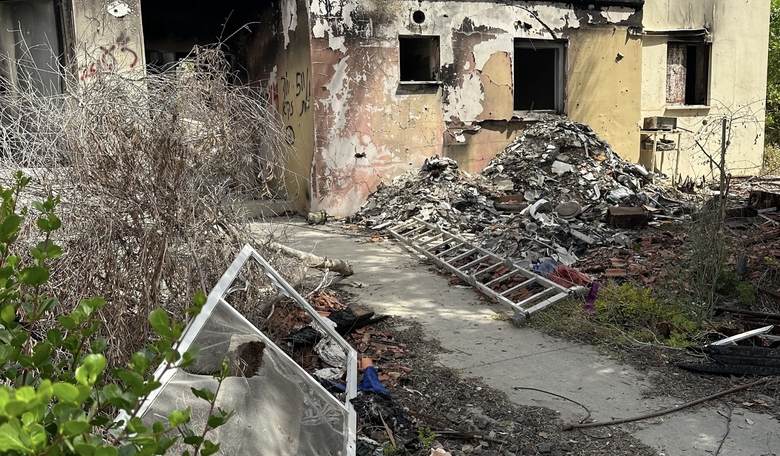
Mourning what they lost but choosing life and rebuilding for today and generations to come
Kibbutz Be’eri was founded as one of the historic “eleven points” remote outposts established at the close of Yom Kippur 1946, to create Jewish communities in the Negev Desert for the future state of Israel. There were no roads, no water, only rocks and sand. The region typically gets one-sixth the annual rainfall of Arizona deserts!
Over ensuing decades, pipelines carried freshwater from deep groundwater wells and Lake Kinneret (the Sea of Galilee) and later desalinated water from the Mediterranean; drainage basins and dams brought winter rainfall runoff to reservoirs; and more recent pipelines carry local and urban recycled water for agriculture. Today, desalinated water even replenishes the Kinneret!
Be’eri is home to 1,200 people and anchors the Eshkol Region. A printing and fintech company employs 600, while farmers raise cattle, potatoes, peanuts, mangoes, wheat, jojoba for oil and skin care products, and more.
For two decades, Be’eri and all other communities east of Gaza endured repeated and sometimes daily rocket, gunfire, firebomb and other attacks. People had 15 seconds to get to safety. The physical dangers and psychological trauma took their toll on humans and animals alike. Families slept in home bomb shelters/safe rooms to safeguard them from nighttime attacks.
On October 7, 2023, one day after its 77th birthday, the kibbutz was struck by Hamas terrorists and Gaza civilians, amid the most barbaric horrors inflicted on Jews since the Holocaust. More than 130 men, women and children were murdered; 32 were kidnapped. Twenty-one children lost one or both parents; 100 lost siblings or other close family members.
The incomprehensible atrocities led to brutal urban warfare, in which Hamas employed labyrinths of tunnels and turned virtually every school, hospital, mosque and other building into military strongholds.
Be’eri’s homes, schools, library building, dining hall and dental clinic were battered and burned. Most survivors were evacuated to Hatzerim, the kibbutz where drip irrigation was invented, until schools are finally rebuilt.
Today, most of Be’eri is an active construction site, as it rises like a Phoenix from those ashes. Its guiding vision is “Be’eri: stronger and more resilient, prosperous and welcoming than ever before – for current members and generations to come.”
Kibbutz residents voted to demolish all but one of the homes damaged during the massacre. This home will be preserved for five years as a memorial and House of Testimony, while they decide its ultimate future. Eighty new houses are being built in three neighborhoods on the eastern side. Hundreds of damaged homes are being repaired and upgraded. Antiquated and damaged water, sewage, electricity, road and communication infrastructure are being replaced.
Other buildings and facilities are being rebuilt, strengthened, modernized and expanded – guided by the principle of “trauma-informed design” – an understanding that physical space carries memories, and good design supports healing, a sense of safety, return of control over one’s life, restoration of familiar spaces, and community recovery through meeting places like the dining hall and sports fields. The total physical reconstruction cost is $150 million.
Partners in recovery include the Israeli government, Jewish National Fund-USA (JNF-USA), Keren Kayemeth LeYisrael (KKL), other Jewish and secular philanthropic organizations, and countless individuals, family foundations and grassroots supporters worldwide. Many donations unlock an additional 25 percent match from KKL.
Among the milestones to date: Be’eri Printing now employs more people than before October 7, and the kibbutz is growing barley for “Single Be’eri,” its signature single malt whiskey.
Projects fully funded but not all completed include a new daycare center and kindergarten, a youth center, an innovation center and library, and a new medical center.
About $12 million must still be raised for other vital projects, especially safe room upgrades for all 418 homes: reinforced doors that can be locked from the inside and filtration systems that purify and recirculate air, so that terrorists cannot set homes on fire and smoke families out, to be murdered.
This final round of fundraising will also cover 20 young adult residential units, to ensure youthful energy, labor and social vitality; a restored community headquarters for leadership and administrative offices; a cemetery and commemorative garden; a regional veterinary clinic; an indoor/outdoor sports complex; and a new dining hall and members’ club, where residents can eat, celebrate and mourn together.
Details are beautifully and movingly presented in the 2025-2026 Impact Report: We Are All Be’eri – The Journey Back Home of Kibbutz Be’eri.
The ultimate goal is not just to bring people back, but to make them want to stay, by giving them a place where they can heal, raise children, reestablish their daily lives, thrive, and be joyous that they have a real home … amid memories of loved ones who will not be coming back.
July 31, 2027, is the return date for Be’eri families that have not yet returned. It will be a day not only of physical relocation, but of continuing personal and communal recovery.
Meanwhile, 50 babies have been born since that horrific October 7. Traditional and family celebrations and gatherings have continued uninterrupted, though with fewer participants. Construction and renovation proceeded apace. And a new avocado and citrus packing facility has joined existing and revitalized winery, dairy, cycling and other enterprises, built for generations to come.
My recent trip to Israel took me to 1948 War battlefields, the Valley of Elah where David challenged Goliath, thousand-year-old Canaanite and Jewish cities, the Pilgrimage Road on which Jesus and other Jews walked to the Second Temple, the City of David and nearby museums – and Be’eri, where a cofounder’s grandson and other friends showed me the hall of remembrance and construction sites.
Everywhere I went on this Israel trip and previously, I witnessed millennia of history, glittering skylines of steel, glass and golden Jerusalem limestone, and incredible examples of Israeli innovation, resilience and resolve – in the face of constant threats to destroy the country from the river to the sea and put its Jewish, Christian, Druze, Baha'i and even Bedouin people to the modern sword of a globalized intifada.
Tel Aviv’s Shimon Peres Center for Peace and Innovation displays these accomplishments via informative and entertaining presentations that utilize virtual reality headgear, videos and interactive activities.
Every experience reminded me how Jews, today and through ages of hostility and attempted eradication, have responded with vows to choose life, remember the past but not dwell on it – and above all restore, rebuild, resanctify, adapt, and devote their intellect and industry to wherever they are or end up, in their repeated diasporas and recent return to their ancestral lands.
There is no better example of this than Kibbutz Be’eri.
Paul Driessen has been to Israel multiple times with the Jewish National Fund, Shurat Hadin and on his own, including visits to many sites of the October 7 massacres. He is the author of articles on energy, environmental, human rights and Israel issues.