





Florida wildlife turns tables on apex predator, raising questions about climate dangers
“Scientific studies,” activist fundraising pitches and “news” stories about apocalyptic threats to Earth’s wildlife are as ubiquitous as trees in the Pacific Northwest.
Overexploitation and habitat alteration had been the gravest causes of the existential crisis facing Earth’s wild animal species, they assert. But now, “intensifying climate change” has become a third major factor. (See here, here and here.)
Alarmists even claim that climate change affects bird migration and reproduction by disrupting their biological rhythms and schedules. They never mention how wind turbines slaughter thousands of migratory birds, ensuring that they never reach their destination and never reproduce.
Another cause, rarely mentioned, is invasive species – such as brown tree snakes accidentally brought to Guam during WWII. With no natural predators to keep them in check, they wiped out 10 of the island’s 12 native bird species.
It’s an endless cycle. Garbage science and theories in = garbage pseudo-scientific fearmongering out = garbage policies = reduced habitats, wildlife, energy, jobs, living standards, heating, air conditioning, and lives.
One has to wonder: What would happen if funding dried up for all of this nonsense the moment that “climate change” stopped being the magic that unlocked grant money? Might we get more honest, replicable science – and less garbage?
Almost certainly. But for now let’s focus instead on an apex predator invasive species case with a happier and truly thought-provoking outcome.
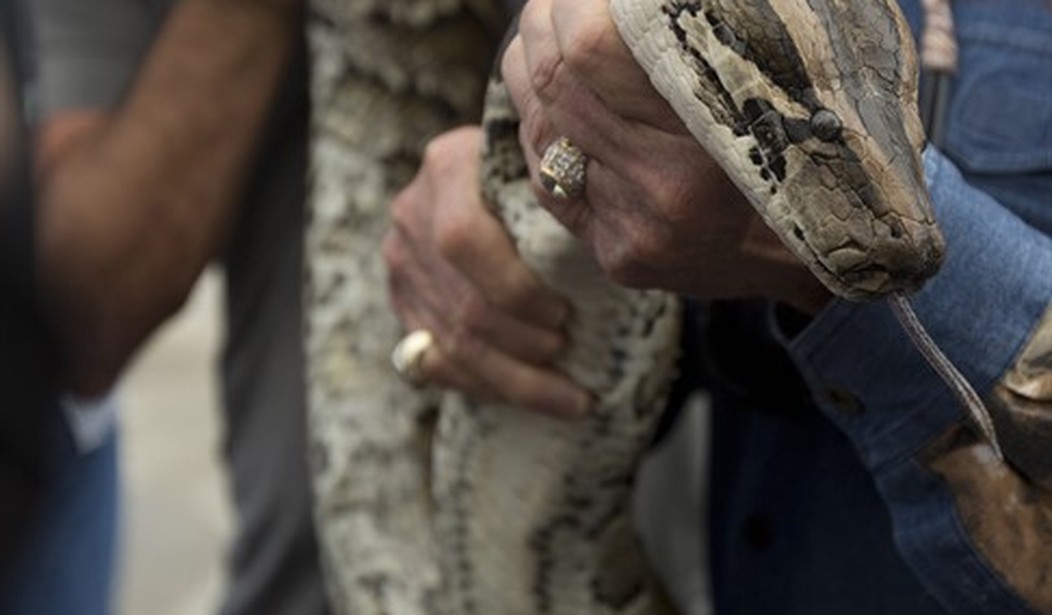
Irresponsible “exotic pet” traders brought Burmese pythons to Florida in the 1970s. Irresponsible “pet” owners “introduced” them into the state’s hospitable wetlands environment not long after, when they discovered how “challenging” it was to care for critters that grew from 20 inches at birth to six feet or more two years later – and might happily consume dogs, cats and even children. True apex predators.
The largest python ever recorded in Florida was 19 feet long; the heaviest, 215 pounds. Goats, pigs, deer and anything smaller are all at risk. The gigantic snakes have even eaten alligators.
With females laying 12-100 eggs each year, the invasive “nuisance” quickly became a crisis across the Big Cypress Swamp, Everglades National Park and beyond.
Bobcat, deer, opossum, raccoon, rabbit and fox populations plummeted by 87-99 percent. Birds also provided handy meals. Localized extinction loomed.
The crisis became a call to arms – and hunters responded. Today, people can legally hunt pythons year-round on private land and in many Florida Fish and Wildlife Conservation Commission areas without a permit or hunting license.
State-sponsored Python Challenges award prizes to successful participants. The Conservation Commission’s Python Action Team offers full-time jobs and pays bonuses based on snake size. Professional python hunter Donna Kalil has caught more than 740, including a 16-footer!
Their combined efforts put a dent in python numbers and reproduction. But big snake babies were always many slithers ahead of human predation.
Thankfully, Mother Nature herself is fighting back. Florida’s wildlife themselves are having a much bigger impact than humans. In effect, prey has become predator. Paws, mouths and beaks of former and current victims have turned the tables and learned that pythons can be tasty targets of opportunity.
The long-term denizens do not intend to go gentle into that dark night, or surrender their territories and lives to these foreign invaders.
A YouTube program called Tecnología Discovery tells the tale of this fascinating turn of events, saying, “The Burmese python is disappearing in Florida at an incredible rate. The real culprits surprise everyone."
Alligators are the obvious first choice for role reversal. They’ve been around for some eight million years and aren’t easy prey. One python’s stomach exploded after it swallowed a six-foot gator. Instead of waiting in deep water for random pythons to swim by, alligators now ambush them during dry seasons, as the snakes come by looking for water. At least one dramatic encounter was caught on cellphone video.
But in this prey-turned-predator saga, mammals, birds and other reptiles are also seeking vengeance.
Florida panthers may be endangered, but they too are stalking the giant slithering reptiles. After pinning a python to the ground with its claws, a cat’s powerful jaws chomp down on the snake’s back, severing the spinal cord, immobilizing the prey and permitting multiple leisurely meals.
Coyotes are proving that even smaller mammals can dine on pythons. Relying on their quickness and pythons’ biological blind spots (python video at 18:05) during various points in the snake's digestive and life cycles, coyotes bite down just behind a snake’s head, severing its spinal cord. The coyote then feasts on the brain matter, leaving the body for other wildlife to devour.
River otters have turned their hunting-pack tactics for large fish into a perfect technique for killing juvenile pythons, which don’t swim as well as adults. A few bites neutralize a snake, turning it into a meal for the entire pack. Otters also smell out python nests while mama is off sunbathing to warm her reptilian blood – and feast on her clutch of eggs.
Raccoons have adopted the same egg-eating strategy. Although pythons nearly wiped out these masked mammals, those that survived did so because they were the most alert and had the best sense of smell. Survival of the fittest. Resurgent coon populations track down python nests, wait for mama to leave, then chow down on her eggs until they sense her returning.
Eastern indigo snakes also track down python breeding areas and devour babies and juveniles.
Vultures still eat python and other carrion but are also smelling out python nests and eating eggs.
Humans too have become craftier and more efficient in exterminating pythons. Wildlife specialists install GPS tracking chips and transmitters in captured males, release them – then follow them to breeding areas, where they eradicate dozens or even hundreds of adults before they can procreate.
Together, this informal alliance of new predators has slashed the survival rate of young pythons to under 15 percent and falling. The unwanted alien reptiles may have become permanent residents of Florida’s wetlands ecosystem. But they will not be the existential threat they once were, and the region’s recently endangered species will gradually rebound – better able to survive than before, hopefully despite new dangers.
Nature and climate alarmists thrive on far-fetched tales, faulty data, wild theories and GIGO models about greedy people and corporations laying waste to Planet Earth and sending it into a climate death spiral. They show little concern for people whose living standards they throttle back – or who are never permitted to achieve modern living standards, and life spans in the first place.
Nor do these self-laudatory, self-serving alarmists show any concern for the habitats and wildlife sacrificed in the name of their fanciful quest for “clean, renewable, sustainable” energy.
If wildlife can adapt and turn the tables on pythons, they can certainly adapt to slight temperature increases. What they may be less able to overcome are habitat losses and rampant devastation inflicted by wind, solar, battery and transmission line installations … and mining the planet to build them.
Paul Driessen is senior policy advisor for the Committee For A Constructive Tomorrow (www.CFACT.org) and author of books, reports and articles on energy, environmental, climate and human rights issues.
Editor’s Note: Do you enjoy Townhall’s conservative reporting that takes on the radical Left and woke media? Support our work so that we can continue to bring you the truth.
Join Townhall VIP and use promo code FIGHT to receive 60% off your membership.



Join the Conversation
VIP members get the ability to comment on articles.