
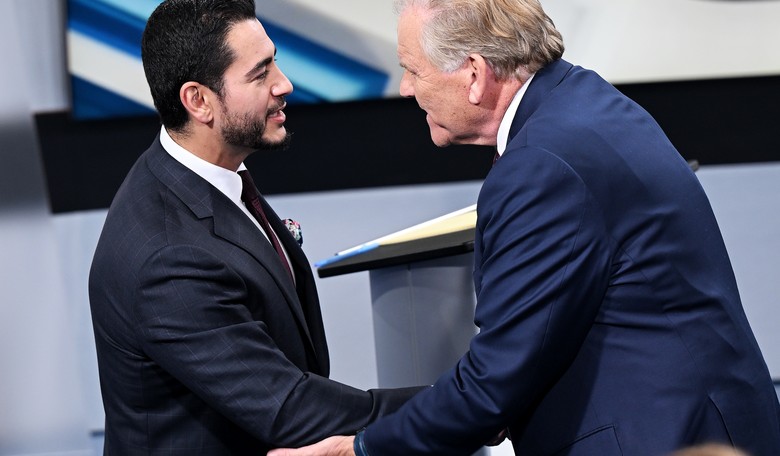
It's been called a "Viral Takedown of MAGA Heckler." But Michigan Democrat Senate candidate Abdul El-Sayed was simply asked if he "would disavow the Muslim Brotherhood."
"Why are you asking the question?" El-Sayed shot back.
"Because they are a terrorist group," the young man asking the question, who identified himself when pressed as Tommy, responded.
"No, no. But what are you implying?" El-Sayed insisted. "Do you assume that I wouldn't?"
El-Sayed wants to paint anyone who would ask such a question as a bigot. Once upon a time, Americans tried to do this to Catholics, he says, presenting himself as being persecuted for his religion. He often mentions John F. Kennedy when making this point.
I'll give El-Sayed one thing. He is very much like Kennedy when he promises, essentially, to be a bad Muslim. In that "viral takedown," he asserts that "it's a crazy thing to assume that somehow I'd have dual loyalties as somebody who's avidly running to protect the right to choose, who's running to protect LGBTQ rights, who's running to protect religious freedom."
As author and political analyst George Weigel recently wrote: "[T]here is little evidence that Catholicism ever shaped Kennedy's political thought. For JFK, Catholicism was more of an ethnic marker than a matter of personal conviction." In his famous speech to Protestant ministers in Houston, Kennedy laid the groundwork for a generation of Catholic politicians who would say they are personally opposed to abortion but that that opinion has no impact on their public life.
American Catholics have never been much for defending the faith, truth be told. Former ambassador to the Holy See Mary Ann Glendon has the perfect formulation for capturing my tribe's problem: We can tend to be either turtles or chameleons. We either want to hide and not be noticed for what ought to make us different, according to the Gospel, or explicitly choose to blend in with the culture. It's choosing to not have the courage to be Catholic.
That might be changing, however, with young people increasingly seeming to be attracted to the countercultural aspects of the faith. To what extent that plays out long-term in the culture and politics remains to be seen.
It is wholly consistent with that historical Catholic timidity that we aren't calling the El-Sayed remarks what they are: bigoted. There is an obvious anti-Catholicism in pretending that somehow asking about the Muslim Brotherhood is anything remotely like asking about the pope in the Vatican. It's even more absurd now that the pontiff was born in Chicago. All this Kennedy talk is one long distraction from the fact that the reason El-Sayed should get asked about the Muslim Brotherhood, a terrorist organization, is because he himself wrote a defense of their possible rise to power in Egypt in 2011 for the Huffington Post. There's more than enough reason to fairly ask questions.
When responding to Tommy, El-Sayed gave a throwaway disavowal of the Muslim Brotherhood. But don't let the "viral" victory claims fool you. First, he seemed much more intent on showing up his interlocutor than on insisting he has nothing to do with any kind of support for the Muslim Brotherhood. El-Sayed has made clear that his candidacy is firmly on the side of the culture of death — abortion wages its own terror on the innocent unborn, even if he does now believe the Muslim Brotherhood is no good.
Michigan shouldn't reject El-Sayed because he is a Muslim, but because he's his own kind of chameleon, blending into some of our most harmful euphemisms and distractions. And, honestly, it's more than reasonable — and unbigoted — to still wonder what he really thinks about the Muslim Brotherhood.
Kathryn Jean Lopez is senior fellow at the National Review Institute, editor-at-large of National Review magazine and author of the new book "A Year With the Mystics: Visionary Wisdom for Daily Living." She is also chair of Cardinal Dolan's pro-life commission in New York and is on the board of the University of Mary. She can be contacted at klopez@nationalreview.com.