
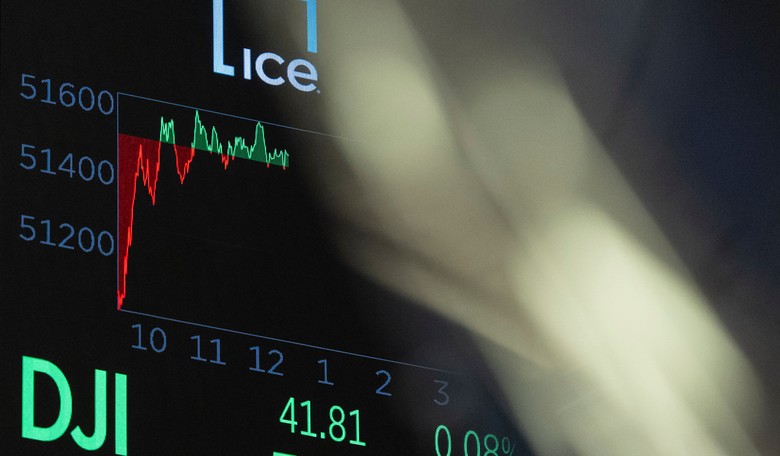
Wall Street gave Democrats a standing ovation on Wednesday and a dose of reality on Thursday. After Democrats won both chambers of Congress, flipping more than two dozen Republican-held House seats, the Dow jumped 3 percent, its best post-midterm day since 1982. Then Thursday arrived. At the close, the S and P 500 had fallen 4.36 percent, or 334.89 points, and the Nasdaq Composite 5.52 percent, or 1,421.52 points. The VIX, Wall Street's fear gauge, jumped 68 percent to 27.46. That is the worst second day after a midterm in nearly a century, well past the 2002 low of 2.3 percent. More than $2 trillion in value evaporated from pension plans, IRAs, and 401(k) plans.
I won't pretend one election explains one bad Thursday. The AI trade was already under scrutiny. The Nasdaq-100 closed in correction territory on Monday, more than 10 percent below its October 6 record. That came on the heels of an October 30 sell-off that erased more than $1 trillion in tech value on doubts about AI spending. Thursday's focus shifted to what a Democrat Congress could mean for the AI buildout. In 30 years of pricing risk, I've learned that investors charge for uncertainty about taxes, regulation, and investigations the same way they charge for a shaky balance sheet. Here's where I land: a Democratic Congress will pull Washington toward the California model, and Republicans handed over the keys by leaving their own agenda unfinished.
I moved to California in 1990, when the mood was upbeat, and the economy was on an upswing. I raised three sons there and made a life for my family. Democrats have since held both legislative chambers for nearly three decades and now hold 29 of 40 Senate seats and 60 of 80 Assembly seats, a two-thirds supermajority in each. Add it up: a 13.3 percent top income tax rate, the highest in the nation, a steady stream of businesses leaving, and regular gas at $5.84 a gallon against a national average of $4.10. Costs are up, crime is up, housing is unaffordable and our educational system is failing our kids. Watching Washington copy that script feels like Groundhog Day, except Bill Murray eventually escaped Punxsutawney.
Texas shows how fast the model travels. The state has more data center capacity operating and under construction than any other, and Bloom Energy projects it will hold nearly 30 percent of U.S. capacity by 2028. Voters just replaced Texas Gov. Greg Abbott with Gina Hinojosa, who promised a ban on all data center approvals until the Legislature acts. Abbott had already paused approvals for audits. Still, a rising technology powerhouse just elected a governor who wants to shut the front door. Thomas Sowell wrote in Is Reality Optional?: "The first lesson of politics is to disregard the first lesson of economics." Power and water are scarce, and a ban doesn't make either one less so.
Ayn Rand wrote that man is "not free to avoid the abyss he refuses to see." Legislators can evade arithmetic for a decade or two, and California has. Markets extend no such courtesy. Thursday's tape was reality sending an invoice, and it arrived before a single bill had passed.
This reaches well beyond Wall Street. Gallup finds 62 percent of American adults own stock, directly or through a 401(k) or IRA. Thursday's losses landed on teachers, nurses, and contractors saving for retirement.
Republicans earned their share of this. They held the House, the Senate, and the White House, then spent the time arguing with each other. The White House pulled more than 50 nominees in 2025, the most in a single year in decades, many after Republican senators balked. When President Trump demanded an end to the filibuster to pass the SAVE America Act, a senior GOP aide told Time that 15 of the 20 Republican senators summoned to the White House were a hard no. I respect the 60-vote rule as a brake, and I'd defend it. But a party can't hold every lever, refuse to pull any, and act surprised when voters hand the levers to the other side. Vice President JD Vance now says the party lost because of the Iran war and cost-of-living worries.
Calm has a case, and it's a fair one. Gridlock usually soothes investors. The S and P 500 has risen an average of 15.5 percent in the six months after the last 14 midterms, going back to 1970, according to Edward Jones. Democrats lack a filibuster-proof Senate majority, and the president can veto what they pass. Wednesday's rally priced exactly that.
A veto stops bills. It doesn't stop subpoenas. Rep. Robert Garcia will chair House Oversight and plans to investigate corporate corruption alongside the Trump family business. Sen. Elissa Slotkin told a University of Chicago audience she wants prosecutions of Trump's enablers to carry "that deterrence message" to graduates weighing administration jobs. A party that wants to look to the future shouldn't spend it on investigations and on frightening young staffers. UBS economist Jonathan Pingle notes that Democrats must now approve any new Fed governors.
Republicans have three moves left. They control both chambers until the new Congress is seated, so they should confirm the qualified nominees in the queue and pass whatever can clear now. Governors who still want the AI buildout should win it, because data center policy is set largely at the state and utility-commission level, according to LPL Research's Jeff Buchbinder, and predictable permitting and power will beat a federal fight. Savers should control what they can: the savings rate, the allocation, and the urge to sell at the bottom. After 30 years managing money for families, I can tell you the last one costs the most.
Margaret Thatcher put it bluntly in a television interview: socialist governments "always run out of other people's money." California has spent three decades testing that theory and keeps finding new pockets. Republicans have until January to prove they understand what they hold, and voters will render another verdict in 2028. Wall Street needed two days to price the risk. Californians needed nearly 30 years. The rest of us should skip the wait.
Jay Rogers is a financial professional with more than 30 years of experience in private equity, private credit, hedge funds, and wealth management. He writes about issues in finance, constitutional law, national security, human nature, and public policy.