


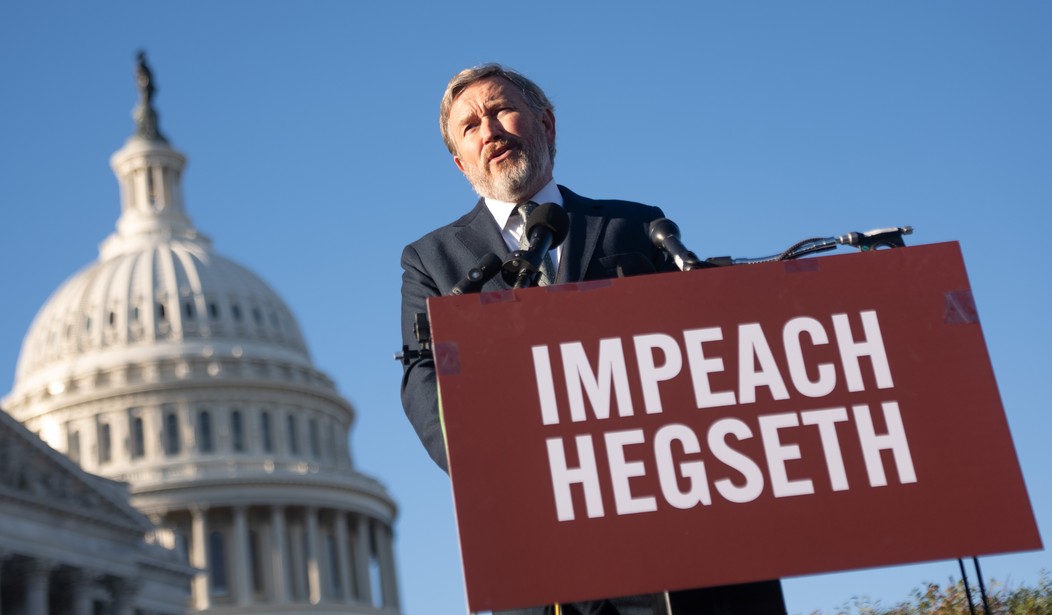
By forcing a House vote this week on eight articles of impeachment against War Secretary Pete Hegseth, outgoing Kentucky Representative Thomas Massie (KY-4) has revived a dangerous Washington habit: weaponizing the Constitution’s ultimate remedy to settle foreign policy disputes.
Speaking from the Pentagon podium on Tuesday morning, Hegseth dismissed the effort as a "political spectacle" and a "stunt" aimed at punishing civilian military leadership for executing lawful orders. He is right. Whatever one thinks of the Trump administration’s military strikes in Iran, Yemen, Venezuela, or against maritime cartel networks, turning a Cabinet official’s execution of Commander in Chief directives into "high crimes and misdemeanors" turns the American constitutional order upside down.
The Framers designed impeachment as an emergency safeguard against treason, bribery, and personal corruption — not as a parliamentary vote of no confidence when lawmakers dislike a president’s foreign policy. Look at American history. In nearly 250 years, only one civilian leader of the War or Defense Department has ever been impeached: Secretary of War William Belknap in 1876. Belknap was not dragged before the Senate over military strategy or executive war powers. He was impeached because he pocketed tens of thousands of dollars in kickbacks — worth more than $500,000 in today’s dollars — from a lucrative trading-post contract at Fort Sill. That is what an impeachable offense looks like.
Massie’s resolution, by contrast, is fundamentally a quarrel over Article II executive authority dressed up as a criminal indictment. The first three articles accuse Hegseth of violating the War Powers Resolution of 1973 by conducting military operations without a formal declaration of war and continuing strikes past the statute’s 60-day clock.
Yet for more than half a century — ever since Congress enacted the War Powers Resolution over President Richard Nixon’s veto — presidents of both parties have consistently maintained that the law’s automatic 60-day withdrawal mandate unconstitutionally infringes upon the president’s authority as Commander in Chief.
Consider the record. In 1999, President Bill Clinton continued NATO’s 78-day air campaign in Kosovo well past the 60-day threshold without congressional authorization, arguing that funding bills implied approval. In 2011, President Barack Obama bypassed the 60-day limit during the seven-month military intervention in Libya, claiming that U.S. airstrikes and drone operations did not even rise to the level of "hostilities" under the act. Neither Secretary of Defense William Cohen nor Secretary of Defense Robert Gates was hauled before Congress on impeachment charges for carrying out their presidents' orders.
If Congress believes the executive branch has overstepped its constitutional bounds in Iran or the Caribbean, the Constitution already gives lawmakers a decisive, unambiguous tool: the power of the purse. Under Article I, Congress raises and funds the armed forces. Lawmakers can restrict appropriations, prohibit funds for specific deployments, or pass binding legislation to end an operation.
What Congress should not do is scapegoat a subordinate Cabinet secretary for following lawful directives issued by the elected Commander in Chief. When House Republicans impeached Homeland Security Secretary Alejandro Mayorkas in 2024 over border enforcement policies, constitutional conservatives rightly warned against lowering the impeachment bar to cover policy failures. Even that partisan effort died quietly in the Senate. Repeating the mistake during a lame-duck session — spearheaded by a congressman who already lost his primary — only cheapens the impeachment power further.
Even if a narrow House majority voted to adopt Massie’s articles, removing Hegseth requires a two-thirds conviction in the Senate, a threshold that will never be met — assuming the Senate doesn't dismiss the charges outright by a simple majority first. The only real consequence of this gambit is signaling to America’s adversaries in Tehran, Caracas, and Beijing that Washington is eager to put its own warfighters and defense leaders on trial in the middle of active global crises.
Oversight is a vital congressional duty. But turning constitutional impeachment into a tool for lame-duck political theater weakens the presidency, undermines civilian control of the military, and invites endless partisan retaliation the next time power changes hands.
Horace Cooper is a legal commentator who taught Constitutional Law at GMU and served as Legislative Counsel to former House Majority Leader Dick Armey.
Editor's Note: Do you enjoy Townhall's conservative reporting exposing the radical left and woke media? Support our work so we can keep bringing you the truth.
Join Townhall VIP and use promo code FIGHT to receive 60% off your membership.

Join the Conversation
VIP members get the ability to comment on articles.