
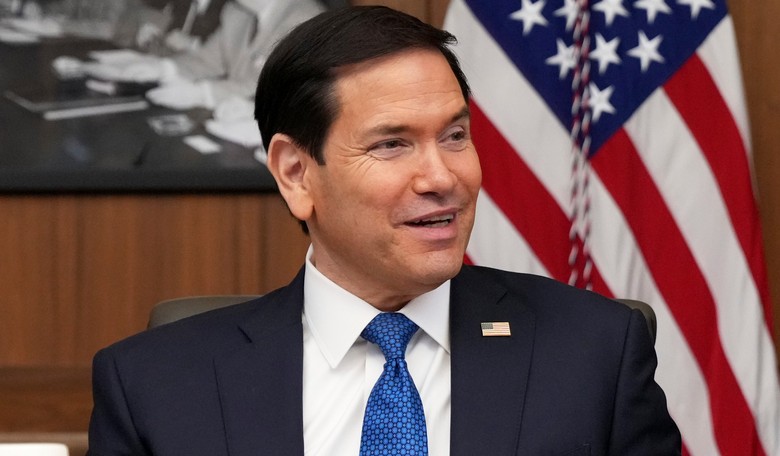
For the first year of President Trump's current term, speculation about his successor focused largely on Vice President JD Vance, with a side discussion about Secretary of State Marco Rubio. Until quite recently, Vance had a huge lead over Rubio in national polls. For example, in a number of national polls from just a couple of months ago, Vance held a lead of 15 to 20 percentage points over Rubio. Now, after the disastrous Republican losses in the midterm elections, the RealClearPolitics average of national polls has Rubio at 35.4 percent, with Vance a bit behind, at 34.0 percent.
Those are national polls, but of course the Republican presidential selection process is not a national primary. As it has for a long time, it will start with the Iowa GOP caucuses, then move on to the New Hampshire primary, then to South Carolina and Nevada. The Iowa contest is a little less than 14 months away. That's not that long a time.
Now, a new poll shows Rubio with a substantial lead over Vance among voters likely to take part in the crucial early contests. Conducted by OnMessage Inc., the survey questioned 1,000 likely voters in the four early states, 250 in each. It was conducted for a group called the Combat Antisemitism Movement, which was seeking information on voter attitudes about the controversial podcasters Tucker Carlson, Candace Owens, and Nick Fuentes. (The short version: Most GOP voters in the early states don't like them.)
As part of the poll, OnMessage also asked likely 2028 voters about their preferences among Vance, Rubio, and a few other possible candidates. The results were very good for Rubio.
In Iowa, Rubio was the choice of 49 percent of likely caucus participants, while Vance was the choice of 28 percent. Others — Donald Trump Jr., Health and Human Services Secretary Robert F. Kennedy Jr., Former Virginia Gov. Glenn Youngkin, Sen. Ted Cruz, and the undecided category — made up the rest. (It should be said that the survey questionnaire was written just before the November 3 midterm elections and pollsters were contacting voters in the days immediately after. It did not include Florida Gov. Ron DeSantis, who has jumped up in the polls in the days since the GOP midterm losses.)
In New Hampshire, the result was Rubio 44 percent, Vance 25 percent. In South Carolina, it was Rubio 43 percent, Vance 28 percent. And in Nevada, it was Rubio 53 percent, Vance 32 percent.
As far as sheer favorability is concerned, the voters seem to like both Vance and Rubio. The poll found that 83 percent of the voters surveyed had a very or somewhat favorable opinion of Rubio, and 80 percent feel the same way about Vance. And both of the men had a higher favorability rating than Trump, whose favorability stood at 75 percent in the poll.
The poll seemed to suggest a Republican electorate with a changing self-image. In the survey, 41 percent of likely GOP early contest voters called themselves conservative Republicans, while 20 percent called themselves MAGA Republicans, 11 percent said they were moderate Republicans, 8 percent said they were just Republicans, and 7 percent called themselves libertarians. The rest said none of the above.
One interesting note about the influence of Trump in the early deciding states appeared when the pollsters asked if Trump endorsed a candidate, "would that make you more or less likely to vote for the candidate he endorsed?" Fifty-three percent said more likely, while 21 percent said less likely and 27 percent said they didn't know.
That 21 percent of GOP caucus and primary voters who appear determined to do the opposite of what Trump says reflects a longstanding minority of opposition in the early contests. Remember that in 2024, former South Carolina Gov. Nikki Haley consistently won significant numbers of voters — 19 percent in the Iowa caucuses, 43 percent in the New Hampshire primary, 40 percent in her native South Carolina, and 30 percent in Nevada. There were always divisions in the Republican early state contests, even when Trump was running away with the race overall.
Now, it appears that a real contest has developed between JD Vance and Marco Rubio, even though neither is formally running for president at the moment. The GOP midterm catastrophe seems to have especially hurt Vance, who, like the president, devoted a lot of political capital to campaigning for Republicans.
But some politically connected types say they've been seeing warm feelings for Rubio around the country for quite a while, even when some in Washington were stuck in a Vance-is-inevitable mindset. "This poll confirms what anybody out in America who is in touch with Republican primary voters can see," says OnMessage's Curt Anderson. "These numbers are shocking in Washington, D.C., and boringly obvious everywhere else."
Of course, all of this is just a snapshot of the moment. And at this time in the election cycle, among Republican voters at least, Rubio seems to be escaping the forces of political gravity that are weighing on Trump and Vance. Rubio is obviously a skilled, experienced politician, but how is it that, as a senior member of the Trump administration, he can make great, high-minded speeches and people don't blame him for what's going on — but they do blame Trump and Vance? Whatever the answer is, we'll learn soon enough whether it can last.
This content originally appeared on the Washington Examiner.
Byron York is chief political correspondent for The Washington Examiner. Email him at byork@washingtonexaminer.com. For a deeper dive into many of the topics Byron covers, listen to his podcast, The Byron York Show, available on the Ricochet Audio Network and everywhere else podcasts are found.