
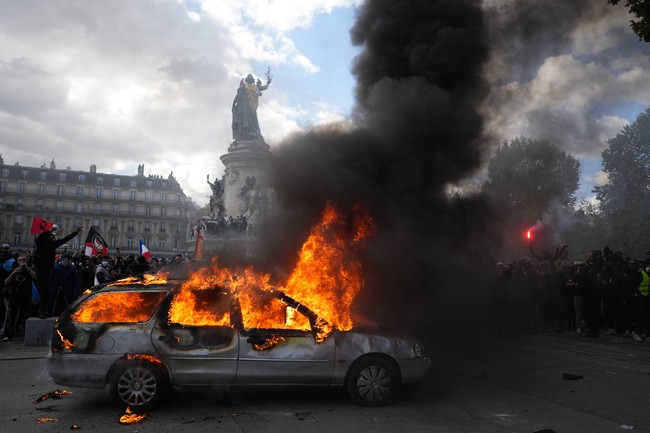
I spend a lot of time working in Paris, and I was there again recently. It remains one of the most beautiful and culturally important cities in the world. But beneath that beauty, France is facing an economic crisis that should concern every Western democracy. The protests spreading across France are being viewed through the familiar lenses of Left versus Right, immigration, and political unrest. Those issues certainly matter, but I believe the real story is much bigger. France is confronting the consequences of an economic model that has promised more than it can sustainably deliver.
Across Western Europe, tensions surrounding Muslim immigration, integration, national identity, and security have become major political issues. Governments have a responsibility to manage their borders, enforce their laws, and maintain public confidence. Those debates are not going away, nor should legitimate concerns be dismissed. But they cannot explain the full extent of France's economic problems. Immigration debates don't account for decades of government borrowing, high taxation, or weak economic growth. The underlying economic problem deserves far more attention.
The numbers tell the story. By June 2026, France's government debt had reached approximately €3.6 trillion, equivalent to 119 percent of GDP. Government spending amounted to approximately 57 percent of GDP in 2025, yet the country still ran a deficit exceeding 5 percent of GDP. Think about that for a moment. Government spending is equivalent to more than half the country's annual economic output, and France still cannot balance its books. These aren't estimates from political opponents. They are figures published by France's own national statistics agency.
For decades, France has embraced a socialist-style approach to economic policy built around expansive government programs, high taxation, and extensive regulation. The promise has been greater economic security, but the cost of maintaining those commitments has continued to grow. Meanwhile, economic growth remains weak, public debt keeps climbing, and the burden of financing the system falls heavily on businesses and workers. At some point, you have to ask whether the very policies designed to provide economic security are making economic success harder to achieve. France remains a capitalist economy, but one increasingly burdened by the cost of government.
Consider what life looks like for a young professional in Paris earning €2,000 a month. After paying rent, transportation, utilities, and groceries, there may be very little left to save, invest, or start a family. A French government study published this year found that half of private-sector renters under 30 spent more than 51 percent of their disposable income on rent, before housing assistance, based on 2022 figures. The study included students, but the broader affordability problem is clear. Young people can do everything society tells them to do, earn an education, find employment, and pay their taxes, yet still struggle to achieve financial independence.
That is why the involvement of students, workers, unions, and Yellow Vest activists in France's latest unrest is worth watching. These groups don't necessarily agree politically, and many are demanding different solutions. Some want additional government spending and stronger public services, while others are frustrated with taxation and the cost of living. Their presence in the same wave of unrest doesn't mean they have embraced the same political ideology. It means dissatisfaction with economic conditions and public institutions is reaching people with very different perspectives. The question is whether the existing economic system can deliver the future they expect.
I've worked extensively across South America, where I've seen how economic dissatisfaction can transform political landscapes. Countries such as Argentina demonstrate how decades of fiscal problems, inflation, and public frustration can eventually produce dramatic political realignments. France is certainly not Argentina, and its economy has not collapsed. But the broader lesson is relevant. When citizens begin to believe the economic system is no longer working for them, traditional political loyalties can change remarkably quickly. Political establishments often recognize the depth of that frustration only after public confidence has already deteriorated.
I believe the solution cannot simply be another government program, another tax increase, or another promise financed through additional borrowing. France needs stronger economic growth, more private investment, greater entrepreneurship, and policies that reward work and allow businesses to expand. Social protections have a role, but France has built a system whose enormous cost places increasing pressure on the economic growth needed to sustain it. There is nothing compassionate about making promises that future generations may struggle to afford. Government can redistribute prosperity, but it cannot redistribute wealth that has never been created.
Europe's political leaders will continue debating immigration, national identity, and the traditional differences between Left and Right. Those issues are important, but they should not distract from the economic pressures building underneath them. France's fiscal problems have developed over decades and cannot be attributed to a single administration or political party. They reflect difficult choices that successive governments have repeatedly postponed. The protesters themselves may disagree about the solutions, but those disagreements don't make the country's economic challenges any less serious.
What concerns me most is that France may be providing an early warning about the sustainability of an economic approach embraced by much of Europe. Not every European country faces France's fiscal problems, and extensive social programs alone do not determine whether an economy succeeds or fails. But every government ultimately faces the same reality: its commitments must be supported by an economy productive enough to finance them. A country does not need to experience a financial collapse before its citizens begin losing confidence in the future. It only needs to reach a point where working harder no longer seems to produce a better life, where government promises continue expanding while economic opportunity feels increasingly limited.
France remains a wealthy country with enormous potential. But wealth accumulated over generations is no guarantee of future prosperity. If governments continue prioritizing promises over productivity and borrowing over economic growth, the pressure will only intensify. France's protests are about many different issues, and not everyone in the streets agrees on what should happen next. But the economic frustrations behind this unrest raise a question the entire continent needs to confront: How long can governments continue promising more when the economies supporting those promises are struggling to deliver?