
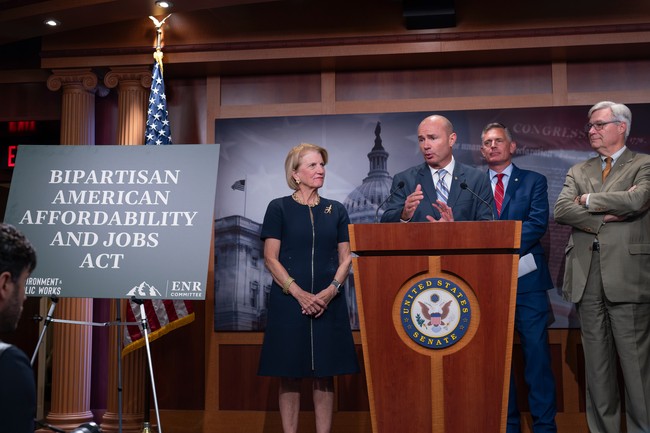
America has forgotten how to build, courtesy of a Byzantine permitting process that delays projects for years and often kills them altogether. A new bill could change that, though, and let the U.S. start building again, including badly needed energy infrastructure that would lower prices.
The current paralysis was made painfully evident this year when the Iran war disrupted tanker traffic through the Strait of Hormuz, and oil jumped from about $70 a barrel to about $100 in a matter of weeks. Prices at the pump skyrocketed while costs for natural gas, fertilizer, electricity, and more all rose as well.
America has weathered the supply shock better than most countries because of our shale production, but the cushion is much thinner than it should be. Every stalled well, pipeline, port, and power line is a shock absorber missing from U.S. infrastructure. Energy security is national security, and a country that cannot build cannot be secure.
The bipartisan American Affordability and Jobs Act, unveiled September 30 by Senate committee leaders, aims to fix the permitting paralysis with purely commonsense reforms. It sets a one-year deadline for environmental assessments and two-year deadline for full impact statements. It gives opponents 150 days to sue, not six years.
It also narrows Section 401 of the Clean Water Act so states can no longer block pipelines on grounds that have nothing to do with water quality. It lets projects keep moving forward while agencies fix paperwork a court has flagged. And it protects issued permits from being yanked by a later administration. It’s the most serious permitting reform in a generation.
And it’s desperately needed. The Mountain Valley Pipeline, which carries natural gas 300 miles from West Virginia to southern Virginia, took nine years to permit. The National Environmental Policy Act has become the most litigated environmental law in the country, and Section 401 is regularly misused by some states as a veto on any interstate pipelines.
This is happening while electricity demand is projected to climb 25 percent by 2030 as new factories, data centers, and electric car chargers come online. While this latest bill goes a very long way in fixing the permitting process, it can be better still, and a great place to start is the section expanding the Federal Energy Regulatory Commission’s (FERC’s) power to site interstate transmission lines.
Today, states decide where most power lines go. FERC holds a narrow “backstop” authority that applies only inside corridors designated by the Energy Department, which has never designated one. The bill scraps that step and lets FERC permit lines of 230 kilovolts or more directly, so long as they meet public-interest, consumer-benefit and reliability tests.
Accelerating useful transmission line construction is a worthy goal but the issue here is who pays. The bill says costs of FERC-sited lines must be allocated to customers “roughly commensurate” with benefits they receive, and that customers getting no benefit, or only a trivial one, can’t be charged, which sounds perfectly reasonable.
But “benefits” are calculated by regional grid operators using their own models and assumptions, and those estimates can be stretched.
That’s happened before, like in 2024 when MISO, the grid operator spanning 15 states from Louisiana to North Dakota, approved a $22 billion package of high-voltage lines designed in large part to help states like Minnesota, Illinois, and Michigan meet their “clean” energy targets with remote wind and solar. Because those lines were classified as “multi-value” projects, their costs are shared across the whole region.
Regulators from Arkansas, Louisiana, Mississippi, North Dakota, and Montana — states with no renewable mandates — filed a FERC complaint arguing the benefits were inflated and that the setup lets states with aggressive “green” goals shift their higher transmission bills onto neighbors who made different choices. MISO’s own independent market monitor has raised similar concerns.
Now imagine giving FERC power to approve such lines over state objections. Families in red states that rejected expensive and inefficient solar and wind mandates could find the cost of blue-state mandates folded into their monthly electric bills.
The One Big Beautiful Bill rightly phased out the open-ended wind and solar tax credits in Biden’s Inflation Reduction Act. It’d be a shame if permitting reform quietly rebuilt that subsidy through utility prices, where it is harder to see and harder to repeal.
Fortunately, the fixes to protect families are simple. Congress can define “benefits” more tightly and accurately: reliability improvements, congestion relief, and measurable savings for customers being charged, not compliance with another state’s policy mandates. And benefit claims can face independent market-monitor review before FERC signs off.
None of this requires scrapping the bill’s core. Americans would benefit tremendously if Congress took a mend-it-don’t-end-it attitude toward this issue to ensure true energy dominance without gimmicks that risk funding subsidies voters already rejected.
E.J. Antoni, Ph.D., is chief economist and the Richard Aster fellow at the Heritage Foundation and a senior fellow at Unleash Prosperity.