
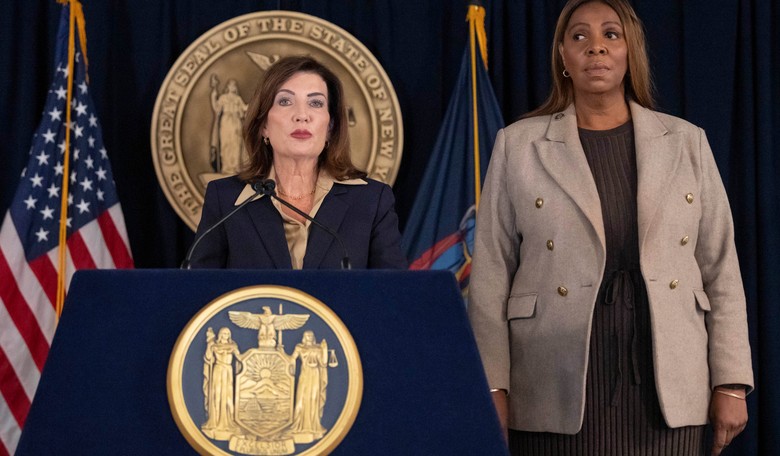
Hanna Stotland did something remarkable: she offered a fair, reasoned, and nuanced take on the Cornell case that’s already ginned up fury among the usual suspects — all of which has happened before, even after all the evidence has been reexamined. A police investigation concluded there wasn’t enough evidence to prosecute, prompting New York Gov. Kathy Hochul to appoint AG Letitia James as special prosecutor. The case is already a circus, but Stotland went line by line in a lengthy article in Slate magazine, known for its contrarian liberalism.
It’s refreshing that someone in this orbit has a level head. We don’t know what’s going on here, though the case reeks of Duke Lacrosse, and the media are notoriously inept at covering these stories. Duke was a hoax, and the UVA gang rape hoax was even worse, leading to a libel suit against Rolling Stone, which published the piece. They lost the suit.
Stotland does seem open to removing fraternities from campus life, which I don’t agree with. But the investigation, the evidentiary process, and the flaws in the Title IX process — all are laid out. This could be a short or a long process. The punishment in a civil case is less severe; hence the standard is a preponderance of the evidence to prove guilt, not beyond a reasonable doubt. Either way, with social media and the press writ large being laughably incapable of covering these stories, expect a circus:
Many people are taken completely aback by some of the disturbing details of this case. As someone who lives in this space, I want to specifically underline something: This story doesn’t happen without substance abuse. The case is an extreme outlier in terms of alleged severity; I’ve not encountered another case in my career involving ketamine, or with four or more alleged assailants over the course of multiple hours. (Though I must note: Despite the prominent use of the chilling phrase the “Cornell Seven,” the lawsuit accuses four of the defendants of having sex with Doe; one of kissing her; and two of snorting drugs off her body.) But the case is par for the course in the sense that everyone on both sides of the allegations was abusing substances, which is a factor in nearly every case I’ve worked on. Doe says she took nine shots of vodka in her own sorority house before heading out for the evening. Meanwhile, according to Doe, every defendant took ketamine, and she did as well. In her statement to police, she said that one of her first two sex partners could not stay awake during sex, and she woke him several times to see if he needed care, and the other was dry-heaving immediately afterward. According to the New York Times’ summary of the men’s statements during the Title IX process, they agree that they were drunk and high on marijuana to the point of vomiting at the time of the encounter.
Even in a world where we eradicate sexual assault, this kind of substance use is life-and-death dangerous. In this world, it’s a great way to end up in my crisis management practice, either as accuser or accused (and yes, it is a societal problem how often men and women slot into these roles). In more than 90 percent of my 363 cases, both students were drinking or high. I can count my cases where both were sober on one hand. I can’t let fear of being called a victim blamer keep me from stating the obvious truth: I’m a substance abuse blamer. Two things are true at once: It’s never a drunk woman’s fault that someone harmed her, and the harm rarely happens when nobody is drunk. That doesn’t mean the men are not civilly (or even criminally) responsible for their behavior; it is just a fact. What would have happened at Chi Phi if everyone were sober, or even just buzzed? Doe’s whole theory of the case is that she was too intoxicated to consent; she does not claim that she said no and was ignored. In fact, in her police statement, she identified multiple occasions when she said no, and the no was respected, in spite of everyone’s intoxication. So if everyone had been sober, in the less likely event that the men proposed the same sex acts, it appears she would either have said yes and meant it or said no and been obeyed.
What about the role of Greek life? Jane Doe sued her sorority on the theory that it was partly to blame for the unsafe drinking on its property. But the fraternity was the site of the alleged horror and is the subject of much of the resulting outrage. That’s to be expected—I’ve never had a case where a student reported being assaulted in a sorority. There is a litany of reasons why fraternities are the site of these types of events: their liminal status as unsupervised sites that are also part of the college, the need of universities like Cornell to rely on them for student housing, the way they attract guests with free alcohol and drugs—I could go on. But we know by now that these are unsafe environments—for women, obviously, but also for men. Cornell banned the frat where the alleged assault took place, but many others continue to operate.
That leads us to the adjudication of this case so far. It’s hard even for lawyers to keep track of the elements, so let’s start with a refresher on three layers of enforcement that can cover alleged campus rapes: criminal, civil, and Title IX. All three are at issue here.
[…]
Police and prosecutors were involved in this case back in 2024, but that wasn’t public knowledge because no one was arrested or charged. Investigations, if they don’t lead to further action, are generally not publicized. That’s because, as we are observing in this matter, just being associated with an alleged crime is extremely stigmatizing. We want that stigma to attach to a defendant once professionals have assessed that it is justified, not every time there is an accusation. When the case was originally investigated, no criminal charges were brought.
But there were consequences from layer two: the Title IX investigation. Title IX is the federal law that mandates, among other things, that universities investigate and punish sexual misconduct on campus. This obligation is based on the idea that making someone sit in class with their rapist is denying them educational opportunities on the basis of sex. The Title IX process is conducted confidentially, within the university’s walls, by faculty and administrators, much as it would be for a student accused of cheating on a test or breaking other school rules. If it sounds odd to you that college administrators would adjudicate allegations of gang rape, you are not alone; commentators on both the left and the right have criticized the process for this reason.
The only punishments the accused students have received have been via this process—the fraternity chapter was shut down and barred from campus. Cornell expelled two students, while the five other students were given a range of sanctions, including suspensions. The assertion that seven gang rapists wrote essays to atone for their sin has become a particular target of disgust and outrage online, but it is a wild mischaracterization of the situation at hand. Let me explain: The civil pleading states that upon receiving the Title IX complaint in November of 2024, Cornell temporarily suspended the seven defendants and afforded them “the opportunity to mitigate their conduct by submitting essays.” Assuming that’s true, the immediate interim suspensions are normal and so is an opportunity to protest them in writing. At that stage of a Title IX process, students can’t write reflection papers as a punishment, because there has been no finding of responsibility. The hearings didn’t even happen until May 2025. Essays can be part of a consequence, especially where a student has been suspended and the essay is required as a condition of return. New reporting says that was part of the punishment for the defendants found responsible for lesser offenses. But no one found responsible for rape was given an essay as penance.
How much will any of this be reexamined, now? That depends. The news that brought the Cornell case into the public eye is the third legal layer at play here: the civil cases that Jane Doe has brought. Civil cases begin when one person or entity decides to sue another—or a bunch of others, in this case. Civil cases seek money damages and/or court orders mandating specific actions like changing a student’s transcript or transferring ownership of a house, but no one can can't result in jail time.
Stotland later turns to the administrative side of things, working as an admissions consultant and an education crisis professional: this is the Armageddon scenario for most college administrations. It’s what keeps them up at night for many reasons, and it’s reared its ugly head here. Yet she also added that the campus likely made the decisions they thought were best in 2024, when this incident occurred, based on what was provided to them. She’s not sold on the idea that this was a quick remedy to cover up the incident and protect the school’s integrity. Colleges have shown it's none too shy about letting criminal proceedings mete out justice, as we saw with the Vanderbilt football program.
She also said an enforcement-only approach won’t solve the problem. Stotland said this should be an area where public health experts weigh in, and colleges have better ways to discuss and create better environments and habits surrounding drugs and alcohol. Banning fraternities seems knee-jerk.
Yet even Stotland noted that this case is messy, as it seems to be a frenetic night of drugs, alcohol, and group sex, where consent and nonconsent are lost amid all of these activities. It’s why I don’t trust James to handle this case properly, as she’s a clown.
Still, it's a fair piece. It doesn't need to be conservative or even pro-fraternity. It just needs to be reasoned and not read as if I'm being yelled at by the Gloria Steinem fan club or the Catharine MacKinnonites.