
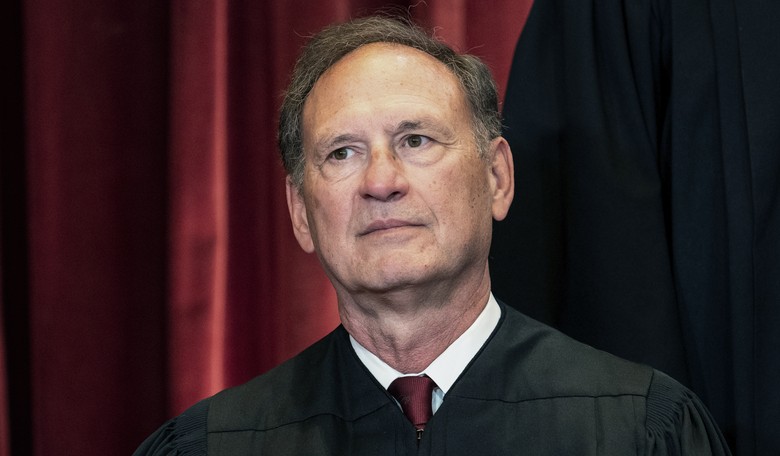
Supreme Court Justice Samuel Alito, the author of the Court’s decision overturning Roe v. Wade and one of its most consistently conservative members, sat down Sunday for two rare televised interviews: one with Shannon Bream on Fox News Sunday and another with Mark Levin on Life, Liberty & Levin. The appearances came ahead of the release of Alito’s new book, "So Ordered: An Originalist’s View of the Constitution, the Court, and Our Country."
With Bream, Alito discussed the campaign to pressure and intimidate the Court, calls by Democrats and others to reshape the institution, the leak of the draft Dobbs opinion, the Court’s decision to overturn Roe, and his displeasure with the continued speculation about whether he will retire.
In his interview with Mark Levin, Alito discussed originalism, the Left’s effort to use the Supreme Court to achieve political ends it cannot secure through the democratic process, and why Ronald Reagan was right to warn that freedom is only one generation away from extinction.
"I am concerned about the future of the court." Supreme Court Justice Samuel Alito sits down with @ShannonBream on @FoxNewsSunday to discuss the future of the nation's highest court as some groups on the left call for major changes to the institution. Some Democrats have advocated for adding justices or implementing term or age limits for the Supreme Court.
— Fox News (@FoxNews) October 4, 2026
When asked about growing calls to impose term limits or age limits on Supreme Court justices, expand the Court, or otherwise restructure it, Alito said the justices do not discuss those proposals among themselves. He added, however, that he is personally concerned by them because they amount to an open effort to intimidate the Court into issuing decisions its critics want.
Alito said he is also concerned about the Court’s future. For much of its history, he argued, the institution has served an essential role in preserving the constitutional order and protecting Americans’ rights. The current push to reshape it, however, threatens to turn an independent branch of government into a mere partisan instrument.
Justice Samuel Alito SPEAKS OUT on the leak of the Dobbs decision that OVERTURNED Roe v. Wade: “And I never dreamed that the draft of the opinion would be leaked. That was totally unprecedented in the history of the country. It was a grave breach of the trust that everybody who worked in this building had before that point. And it very predictably made the five of us in the majority targets for assassination and nearly resulted in the ass*ssination of my colleague Brett Kavanaugh.” “I anticipated that it would anger a great many people who believed and continue to believe strongly that there should be a constitutional right to abortion. So I understood that. I wasn't surprised that there was such a reaction. I didn't anticipate the particulars, the forms that that reaction would take, the most extreme forms.”
— RedWave Press (@RedWavePress) October 5, 2026
Alito went on to discuss the leak of the draft Dobbs opinion, the decision that ultimately overturned Roe v. Wade. While he said he expected outrage from those who believe abortion is a so-called constitutional right, he did not anticipate the particulars, especially the unprecedented leak of a draft opinion and the threats that followed against the five conservative justices.
"I've been bemused by the retirement speculation." Supreme Court Justice Samuel Alito addresses speculation about his future on the bench during an interview with @ShannonBream on @FoxNewsSunday. Alito says the constant attention surrounding whether he will retire is "not too pleasant."
— Fox News (@FoxNews) October 4, 2026
The conversation then turned to speculation about Alito’s retirement, which he described as “not too pleasant.” While he said such talk is inevitable for a justice with lifetime tenure, he said he currently has no retirement timetable.
Later Sunday, Alito also sat down with Mark Levin, where the two discussed the tenets of originalism, the constitutional doctrine holding that the Constitution should be interpreted according to its original public meaning and applied to modern-day issues.
Alito contrasted that approach with those who treat the Constitution as a living document that can be made to mean whatever their preferred political outcome requires, a view most often embraced by the American Left.
"They want the Constitution to mean whatever they want it to mean." Supreme Court Justice Samuel Alito discusses originalism on "Life, Liberty & Levin," explaining his view that the Constitution should be interpreted according to the meaning of its words when they were adopted. Alito contrasts that approach with interpretations that allow the Constitution's meaning to change over time. @marklevinshow
— Fox News (@FoxNews) October 5, 2026
Justice Alito went on to discuss what the republic ultimately relies on: not a single leader, executive order, or piece of legislation, but the people themselves. Its survival, he argued, depends on Americans’ continued commitment to the Constitution, its separation of powers, the rights it protects, and the cause of freedom. Invoking Ronald Reagan’s warning that freedom is never more than one generation away from extinction, Alito reaffirmed that the country’s future depends on each generation actively choosing to preserve it.
"The success of the Constitution, the success of our republic, the preservation of our republic does depend ultimately on the citizenry," Justice Alito said. "It depends on ordinary citizens. I think President Reagan once said something like, American liberty is never more than one generation from extinction. So ultimately, the success of the republic depends on the people."
"American liberty is never more than one generation away from extinction." Referencing the words of former President Ronald Reagan, Supreme Court Justice Samuel Alito reflects on the responsibility Americans have to protect the nation's founding document during an interview on "Life, Liberty & Levin." "The success of the republic depends on the people." @marklevinshow
— Fox News (@FoxNews) October 5, 2026