
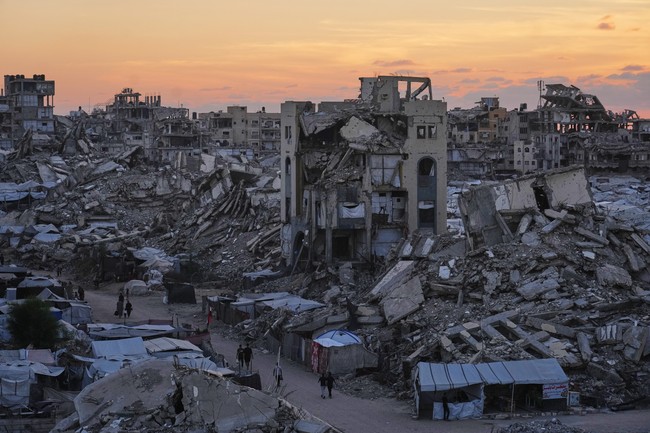
This week, my social media feeds have filled with satellite images, many reportedly from Google Earth, showing whole neighborhoods of Gaza reduced to gray rubble. The posts accompanying them tend to share a single conclusion: this is the evidence of genocide, and Israel is guilty of it.
The images are sobering. They should be. Behind every collapsed roof was a family, a kitchen table, children who went to sleep there. Anyone who can look at those pictures and feel nothing has lost something important. Grief over the suffering of Palestinian civilians is not a betrayal of Israel, and it is not weakness. It is simply what decent people feel.
But grief is not the same as understanding. A photograph taken from orbit can show you what happened to a place. It cannot tell you why. And if we are going to render judgments that history will record, we owe it to the dead on every side to get the why right.
Go back to October 6, 2023. On that day, there was a ceasefire in place between Israel and Gaza. Israel had withdrawn every soldier and every settler from Gaza nearly two decades earlier, in 2005. Hamas had seized full control of the territory in 2007. Whatever grievances existed, and there were many, the people of southern Israel went to bed that night in their kibbutzim, and young people danced at a music festival near the border, believing they were at peace.
The next morning, Hamas terrorists crossed that border and murdered roughly 1,200 people, most of them civilians. They killed elderly people in their homes and parents in front of their children. They committed acts of sexual violence. They took more than 250 hostages, including babies and grandmothers, back into Gaza. It was the deadliest single day for the Jewish people since the Holocaust.
Hamas didn’t build that capacity alone. For years, the Islamic Republic of Iran has funded, armed, and trained Hamas as part of its network of proxy forces aimed at Israel’s destruction. The rockets, the money, the expertise, the ambition to strike at the Jewish state from every direction: much of that traces back to Tehran. Iran has been content to fight Israel to the last Palestinian.
Hamas spent years building hundreds of miles of tunnels beneath Gaza’s homes, schools, mosques, and hospitals. It placed its fighters, its weapons, and its command centers among the very civilians it claimed to govern. It did this deliberately, because it understood that when Israel responded, and it knew Israel would respond, the resulting devastation would become its most effective propaganda. The rubble in those pictures is, in no small part, the rubble Hamas planned for.
Genocide is not a synonym for war, or even for terrible war. It means the intent to destroy a people. It is worth remembering which party in this conflict has a founding charter calling for the killing of Jews, and which party spent the war issuing evacuation warnings, opening humanitarian corridors, and repeatedly offering to stop fighting if the hostages came home. One can criticize specific Israeli decisions, and people of good faith do, without surrendering the moral distinction between a nation defending itself and an organization that began the slaughter on purpose.
I spent 18 straight hours on the air on September 11, 2001, the day after I was named host of my program. I remember the images of lower Manhattan, the smoke and the twisted steel. No serious person looked at Ground Zero and concluded that America was the aggressor. Nor, when America answered, did the rubble left behind in Afghanistan erase the question of who had started it.
One of the first rules of the playground was simple: don’t start it. It was not a rule meant to excuse whatever came next. It was a recognition that the one who throws the first punch bears a unique responsibility for everything that follows. Adults sometimes pretend that geopolitics is too complicated for such a lesson. It is not.
I confess I grow weary of having to explain this. But weariness is no excuse for silence, because history is being written right now, one viral image at a time, and too much of it is being written without its first chapter.
The destruction in Gaza is real, and it is heartbreaking. It is also the direct consequence of a choice made by Hamas, backed by Iran, on October 7. Had that choice not been made, those neighborhoods would still be standing.
If we want fewer images like these in the future, the lesson could not be plainer. Don’t start it.