
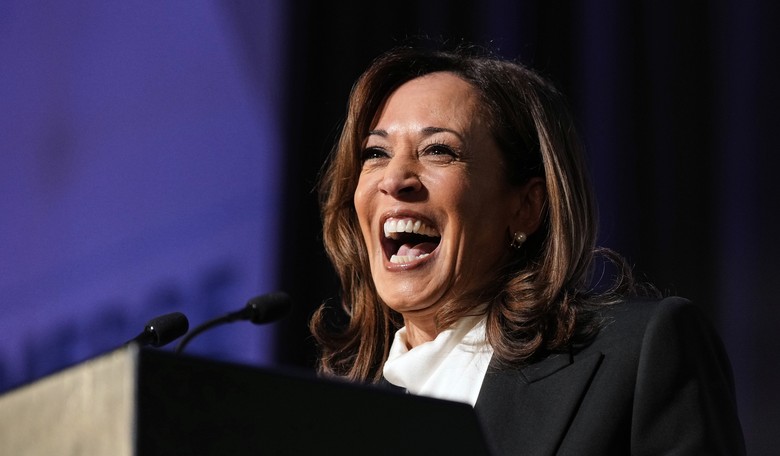
Former Vice President Kamala Harris appears to be keeping the door open to another presidential run. If her recent appearance on "Off Air with Big Boy" offers any preview of the message, or competence, she would bring to a future campaign, Democrats may be preparing for another defeat. The alternative, of course, is worse: a Harris presidency.
When the conversation turned to artificial intelligence, a field that is advancing rapidly but remains dominated by widespread ignorance, Harris showed she belongs firmly in the latter category. Her confusion over what an algorithm is offered a glimpse of the limited knowledge base from which AI and technology policy could be shaped under a possible Harris administration.
🔥🚨 LMAO! Kamala Harris just tried to explain THE ALGORITHM, and it is NIGHTMARE FUEL
— The Patriot Oasis™ (@ThePatriotOasis) September 25, 2026
“Suggesting I have no more interest because I’m looking at this yellow flower… as though my brain can’t handle the fact that there may be a pink flower.”
Then she pivoted to collard greens.… pic.twitter.com/H56CHApWSy
"There is a part of this that is about understanding that, you know, if you keep seeing the same thing over and over again, know that you are being targeted because you looked at it the first time, they're just going to keep sending it to you. Which means they're trying to dumb people down with the assumption that people don't have any interest beyond what they've already seen," the former vice president said. "Think about that."
"Oh yeah, the algorithm," Big Boy, aka Kurt James replied.
"Right, but the algorithm suggesting, I have no more interest because I'm looking at this yellow flower. I'm only interested in yellow flowers. So here's more yellow flowers. As though my brain can't handle the fact that there may be a pink flower that I might be interested in looking at," Harris said. "And so part of it is understanding how the algorithm is manipulating us and figuring out how we're going to psych it out a bit."
If this is the kind of thinking behind technology policy, Americans should be worried. Harris turns a fairly ordinary feature of recommendation software into a sinister theory in which social-media companies deliberately make users less capable of thought. It mistakes a profit-driven engagement system for a scheme to infantilize the public, and provides a ready-made rationale for unnecessary regulation.
That is not what the algorithm is doing. Platforms do not decide that a user lacks the mental capacity to enjoy a “pink flower” after expressing interest in a yellow one. They track behavior and predict what content is most likely to retain attention, because attention produces advertising revenue. Cynical? Often. Sinister mind-control plot? Hardly.
Harris’s explanation also erases the user’s role. People are not helpless captives of an algorithm. They decide what to search for, whom to follow, what to click, what to finish, what to share, and what to dismiss. They can select “not interested,” seek out competing viewpoints, and stop treating a social-media feed as their entire information diet. Platforms can influence attention, certainly. They do not abolish human agency.
The former vice president then explained how she escapes the clutches of the evil algorithm: by leaning into some of her favorite tropes about connecting with minority communities:
“I do try sometimes. I mean, you know, I love to cook,” Harris said, before touting her prowess at roasted chicken, pasta sauce, and collard greens.