
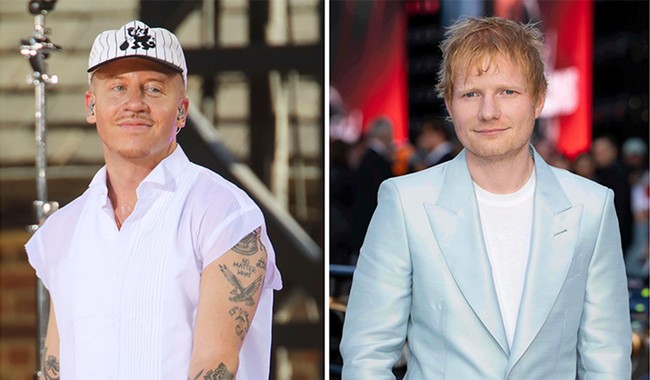
Free speech is a bedrock principle of the United States. It is the right that lets ideas compete in public, even when they are controversial, clumsy, or poorly timed. Like every freedom, it also carries responsibilities. That lesson is playing out on a stadium tour that was supposed to be about music.
The artist Macklemore used his opening slot on Ed Sheeran’s Loop Tour to turn a night of entertainment into a political statement. He told tens of thousands of people that one reason he joined the tour was so he could stand in American stadiums and say “Free Palestine.” He performed a protest song. He projected images and political messaging onto the screens. The First Amendment exists precisely because speech can be provocative and uncomfortable. The government cannot jail him for a political slogan, and no decent person should want it to.
Promoters, venue owners, and headliners are not government agencies or public utilities. These entities have contracts, insurance, stadium leases, and hundreds of thousands of ticket holders who paid for a concert. After Macklemore’s New Jersey dates, venue stakeholders, including Robert Kraft at Gillette Stadium, objected to his continued presence on the bill. The tour promoter said upcoming venues would not host the show with Macklemore on the lineup and that keeping him would risk canceling dates. He was removed. Other supporting acts then withdrew in solidarity.
The sequence of events was messy, emotional, yet still thoroughly American. It wasn’t censorship. Rather, the marketplace is answering speech with more speech combined with business judgment.
Artists have the right to express their views, and throughout history they have been driven by the political tides of the day and often embed direct messages or hidden ideas in their work. Promoters and performers also have contractual and commercial decisions to make. Those two facts are not in conflict unless we pretend that a private stage is a public square and that a ticket is a summons to a town hall. People bought concert tickets for music, i.e., performing arts, not necessarily a sermon, but art consumers are accustomed to artists' political statements, sometimes clearly to draw attention themselves. Maybe even sell more tickets!
Fans can use their own free speech, and their own wallets, to decide whether they want to keep supporting an artist who treats the microphone as a podium. That is how a free society works. Artists have a right to speak. Audiences have a right to decide whether to listen.
Sheeran’s stated desire to keep his concerts centered on music rather than politics highlights how difficult that has become. He has said he wants shows about unity, not division. He later told a Philadelphia crowd that he had made mistakes, that he did not want to be a political commentator, and that he nonetheless felt compelled to describe Gaza as a humanitarian catastrophe while also calling the October 7 Hamas attack horrific.
We are living in an era where even a concert tour can become a proxy battle over geopolitics.
All sides are tempted to treat this as a morality play about who is silenced. That misses the distinction that matters. Government punishment of speech is a First Amendment crisis. A promoter declining to keep an act after venues threaten to cancel is a private choice which may have consequences.
A fan boycotting is a private choice. An opening act walking off in protest is a private choice. Those choices can be wise or foolish, principled or opportunistic. They are still choices. Macklemore can book his own dates, record his own records, and keep saying exactly what he believes. Sheeran can try to rebuild a tour that does not collapse under the weight of the day’s headlines. Kraft can decide what he will and will not host in a stadium he owns. None of that requires the state. All of it requires adults to admit that words have consequences.
Free speech is an invitation to the marketplace of ideas, including the idea that a Saturday night in a football stadium might still belong to music. Maybe the most controversial thing an entertainer can say today is, “Let’s just play the music.” That line will not satisfy activists who want every platform conscripted. It will not satisfy critics who want every artist punished for the wrong slogan. It does something more useful. It reminds us that liberty is largest when people may speak, others may answer, and no one is entitled to applause.
Shaun McCutcheon is a free speech advocate, an Alabama-based electrical engineer, the founder of Multipolar, and was the successful plaintiff in the 2014 Supreme Court case McCutcheon v. FEC.