
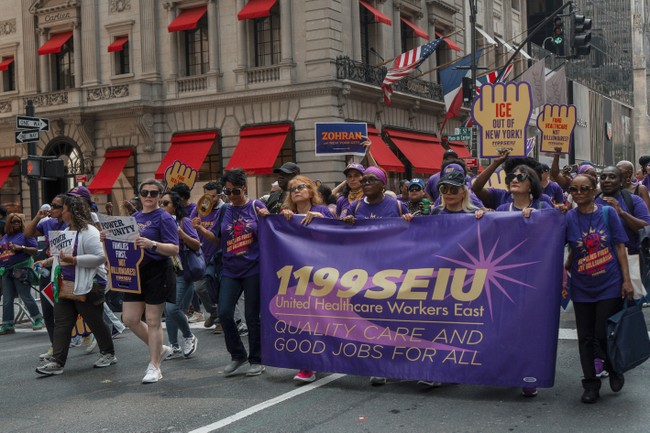
Most Americans could tell you three things about Labor Day: it's the unofficial end of summer, it's a good excuse for a cookout, and you're not supposed to wear white after it.
But do you know why Labor Day exists?
Labor Day became a holiday during some of the most violent labor conflicts in American history. One of the biggest was the Pullman Strike of 1894.
The conflict started at the Pullman Palace Car Company outside Chicago, when employees had their wages cut by roughly 25 to 30 percent during a national economic depression. When they walked out in May 1894, Eugene Debs' American Railway Union, then the country's largest labor union, organized a nationwide boycott of any train carrying a Pullman car. The boycott disrupted rail traffic across the country.
As the Pullman strike spread throughout the nation, tensions between Democrat President Grover Cleveland's administration and organized labor intensified. Congress acted quickly, and President Cleveland signed legislation making Labor Day a federal holiday on June 28.
Interestingly, there were two competing traditions for celebrating labor at the time.
In 1889, an international convention of socialist parties in Paris, known as the Second International, established May 1 as a day for international labor demonstrations. Socialist and communist movements across Europe embraced May Day, and dozens of countries still mark the holiday on or around that date today.
America had developed a different tradition.
In 1882, the Central Labor Union organized a labor parade in New York City in September. The idea spread, and a majority of states had already adopted Labor Day by the time it became a national holiday.
Notably, the United States developed its own distinctly American labor holiday rather than adopt the socialist one celebrated elsewhere. The idea was to honor those who built the country.
So what are we celebrating more than 130 years later?
For most Americans, it’s simply a long weekend.
But for the people who organize many of the official events, Labor Day remains one of the biggest annual moments for union leadership to give speeches, headline rallies, and mobilize members not only around wages and working conditions, but around elections and political causes.
That distinction matters, because it points to a real tension in how Americans talk about the labor movement.
We can all agree that hard-working employees deserve a safe and respectful workplace. But being pro-employee is not the same thing as supporting unions that act like political machines.
Take Wisconsin state Rep. Francesca Hong, a self-described socialist who ran for governor, narrowly losing in the Democratic primary. She was formally endorsed by the Service Employees International Union (SEIU), which represents healthcare and service employees across the state.
That's not an isolated example.
During the 2023–24 election cycle, four of the nation's largest public-sector unions — the National Education Association (NEA), American Federation of Teachers (AFT), SEIU, and American Federation of State, County, and Municipal Employees (AFSCME), along with their state affiliates — spent more than $915 million on elections and political and ideological causes.
Nearly all that money was directed to Democratic candidates or leftist causes. Most of it — 86 percent — came out of members’ dues. In fact, unions spent less on representational activities than on advancing a political agenda.
There’s no question that unions are political powerhouses. But should that be financed by their members?
That's a disconnect worth naming.
Somewhere between the first Labor Day parade in 1882 and today's political rallies, a holiday meant to honor American employees became more about the organizations that claim to speak for them.
Employees and organized labor are not the same thing.
Labor Day belongs to the teacher opening her classroom, the nurse starting another shift, the mechanic fixing a truck, the carpenter building a house, and millions of other Americans who keep the country running.
Most of these men and women do not belong to unions, having the benefit of a direct relationship with their employer. For those who do, some strongly support their unions. Others would leave tomorrow if they had a practical way to do it.
That last group deserves more attention than it gets. Federal labor law protects both the right to organize and the right not to do so.
So enjoy the cookout. Take the long weekend. Wear white if you're willing to risk it.
And remember who the holiday is actually for: not union leaders or politicians, but the employees themselves.
Dan Remmenga is Executive Director of the Center for Independent Employees, a 501(c)(3) nonprofit legal organization that provides representation and aid to employees opposed to unions in their workplaces.