
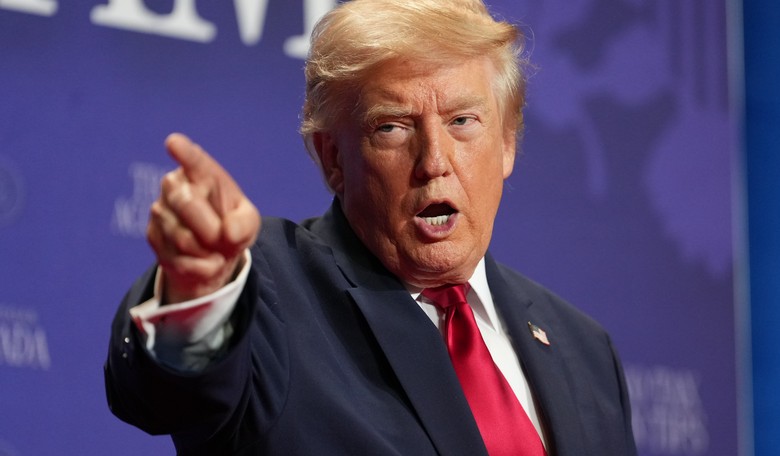
President Trump sparked the predictable outrage Monday after telling communities to “let Data Reign” and embrace the data centers powering America’s AI future. Apparently, suggesting that the United States should build the infrastructure necessary to compete in the most consequential technological race of the century is enough to provoke a national meltdown.
"The only reason that communities throughout the U.S.A. should not want Data Centers is if they want to end up being backwards and poor," the president wrote on Truth Social, Monday. "If they want to be successful and rich, with far lower taxes and jobs all over the place, let Data Reign. The good news is that there are plenty of other places that want them. If we kill the Golden Goose, you will only have yourselves to blame. China could not be happier with this anti Data Center movement. Actually, they can’t believe it is happening! President DJT."
Trump orders Americans to stop complaining about data centers disrupting their communities in new post:
— Headquarters (@HQNewsNow) August 31, 2026
“The only reason that communities throughout the U.S.A. should not want Data Centers is if they want to end up being backwards and poor.” pic.twitter.com/jeGajPSZoq
Trump’s followers on Truth Social are outraged at him for supporting data centers:
— Headquarters (@HQNewsNow) August 31, 2026
“I regret ever supporting you” https://t.co/rp1rzgxUEK pic.twitter.com/FcTdLXM1pb
The administration has chosen to support the data centers America needs to remain competitive in AI, even though it is politically unpopular to do so. Nearly seven in ten Americans, including 60 percent of Republicans, say they oppose putting one in their own community. But that is precisely the point, that a lot of people implicitly want the AI revolution, but far too many want the infrastructure in someone else’s backyard. President Trump, unlike the professional NIMBYs, is not demanding that sacrifice from a safe distance.
Just five miles from Mar-a-Lago, the presidents Florida home, sits a data center. Palm Beach County, where Mar-a-Lago resides is home to 15 data-center facilities, 12 operational and three in development, making it Florida’s fifth-largest county market for the industry. The story is much the same in Washington. A data center sits about half a mile from the White House, while just across the Potomac is Loudoun County, Virginia, the global epicenter of data centers, with over 200 facilities.
Trump is practicing what he preaches. He is a YIMBY, “yes in my backyard,” when it comes to the infrastructure of the future. Much of the opposition, by contrast, is classic NIMBYism. People want the jobs, AI tools, and economic gains promised by the next technological revolution. But they also want the servers, construction, and power generation built in someone else’s backyard. Or, worse, they oppose the infrastructure outright while complaining that AI’s promised benefits have not yet arrived, as they demand new jobs, revived manufacturing, reshoring, energy abundance, and economic growth.
PabloReports: What do you make of Trump saying Americans who oppose data centers are backwards and poor?
— Acyn (@Acyn) August 31, 2026
AOC: I mean, how about we put one in Mar-a-Lago? I love that. Let’s put a data center at Mar-a-Lago, and we’ll see how backwards and poor he is in response to that. pic.twitter.com/QzEyhU3xdZ
Much of the loudest opposition to AI data centers comes conveniently from people who live, work, and tweet from cities like New York and Washington, D.C., places already powered by enormous networks of digital infrastructure and data centers. They enjoy the cloud services, instant delivery, streaming platforms, online commerce, and increasingly AI-powered tools that these facilities make possible.
I think a lot of people don't realize that many data centers have been around us, completely non-controversially, for a long time.
— Logan Dobson (@LoganDobson) August 31, 2026
Mr. Bremmer I believe lives in the great city of New York -- how many people realize that there are many data centers in NYC? https://t.co/AY4GYN0VlK pic.twitter.com/kfgiG7brAp
And this is the larger point. Opponents insist their communities do not need data centers, as though Big Tech woke up one morning and decided to impose servers on innocent Americans for fun. But every AI prompt, cloud backup, streamed show, online order, and app depends on the computing power housed inside them. People say they do not want data centers, then spend all day using the services that require them. That is not Big Tech imposing its will, it is people demanding more data centers. AI does not run on good intentions, public meetings, or angry posts on X; it runs on enormous amounts of specialized computing infrastructure.
Trump’s message is simple, America cannot lead the AI race while refusing to build the infrastructure that makes AI possible. We can build it here, or we can pat ourselves on the back for opposing Big Tech while the investment, jobs, and technological advantage go somewhere else.