
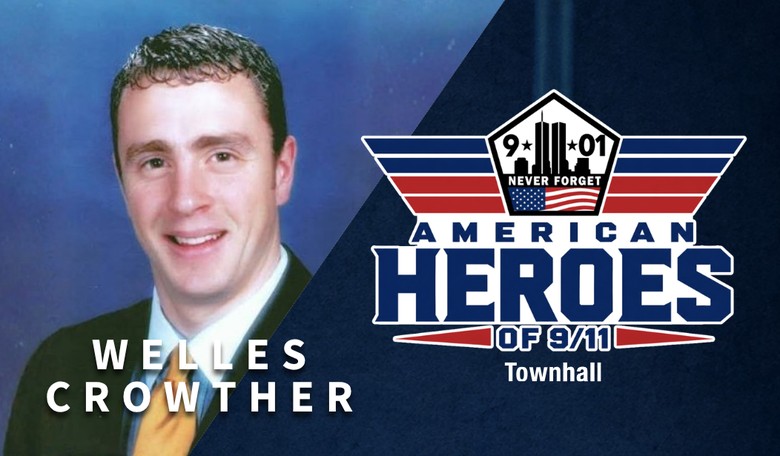
As we approach the 25th anniversary of the September 11 terrorist attacks against the United States, Townhall plans to honor the lives lost and the lives forever changed with our "Heroes of 9/11" series. Every day from now until September 11, we will highlight an American hero. This year, most especially, we wish not simply to commemorate an event, but the character of exceptional men and women who demonstrated the best of humanity in one of its darkest moments. More than that, we want to educate younger generations for whom September 11 is little more than a historical episode so that we embody what it means to "Never Forget."
Judy Wein was working on the 103rd Floor of the World Trade Center's South Tower when American Airlines Flight 11 hit the North Tower. Despite the Port Authority announcing the South Tower was secure, Wein chose to evacuate. She made it down to the Sky Lobby on the 78th Floor and waited for the express elevator to take her to the street.
That's when United Flight 175 hit the South Tower between the 77th and 85th Floors. Wein survived the impact, but she was left with a broken arm, three broken ribs, and a punctured lung.
Accounts say that roughly 200 people were in the Sky Lobby when Flight 175 hit the South Tower. Only 12 survived, including Wein.
Left in pain and disoriented, Wein and the other survivors had no idea what to do.
That's when the man in the red bandana appeared through the smoke and the chaos. At the time, Wein and the other survivors had no idea who this man was.
All they knew was that he was calm and prepared. He showed Wein and the others where the stairs were and then found a fire extinguisher. The man in the red bandana escorted them down to the 61st Floor and then turned around to go back for more people.
"If he hadn't come back, I wouldn't have made it," said Wein. "People can live 100 years and not have the compassion, the wherewithal to do what he did."
That was the second group of survivors Crowther helped rescue. Before finding Wein, Crowther found Ling Young and another group of survivors on the Sky Lobby. When the plane hit, Young ended up being badly burned. Crowther showed up, carrying a young woman on his back, and directed Young and the group to a staircase.
Wein never forgot the man in the red bandana and she spent the months following September 11 going online and covering up the bottom of people's faces with her hand, hoping to recognize the man who saved her life.
Eventually, Wein learned who the man in the red bandana was. His name was Welles Crowther, and he was 24 years old.
He was identified after survivor accounts telling of the "man in the red bandana" circulated and Alison Crowther recognized her son.
Every year around 9/11, I watch "The Man in the Red Bandana."
— Kendall Baker (@kendallbaker) September 10, 2024
It's a tribute to former Boston College lacrosse player Welles Crowther, who died after saving nearly 20 lives that day.
Political debates don't matter in the grand scheme of things. Heroes like Welles do. ❤️🇺🇸 pic.twitter.com/RlsTqfeONd
Crowther graduated from Boston College in 1999 and worked as an equity trader at Sandler O’Neill & Partners on the South Tower’s 104th Floor. He was the oldest of three children born to Jefferson and Alison Crowther, and he joined the volunteer fire department in Upper Nyack, New York when he was just 16.
Growing up, Crowther would see his father put a blue bandana in his pocket; when Crowther was six, his father gave him the red bandana that would become Welles' signature accessory. Despite loving his job with Sandler O'Neill & Partners, Crowther really wanted to join the FDNY, the CIA, or the FBI to help others.
The morning of September 11, Crowther was at his desk when the plane hit the South Tower. Crowther called his mother and left a short, calm message: "Mom, this is Welles. I want you to know that I'm okay."
Then he put the bandana on and went to work.
That message would be the last time the Crowthers heard from their son, and it would be the only information they had on his final moments for months.
In March 2002, Crowther's body was found — intact and with no signs of burns — in the rubble of the South Tower. He was alongside firefighters and other emergency workers who were running a rescue command center in the South Tower's lobby.
Investigators believe Crowther was aiding first responders with the rescue efforts when the South Tower collapsed. He and the others, authorities said, died suddenly and painlessly.
A mostly completed application for the FDNY was found at Crowther's home after the attacks. In 2006, FDNY Commissioner Nicholas Scoppetta named Crowther an honorary New York City firefighter. On May 22 of this year, President Trump announced Crowther would be posthumously awarded the Presidential Medal of Freedom.
BREAKING: President Trump announces that 9/11 hero Welles Crowther will posthumously receive the Presidential Medal of Freedom.
— Fox News (@FoxNews) May 22, 2026
Known as “The Man in the Red Bandana,” Crowther repeatedly ran back into the South Tower on 9/11 to help others escape, saving as many as 18 lives… pic.twitter.com/4xDqNQqHsb
Survivor accounts indicate Crowther saved as many as 18 people that morning, including Young and Wein. The red bandana that so defined Crowther is now on display in the 9/11 Memorial & Museum.
For Crowther's parents, confirmation of his final moments showed them how kind and courageous their son was.
"If Welles' story helps people to think of others then God bless them," Jefferson Crowther told CNN. "He didn't live long enough to be head of a corporation or do good works or endow a museum, but what he did on September 11, that's his legacy."
This is part of the American Heroes of 9/11 series. To read more about the American Heroes of 9/11, click here.