
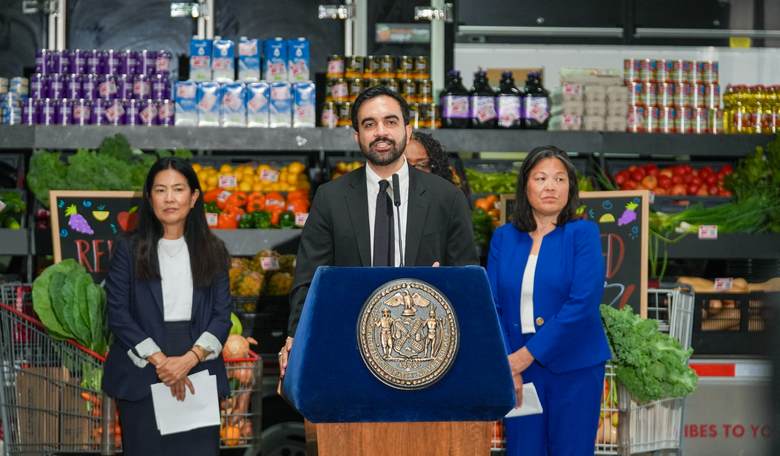
New York City Mayor Zohran Mamdani wants to open five government-run grocery stores that will sell staples at prices private businesses simply cannot match. But don’t worry, he says he has no intention of putting local grocers out of business. His solution, apparently, is simple, use taxpayer money to subsidize the city-run stores, and then use more taxpayer money to pay small businesses not to sell groceries.
In an interview on Wednesday, Waverly Neer, a senior vice president of the NYC Economic Development Corporation (NYCEDC), which is overseeing Mamdani’s city-run grocery-store rollout, revealed that one proposal under consideration would let nearby grocers apply for grants to offset revenue lost to the city’s subsidized stores. In other words, New York City may use taxpayer money to undercut local businesses, then use more taxpayer money to compensate them for the damage they caused.
Socialists always come up with more ways to steal your money to solve problems they created by giving away money they already stole from you. https://t.co/reJPTSkViL
— Daniel Di Martino (@DanielDiMartino) August 20, 2026
"I think ultimately the goals of these locations, not just here in East Harlem, but you know, any borough location is to be complementary to the neighborhood," Neer said. "And really, you know, rising tides, right? We can we can all cooperate and work together in a meaningful way. "
"Do you mind? What is the I've heard that that term from EDC officials that these are meant to be complementary. What does that mean?" Spectrum News NY1's Dan Rivoli asked. "What does that complimentary mean in terms of policy operations and things like that? "
"Yeah, I think we're, you know, as an agency, looking at a number of different complementary policies and programs, grants, incentives that can come alongside these grocery stores to support other, you know, local independent businesses that are in the neighborhoods," Neer replied. "We're going to continue to listen and we're going to continue to engage and be, you know, alongside the operator as our partner. Like I said, making sure that we are complimentary to the other businesses that are here in the neighborhood."
"So other locations, other grocery stores can get grants from the city under this?" Rivoli clarified.
"[That's] something on the table," Neer said. "We're exploring a lot of different options and opportunities. I think, you know, there's a whole host of levers that the EDC is able to work within to make sure that, you know, everyone has equitable and equal access to opportunities here."
So not only will the city be selling groceries, it will also be paying other grocery store owners not to sell groceries. This just keeps getting more insane. https://t.co/djX8wnRWSl
— David Marcus (@BlueBoxDave) August 20, 2026
Not only are Mamdani’s five city-run grocery stores set to cost New Yorkers a pretty penny, but he has also promised to sell core grocery items at 30 percent below market value. That detail alone reveals the city's entire "business" model. Grocery stores typically operate on profit margins of roughly one to four percent, meaning a neighborhood grocer cannot possibly compete with a taxpayer-subsidized store selling necessities at a 30 percent discount.
How can Mamdani afford to do it? That is exactly why these stores will cost tens of millions of dollars to build and require continued public subsidies to operate. Mamdani is not trying to run a business, he is asking every New Yorker to help pay for a select few New Yorkers’ groceries.
It is government’s oldest and most continuous trick: create a problem, and then offer a solution to the problem they are responsible for creating.