
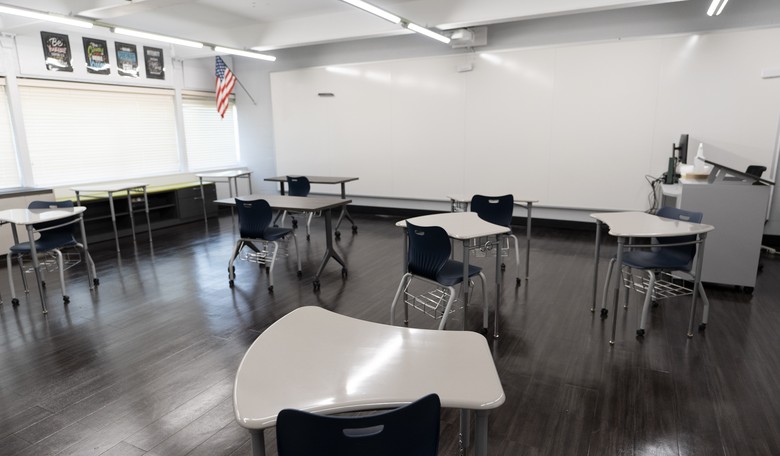
The annual back-to-school ritual this year is happening amid a rash of school closures due to empty classrooms. In California, 79 public schools closed in 2025, and, so far this year, 73 public schools have already closed.
This same pattern is occurring in other Democrat-controlled states. In Illinois, for example, 72 Illinois public schools have closed in the past five years, despite a moratorium on school closures in Chicago; among the 397 Illinois districts having at least 1,000 students, there was an enrollment decline in 345 of them between 2019 and 2025.
Led by the potential Democrat presidential candidate Gov. JB Pritzker, Illinois public schools lost 136,000 students during that six-year period. Charter schools, which the Democrats limit mostly to their constituents in Chicago, have also seen an enrollment decline as many families have moved away from the state and its liberal policies.
California’s San Jose Unified public school district has lost 22 percent of its enrollment since 2015-16, and has closed five schools entirely. Enrollment in the Los Angeles Unified has fallen by 17,000 kids in just one year, while closing or consolidating 14 public schools due to the declining number of students.
The Democrat-controlled states of New York, California, and Illinois comprise a total of 44 percent of the total decline in public-school enrollment nationwide since 2019. Only ten states – nine of them conservative including Idaho, Alabama, Texas, and Florida – had an increase or no change in public-school enrollment between 2019 and 2025.
Meanwhile, many states have begun limiting or prohibiting the use of cell phones by kids who remain in public school. Both liberal and conservative states have enacted “bell-to-bell” bans on students using cell phones while in school.
When students are glued all day to their handheld digital devices, they are not interacting with fellow students or paying attention to instruction. High-school boys are using their phones to gamble on sporting events, which is not a pathway to success.
New York, Virginia, Georgia (K-8), and Oklahoma have all enacted bell-to-bell bans on cell phone use by students at public school. Rhode Island has gone even further by prohibiting any physical access by students to personal electronic devices, with some exceptions.
The growing concern by parents about the amount of “screen time” spent by kids on electronic devices is supported by studies showing the harm. Iowa HF 2451 (which became HF 2685), proposed limiting the amount of instruction using computer screens to a maximum of 60 minutes per day through the 5th grade, but has not yet passed while other legislators in other states including New Mexico have raised similar concerns about too much screen time.
This is a sea change in public education, which embraced donations of computers such as Chromebooks as a way to supposedly make learning more efficient. Many conservatives opposed the high-tech invasion of computers into the classroom, and they were right.
Despite these growing bans, as of last year 88 percent of public schools were providing a computer to every student, as discovered by a survey conducted by the National Center for Education Statistics. In one anecdote retold by CNN, a middle school social studies teacher did not teach a single lesson the entire year, and instead had students merely doing computer-based exercises.
Chronic, substantial absenteeism has been a known problem in public schools since the pandemic, and it is hardly surprising that many students fail to show up today in schools relying on screen time. Absenteeism increases in public schools by grade level, rising from 14 percent in fifth grade to 32 percent by the twelfth grade.
Private school enrollment is increasing only where funded by school-choice programs, as in Texas where that state’s new initiative begins this month. More than 274,000 students applied for this special funding there, many of whom remain on the waiting list due to a cap in this program.
Students attending a participating private school in Texas can receive $10,500 per student annually. A homeschooled student can receive $2,000 each year in Texas, while an average of $8,000 is made available for qualified expenses to homeschoolers in Florida.
Early data indicate that roughly 36,000 of the applicants in Texas were public school students seeking to switch over to private schools through use of these new Texas Education Freedom Accounts. They can attend religiously affiliated private schools with this funding, including Muslim schools to which some Texans have objected.
Texas initially appropriated $1 billion to fund this initiative, which could be increased in its next legislative session that opens in January. Texas has a large budgetary surplus available to expand this program, if deemed successful.
Conservative North Dakota is another oil-rich state that has plenty of funds to allocate toward a school-choice program, but so far has declined to do so. The Texas experiment that starts this month could decide whether North Dakota and other wealthy states adopt a similar approach.
John and Andy Schlafly are sons of Phyllis Schlafly (1924-2016) and lead the continuing Phyllis Schlafly Eagles organizations with writing and policy work.