
For decades, the legacy civil rights establishment has relied on a rigid, predictable playbook. Whenever the economic fortunes of black Americans shift, organizations like the National Urban League instantly point their fingers at Washington. Their latest reports follow this exact script, claiming black workers have "gone backward" due to corporate rollbacks of Diversity, Equity, and Inclusion (DEI) programs and changes to federal Equal Employment Opportunity Commission (EEOC) rules. The group blames the Trump Administration.
But this obsessive focus on federal regulatory structures reveals a glaring analytical blind spot. By treating employment in the 21st century in America purely as a civil rights issue rather than an economic one, these groups ignore the real-world operational pressures facing private businesses.
The truth is that federal mandates do not sign paychecks — private employers do. And over the last 18 months, the private sector has been squeezed by a toxic combination of high interest rates and aggressive regional minimum wage hikes. Neither of these burdens is set by the White House, yet both are actively decimating the pipelines into entry-level employment for the very people these legacy organizations claim to defend.
To understand why black employment has cooled, one must look at the cost of capital and the cost of baseline labor, not corporate DEI press releases. First, consider the Federal Reserve's prolonged high-interest-rate policy. Operated independently from the White House, the Fed kept interest rates at multi-decade highs to combat persistent inflation. This policy acts as a direct chokehold on credit. Anyone who thinks the President is behind this elevated rate hasn't been paying attention.
Notably, black-owned employer firms and the commercial industries that disproportionately employ black workers — such as construction, manufacturing, and logistics — rely heavily on short-term business loans to fund operations and expand payrolls. When capital dries up, private hiring capacity collapses. Corporate DEI programs cannot save a job when a business cannot afford the credit needed to keep its lights on.
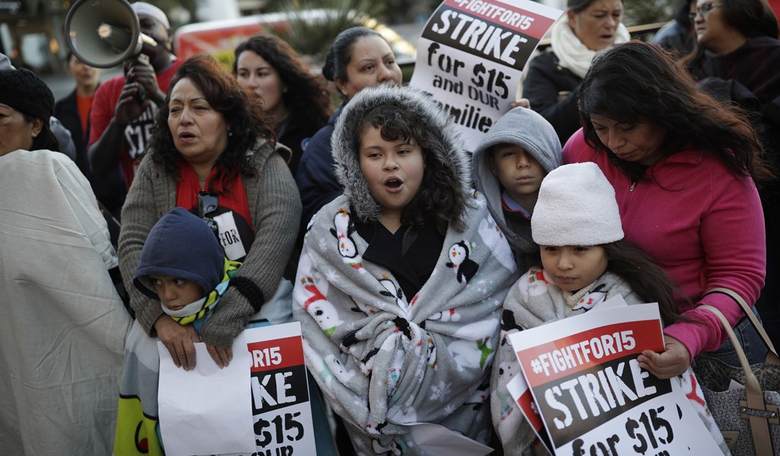
Simultaneously, a wave of aggressive, localized minimum wage spikes has hit major employment hubs across the country. Over the last 18 months, dozens of states and city councils have enacted minimum wage rates past $15, $16, and even $17 per hour. While legacy civil rights leaders applaud these mandates from comfortable boardrooms, the economic reality on the ground is devastating. These steep wage hikes occurred precisely in the high-density urban areas where black workers disproportionately reside.
In a cooling private economy, an artificial price floor does not magically guarantee higher income; in fact, it acts as a barrier to entry. When a local retail shop, restaurant, or logistics provider is forced by local politicians to pay an unsustainable baseline wage, they adapt to survive. They freeze entry-level hiring. They cut weekly shifts. They replace cashiers with automated kiosks, or they leave the area.
Data show that even a 10 percent increase in local minimum wages is associated with a noticeable drop in employment for young black men without a college degree. By forcing wages up well above market rates, local governments have locked the most vulnerable workers entirely out of the labor market. The result is the black youth unemployment rate hovering near a staggering 19 percent, according to the Bureau of Labor Statistics for July 2026.
By trying to blame the Trump Administration, the Urban League completely misses this dynamic. They treat employment as a top-down distribution mechanism managed by federal regulators. But a healthy job market is a bottom-up ecosystem driven by market demand and operational viability. When the cost of baseline labor is artificially inflated and the cost of capital is restrictively high, small and medium-sized private businesses cannot take risks on new, uncredentialed workers.
The path to genuine upward mobility for black Americans does not lie in resurrecting divisive corporate hiring frameworks or expanding EEOC reporting mandates. It lies in freeing the private sector to do what it does best: grow. True economic empowerment requires lower interest rates to unleash capital, and sensible, localized wage structures that allow young people to secure their first jobs and build vital workplace skills.
If legacy civil rights organizations genuinely care about black workers losing ground, they must stop looking for regulatory ghosts in Washington. It is time they confront the destructive regional policies and independent monetary pressures that are actually closing the doors to the American Dream.
Horace Cooper is Chairman of Project 21, a national network of black professionals dedicated to promoting market-based solutions and individual liberty