
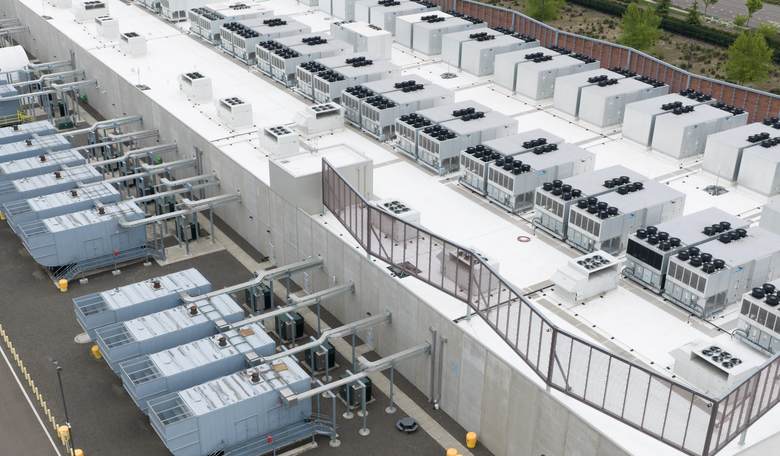
Massive 500-megawatt data centers are bringing significant economic gains to communities across the United States, directly solving many of the economic concerns plaguing average Americans.
According to a Wells Fargo Securities study, since 2024, counties hosting these large-scale data centers have seen increased housing stock, rising home values, greater job creation, and lower unemployment when compared to the national average.
Counties that build data centers are seeing new housing, higher home values, lower unemployment and more job growth… pic.twitter.com/E6OLtKLLMZ
— Sara Eisen (@SaraEisen) August 11, 2026
Since 2024, counties hosting large data centers have posted major gains across the board. Home values have climbed nearly 15 percent, well ahead of the national average of just under 10 percent. Even in counties where facilities remain under construction, home prices have risen roughly 7 percent.
The employment gains are even more striking. National job growth sits at just over one percent, but counties with data centers under construction have seen growth closer to two percent. Where massive 500-megawatt centers are already operating, job growth has reached roughly four percent, nearly four times the national rate.
Housing growth has also surged in communities with operational data centers. While the national housing-growth rate remains negative amid a broader supply shortage, housing stock in counties with active facilities has risen by nearly 50 percent. Counties with data centers still under construction have seen housing construction fall by about 10 percent, likely reflecting a short-term demand shock as workers arrive before supply catches up. Many developers, however, are investing directly in local housing to help close that gap.
The unemployment data also reinforces the consistent trend of economic gains. The national rate sits just above 4.2 percent, compared with approximately 3.9 percent in counties with facilities under construction and just 3.5 percent in counties with operational data centers.
The chart may not map perfectly onto the effects of every data center, particularly those smaller than 500 megawatts. But it does show the broader economic trend: data centers are associated with economic growth, not deprivation, in the communities that host them.
Individual cases also reinforce the point. For example, in Ellendale, North Dakota, a 400-megawatt data center has generated roughly nine times the town’s typical annual sales-tax revenue this year, helped expand the local housing stock, and brought new economic activity to a 1,100 person community that had long been overlooked.
Broader economic concerns tend to focus on the long term, especially jobs, since construction can produce only a temporary employment boost. But these massive projects in particular create several hundred permanent positions, and the data points in the same direction. As the Wells Fargo study shows, job growth in communities with operational data centers actually outpaces growth in communities where the facilities are still under construction.
Other concerns center on utility costs, particularly electricity. But the available research shows that, in communities with data centers, electricity prices either decline or rise in line with inflation.
Data centers remain deeply unpopular with much of the American public as well: over half of Americans are wary of their construction, and Democrats and Republicans alike have begun imposing moratoriums and additional approval barriers on new projects.
This lack of faith reflects a broader turn against the free market. Too many Americans appear willing to impose government control on an emerging technology in hopes of quelling fears that are often unsupported by the data.
History lands squarely on the side of innovation. The sooner the United States recognizes that, the sooner Americans can share in the economic boom that artificial intelligence, and its accompanying data centers, can bring.