
The Trump administration ran on a promise to restore the towns hollowed out by decades of offshoring and industrial decline, communities that America’s political and economic elite too often left behind. Now, the AI boom may offer those places an unexpected lifeline. Once again, it is private-sector investment, not another Washington-guided economic plan, that is creating a path toward renewed prosperity.
Ellendale, North Dakota, offers one striking example. A massive new AI data center is breathing life into the small community, bringing construction jobs, new tax revenue, and the prospect of long-term investment to a town that had largely been overlooked by the modern economy.
Everyone needs to hear this story. A data center came to a dying North Dakota town. The result? It can finally afford to repave streets, build a public-safety complex, create walking trails, and update the public school.
— Billy Binion (@billybinion) August 9, 2026
How is that bad? The data center haters should explain. https://t.co/UjKOd6zeG7
Ellendale was a sleepy North Dakota farm town of about 1,100 people, featuring a faded main street, boarded-up storefronts, an old grain elevator, a deteriorating opera house, and a hotel that was only half full on a normal weekday. The town’s annual sales-tax take was roughly $400,000.
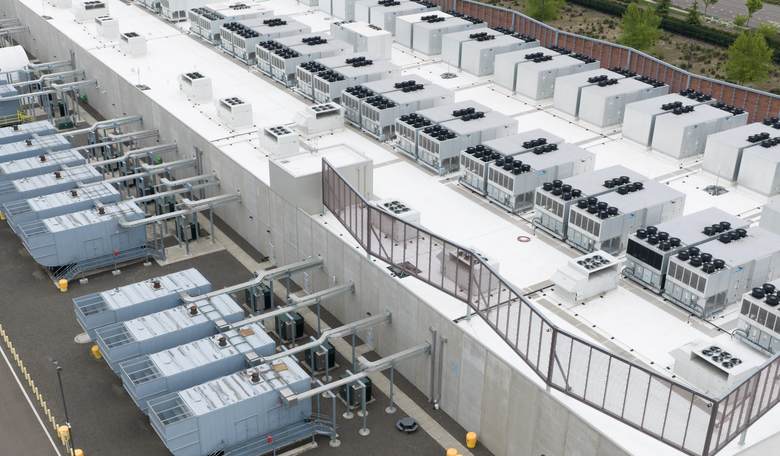
However, since 2022, where Applied Digital has been building the Polaris Forge 1 project, an approximately $11 billion, 2.5-million-square-foot, 400-megawatt data center, the town is being revitalized.
In the first seven months of 2026, Ellendale reportedly collected $3.5 million in sales-tax revenue, nearly nine times its pre-data-center annual total. Mayor Don Flaherty said the windfall would help fund long-deferred projects, including street repaving, a senior-center renovation, a new public-safety complex, walking trails, and restoration of the town’s historic opera house.
The project has also expanded Ellendale’s housing stock. With more than 2,000 construction workers arriving in the area, Applied Digital supported the development of 20 single-family rental homes and a 38-unit apartment complex intended to house incoming workers. The development was backed by $3.5 million in matching private equity from the company and a $3.5 million loan from the Bank of North Dakota.
"We were a dying little town."
— Peter J. Hasson (@peterjhasson) August 9, 2026
AI and data centers are saving the small towns everybody else left for dead -- and I hope the people trying to stop that from happening have trouble sleeping at night pic.twitter.com/tIPrZxErNt
The project is expected to deliver benefits well beyond a permanent source of tax revenue. Polaris Forge 1 will retain roughly 200 to 400 full-time workers, technicians, security personnel, facilities operators, electricians, and contractors, enough to sustain rentals, restaurants, retail shops, and local services long after the temporary construction workforce has moved on.
North Dakota’s cold climate also gives the facility a built-in economic advantage, sharply reducing cooling costs and making a long-term operation far more viable. Applied Digital says the state offers more than 220 days of “free cooling” each year, a major advantage for an energy-intensive AI facility built to run around the clock. Its constant electricity demand can also support grid upgrades and spread fixed system costs over more kilowatt-hours, possibly driving prices down for the rest of the community.
And yet, opposition to these AI data centers remains widespread, pervading both the Left and the Right, and even Texas has placed a moratorium on approving new data center construction.
Okay, so say it wasn't a data center. Say it was a new golf course. Would that be okay? It would use more water, create fewer jobs, and pay less in local taxes.
— Tom Giovanetti (@tgiovanetti) August 9, 2026
Say it was a steel mill. Say it was a refinery. Or a plastics manufacturer. Would you want that?
Do you want economic… https://t.co/JRBT5r1lJc
If a new steel mill came to town these same people would be doing somersaults. But not a data center. Oh no.
— Tom Giovanetti (@tgiovanetti) August 9, 2026
AI is poised to launch the next industrial revolution. It is time to stop treating manufacturing jobs as the only measure of economic renewal and start recognizing the opportunities created by artificial intelligence and the supporting industries that surround it.
Ellendale, North Dakota, will not be every town’s story. But it shows what is possible when private investment and new technology reach communities too often left behind: a larger tax base, new infrastructure, new housing, and a renewed sense that a town’s best days need not be in its past.
Opposition to AI is too often opposition to that possibility. America has repeatedly achieved more through private enterprise, innovation, and free markets than through government-directed revitalization schemes. The task is not to block the future, but to make sure more communities have the freedom and capacity to benefit from it.
Data centers have become a convenient scapegoat for problems policymakers should have addressed long ago.
— 𝗝𝗲𝗿𝗮𝗺𝘆 𝗗. 𝗞𝗶𝘁𝗰𝗵𝗲𝗻 (@JeramyKitchen) August 9, 2026
- Grid capacity? Build infrastructure.
- Water scarcity? Fix water policy.
- Transmission costs? Make those creating the costs bear them.
- Corporate welfare? End it for… pic.twitter.com/cysRV0dmI7