
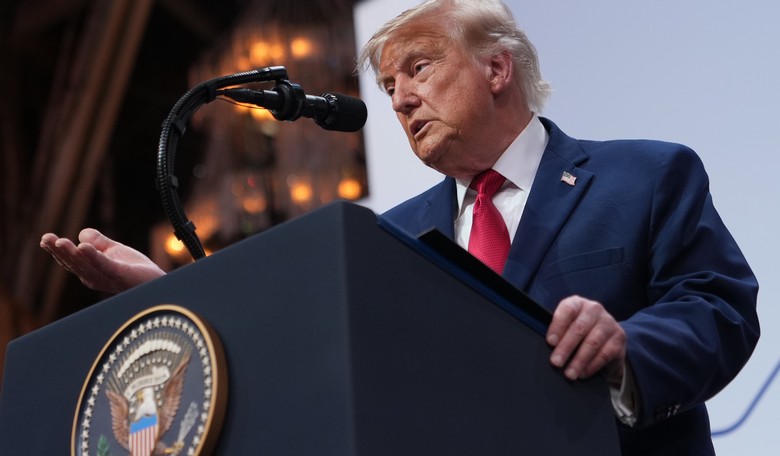
President Trump refused to confirm Thursday whether he has settled on a political successor, as a report from the Washington Post indicated he may be leaning toward Vice President JD Vance over Secretary of State Marco Rubio.
Q: There's report that you told donors that they need to get J.D. Vance elected in 2028. Is that your official endorsement?
— Acyn (@Acyn) August 6, 2026
Trump: No. I heard about it a little while ago. I think he's great. We're way too early to be think being that. pic.twitter.com/fuvLJe7JOI
"There's report that you told donors that they need to get J.D. Vance elected in 2028," a reporter said, Thursday. "Is that your official endorsement?"
"No," the president said. “I heard about it a little while ago. I think he’s great, but we’re way too early to even be thinking about that."
The Washington Post reported Thursday that Trump told donors during a private Oval Office meeting, “At the end of the day, we need to elect JD.” While he has still not made a definitive choice, Vice President Vance is a natural successor to Trump and remains the early favorite to inherit much of the president’s MAGA coalition.
Still, Trump’s final endorsement is decisive. The president has kept his options open between Vance and Secretary of State Marco Rubio, and both remain close allies. If Trump ultimately chooses Rubio, much of the MAGA movement would likely coalesce behind him.
BREAKING: Marco Rubio’s 2028 Republican nomination odds dip following reports Trump is leaning toward JD Vance as his preferred successor.
— Polymarket (@Polymarket) August 6, 2026
24% chance. pic.twitter.com/i9ZVwjIvu0
The decision between Vance and Rubio is not just pivotal for who carries the MAGA torch forward; it is set to determine what American conservatism means after Trump.
Vance and Rubio remain allies, unified behind President Trump, but they represent different instincts within the movement. Vance has generally favored a more restrained foreign policy and has been more willing to embrace protectionism and government-directed industrial policy, an economic approach that remains separated from the free-market conservatism of the Reagan era. Rubio, by contrast, has built his career around a more hawkish, internationally engaged vision of American leadership abroad, though he has also begun to adopt elements of Trump’s economic nationalism in a more restrained manner.
In that sense, Vance resembles a modern Richard Nixon: nationalist, skeptical of global commitments, and willing to use government power to shape the economy. Rubio more closely resembles a modern Reagan: outward-looking, more committed to American strength abroad, and more closely associated with the traditional conservative case for liberty, markets, and national leadership.
As 2028 gets closer, conservatives need to take seriously where they want Republicanism to go in an era no longer defined by President Trump’s active leadership. That decision may prove even more consequential than Trump’s first victory in 2016.