
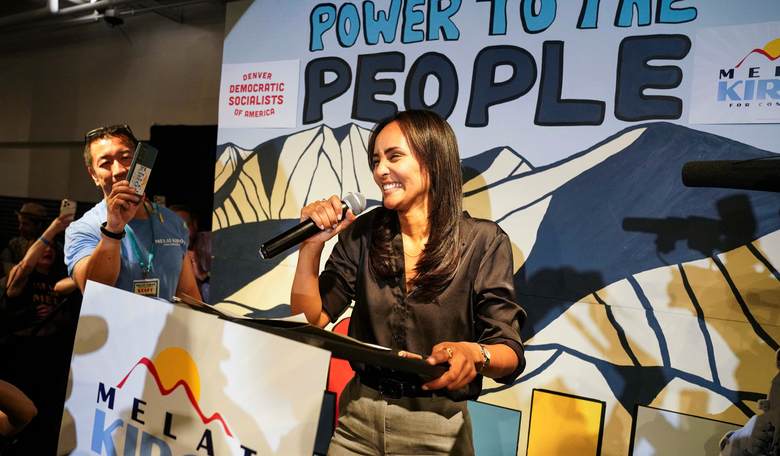
“There's nothing more American than socialism.”
That was Colorado Democrat and congressional candidate Melat Kiros on a PBS interview Monday, where she told Margaret Hoover that socialism, not capitalism, best fulfills the Declaration of Independence’s promises of life, liberty, and the pursuit of happiness. She argued that workers have no real say under capitalism and described the system not as a marketplace of competition, but as one of monopoly.
The irony is stark. For someone so eager to denounce monopoly, Kiros seems unlikely to confront the largest one of all: government’s monopoly over labor, consumption, and production.
Colorado socialist Melat Kiros: The evidence shows there's nothing more American than socialism, it's actually capable of delivering life, liberty, and the pursuit of happiness.
— Defiant L’s (@DefiantLs) August 4, 2026
pic.twitter.com/eVHMAn0rv9
"I don't think there's anything more American than subscribing to an economic philosophy that, as the evidence shows, is the only one that's actually capable of delivering things like life, liberty, and the pursuit of happiness," Kiros said. "I really can't think of anything else."
"You know, when we talk about capitalism, you know, one of the things that folks talk about with capitalism as a theory is that it's responsible for, you know, delivering people out of poverty here in the US," she continued. "Which isn't the entire story. At the same time that a lot of folks were getting delivered out of poverty, there were a lot of social safety programs that were also being created at the same time. A lot of fair labor laws that were being enacted. You know, rights that workers were taking back to make sure that they were not working in unsafe conditions, to make sure that they were earning fair wages. That is not capitalism, right?"
"Socialism is about delivering democracy in the workplace and making sure that workers have a say about the conditions that they're working in, about negotiating for the kind of wage that would be fair for the labor that they are contributing to whatever industry it is that they're working in. And I also think that, you know, when folks think of capitalism, I think they think of free markets and competition and, you know, innovation."
"What do you think of?" Hoover asked.
"I think of monopolies."
There's a lot to address.
First, yes, social safety nets expanded alongside U.S. industrialization, but to claim they were the engine of prosperity is nonsense. In too many cases, government didn’t civilize capitalism; it actually warped it. Subsidies dulled the discipline of private enterprise, rewarded businesses that were best at chasing favors rather than serving workers, and helped create the very corporate monster critics now point to as proof that free markets failed.
However, the more urgent point is monopoly. Socialists regularly argue that private enterprise naturally ends in monopoly rather than competition, and then use that claim to dismiss the entire system as ineffective. But that argument ignores the real monopoly at the center of the economy: government.
Too often, socialists focus only on production, even though in most cases the free market is still doing the producing. But if private enterprise no longer seems to serve its customers, it’s worth asking why. In healthcare, government accounts for roughly 40 percent of revenue and that translates to about 40 percent of the customer base. In higher education, it makes up about 35 percent of customer demand and in housing, it represents roughly 13 to 15 percent of the customer base. That is a massive share of consumption in some of the country’s most expensive industries.
Labor tells a similar story. Groups like teachers, government workers, utility workers, and construction workers often hold highly concentrated bargaining power, and the unions that represent them end up catering to insiders rather than workers as a whole. Too often, unions stop fighting for labor broadly and start protecting those already inside the gate, functioning less like advocates for open opportunity and more like monopolies that keep others from breaking in.
And as for production, no one has yet pointed to a genuine monopoly that wasn’t built, protected, or supercharged by government in the first place.
Now to Kiros’ broader claim that “there’s nothing more American than socialism”: it’s a claim that collapses the moment you look at how socialism actually works. Whatever label the DSA wants to put on it, socialism depends on force, forcing taxpayers to subsidize industries, bankroll safety nets and welfare programs, impose wage controls, and direct private enterprise toward political ends that the DSA deems virtuous.
When the Declaration of Independence says mankind has a right to the pursuit of happiness, it acknowledges something important: that happiness looks different for everyone. That is exactly why this country was built on a doctrine of freedom, on keeping government out of the way, and letting individuals make their own choices about what a good life actually looks like. The only economic system that has ever truly matched the government our Founders built is the free market. It always has been. It always will be.