
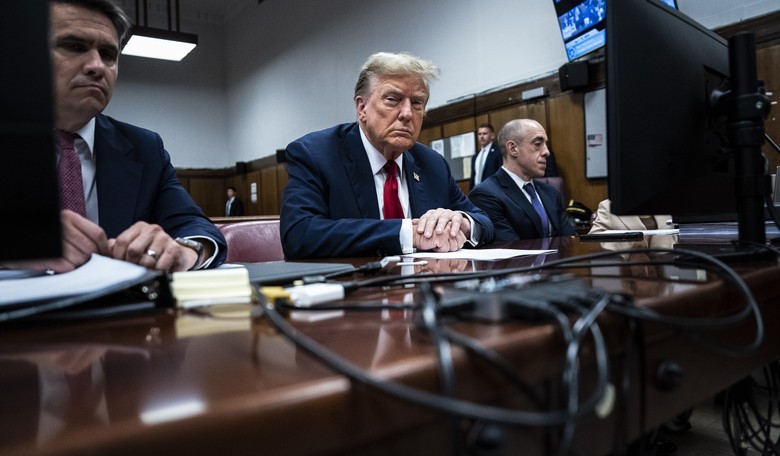
Monday saw the beginning of Trump's "hush money" trial involving Michael Cohen and Stormy Daniels in New York City, and jury selection has proven even more fraught a process than some expected after the first day. At the conclusion of the first round of the process, more than half the prospective jurors from the first pool of 96 to be selected — out of the 200 total called on Monday — had been excused after telling the court they were unable to be fair and impartial in weighing the evidence set to be presented at trial.
The potential jurors who did not self-identify as being unable to serve on the jury next face 42 multi-part questions before the court as the judge and attorneys for both sides consider each potential juror's answers.
The first few questions posed to potential members of the jury are biographical and relatively generic:
- "Without telling us your address, in what neighborhood to you live?"
- "What do you do for a living?"
- "Who is your current employer?"
- "What is your educational background?"
- "Are you married?"
- "If you have adult children, what do they do?"
- "What do you like to do in your spare time?"
- "Do you participate in any organizations or advocacy groups?"
- "Have you ever served on a jury before?"
The next portion seeks to elicit more information about how and from where a juror gathers information and news. "Which of the following print publications, cable and/or network programs, or online media such as websites, blogs, or social media platforms do you visit, read or watch?" the questionnaire probes. Among the options for potential jurors are the New York Times, Wall Street Journal, New York Post, Huffington Post, CNN, MSNBC, Fox News, Newsmax, Truth Social, Facebook, X, amd Tik Tok (sic).
Potential jurors are also asked open-ended questions about which podcasts they watch or listen to and what, if any, talk radio programs they consume.
The following section seeks more information about the potential jurors' past experience or knowledge of law enforcement, the criminal justice system, or the legal field. Questions include whether the potential juror, their relative, or "a close friend" has been the victim of a crime; employed by a law enforcement agency or by a government entity; employed in the accounting or finance field; interacted with the criminal justice system; or accused and/or convicted of a crime.
Potential jurors are also asked point-blank whether they "have any political, moral, intellectual, or religious beliefs or opinions which might prevent you from following the Court's instructions on the law or which might slant your approach to this case."
Moving on to the mechanics and demands of sitting as a juror in the trial, the questionnaire asks about any health conditions that "might interfere" with a potential juror's ability to be at the courthouse, whether they take any medications that would prevent them from being able to concentrate during proceedings and deliberations, and if they practice a religion that would prevent them from sitting as a juror on particular days/evenings.
Again, potential jurors face a blunt question: "Can you give us an assurance that you will be fair and impartial and not base your decision in this case upon a bias or prejudice in favor of or against a person who may appear in this trial, on account of that person's race, color, national origin, ancestry, gender, gender identity or expression, religion, religious practice, age, disability, sexual orientation or political views?"
Potential jurors are also asked if they can "promise to guard against allowing stereotypes or attitudes about individuals or about groups of people, referred to as an implicit bias, influence your decision?"
Moving on to very specific questions dealing with the case and its key players, potential jurors will answer a series of questions about knowledge of or experience with Donald Trump and his circle:
- "Have you, a relative, or a close friend ever worked for any company or organization that is owned or run by Donald Trump or anyone in his family?"
- "Have you, a relative, or a close friend ever worked or volunteered for a Trump presidential campaign, the Trump presidential administration, or any other political entity affiliated with Mr. Trump?"
- "Have you ever attended a rally or campaign event for Donald Trump?"
- "Are you signed up for or have you ever been signed up for, subscribed to, or followed any newsletter or email listserv run by or on behalf of Mr. Trump or the Trump organization?"
- "Do you currently follow Donald Trump on any social media site or have you done so in the past?"
- "Have you, a relative, or a close friend ever worked or volunteered for any anti-Trump group or organization?"
- "Have you ever attended a rally or campaign event for any anti-Trump group or organization?"
- "Are you signed up for or have you ever been signed up for, subscribed to, or followed any newsletter or email listserv run by or on behalf of any anti-Trump group or organization?"
- "Do you currently follow any anti-Trump group or organization on any social media site, or have you done so in the past?"
- "Have you ever considered yourself a supporter of or belonged to any of the following:
- the QAnon movement
- Proud Boys
- Oathkeepers
- Three Percenters
- Boogaloo Boys
- Antifa"
There are still more questions:
- "Do you have strong opinions or firmly held beliefs about whether a former president may be criminally charged in state court?"
- "Do you have any feelings or opinions about how Mr. Trump is being treated in this case?"
- "Do you have any strong opinions or firmly held beliefs about former President Donald Trump, or the fact that he is a current candidate for president that would interfere with your ability to be a fair and impartial juror?"
- "Can you give us your assurance that you will decide this case solely on the evidence you see and hear in the courtroom and the law as the judge gives it?"
The potential jurors are also asked whether they've read or listened to books and podcasts from Michael Cohen and Mark Pomerantz including "Disloyal: A Memoir," "Revenge," the "Mea Culpa" podcast, or "People Vs. Donald Trump." In addition, the pool must answer whether they've read or listened to audiobooks from Donald Trump.
The final questions rounding out the lengthy questionnaire include:
- "Do you have any opinions about the legal limits governing political contributions?"
- "Can you promise to set aside anything you may have heard or read about this case and render your verdict based solely on the evidence presented in this courtroom and the law as given to you by the judge?"
- "Can you give us your absolute assurance that you will refrain from discussing this case with anyone in any manner and from watching, reading, or listening to any accounts of this case during the pendency of the trial?"
- "Can you assure us that you will follow the judge's instructions on the law, including instructions on the definition of reasonable doubt and the presumption of innocence?"
- "If Mr. Trump chooses not to testify or to introduce any evidence, can you give us your assurance that you will not hold that against him?"
And, finally, the last question: "Is there any reason, whether it be a bias or something else, that would prevent you from being fair and impartial if you are selected as a juror for this case?"
It's expected that the process of selecting the final 18 members — 12 jurors and six alternates — will take one to two weeks. If Monday was merely a preview of what's to come, this may be more of a spectacle than expected before a single witness is sworn in to testify.