





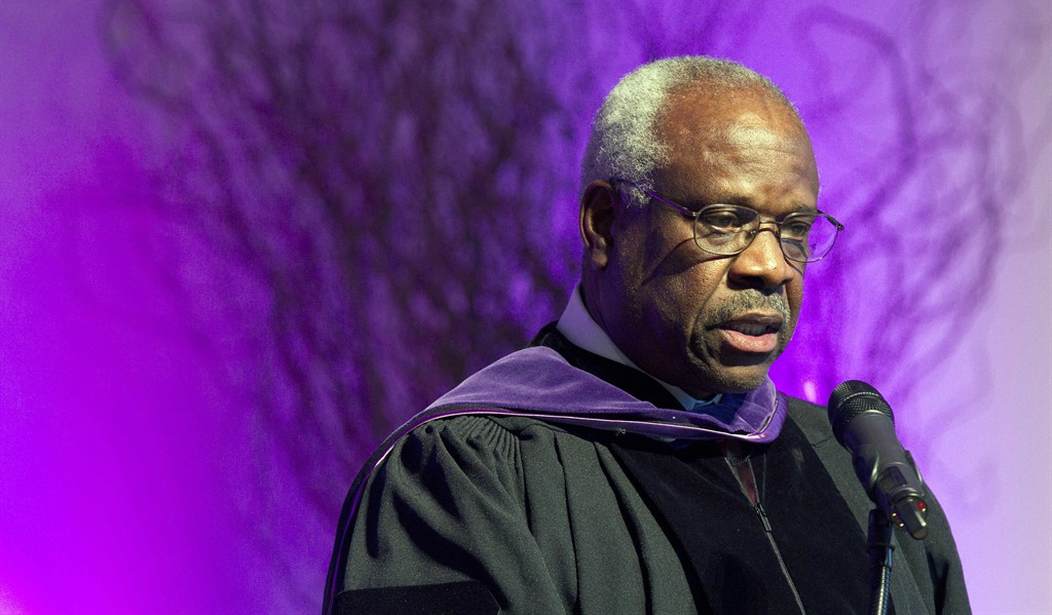
With the passing of Justice Antonin Scalia, it seems as if Clarence Thomas feels compelled to fill the void left by the outspoken Originalist. Prior to Justice Alito’s confirmation, Justice Thomas and Scalia constituted the core of the conservative win on the Court. Adam Liptak of The New York Times reported that Thomas has remained silent since a 2006 case involving the death penalty. Liptak added that Thomas is self-conscious about his southern dialect, but added that his silence is also part of his personality; Thomas wrote in his memoir that he was quiet undergraduate and law school student. But not today–he finally asked some questions in a domestic abuse case:
Breaking a decade-long silence, Justice Clarence Thomas on Monday asked several questions from the Supreme Court bench. He spoke just weeks after the death of Justice Antonin Scalia, whose empty seat next to Justice Thomas’s remains draped in black.It was hard to escape the conclusion that the absence of the voluble Justice Scalia, who had dominated Supreme Court arguments, somehow liberated Justice Thomas and allowed him to resume participating in the court’s most public activity.
The questions came in a minor case on domestic violence convictions and gun rights. Justice Thomas, according to the few reporters in the courtroom, asked a question about whether such convictions suspend a constitutional right.
SCOTUSblog had a rundown of that case called Voisine v. United States that once again deals with domestic abuse charges and the forfeiture of one’s Second Amendment rights:
Whether a prior conviction for a “reckless” domestic assault qualifies as a federal “misdemeanor crime of domestic violence” is, for defendants in the thirty-four states that have reckless assault statutes, not an unimportant question. Such a conviction leads to a ban on firearms possession under federal law and raises the possibility of a ten-year sentence for those who violate that prohibition. But the convoluted path through statutory and common-law precedents required to answer the question is somewhat of a snoozer.[…]
Let’s start with the undisputed facts. The cases of Stephen Voisine and William Armstrong have been consolidated for this argument, but are otherwise unrelated. Both men pled guilty, on different occasions, in Maine’s state courts to different misdemeanor assaults on their domestic partners (girlfriend and wife, respectively). Some years later, they were each found in possession of a firearm – six guns in Armstrong’s case, during a search of his home for drug distribution; and a rifle in Voisine’s case after he shot a bald eagle.
Charged with the federal offense of “domestic abuser in possession” (my words, not the statute’s), both men lost motions to dismiss the charges, based on the same argument: that their prior assault convictions did not meet the definition of “misdemeanor crime of domestic violence” because the applicable Maine statute broadly permits a conviction for “intentional, knowing, or reckless” assaults and their indictments did not specify which type of intent they actually had. Both men then pled guilty conditionally (meaning that they preserved their legal argument for appeal) to the federal charge of possessing a firearm after their prior domestic violence convictions. The First Circuit affirmed.

Join the Conversation
VIP members get the ability to comment on articles.