
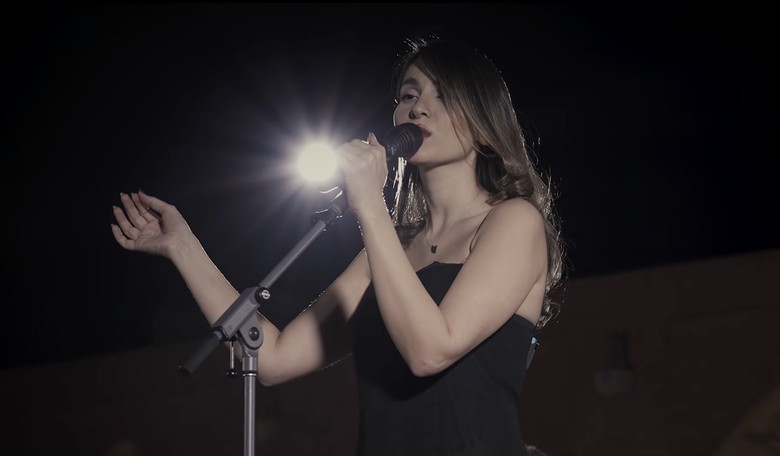
What kind of medieval dictatorship takes a whip to the back of a young woman because she dared to sing? What grotesque distortion of religious faith enables judges to order the physical torture of musicians for entertaining their fellow citizens? Welcome to the Islamic Republic of Iran, where the clerical establishment regards the sound of a woman’s singing voice as a threat to public morality.
On Monday, November 23, Iranian singer Parastoo Ahmadi was subjected to 74 lashes. Four male members of her concert team suffered the same barbaric punishment. Between them, these five artists received 370 lashes. Their crime? Performing a concert in December 2024 at the historic Deir-e Gachin caravanserai near the holy city of Qom, during which Ahmadi wore an elegant black evening dress and left her hair uncovered.
The concert, performed without a live audience and subsequently viewed more than three million times on YouTube, was a beautiful celebration of Iranian music and cultural heritage. Yet the judiciary deemed it obscene and immoral. The authorities also imposed a two-year prohibition on artistic activities and foreign travel, effectively robbing these talented people of their livelihoods.
The hypocrisy is breathtaking. Just 48 hours before Ahmadi was flogged, male singers were being honoured for their musical achievements at the prestigious Hafez Arts Ceremony in Tehran. They walked the red carpet, basked in the applause of their admirers, and received accolades for exercising the very artistic talents for which their female colleague was about to be whipped.
Angry Iranians took to social media, castigating male award recipients for their apparent silence and failure to demonstrate solidarity with Ahmadi. While speaking out carries considerable personal risks in Iran, some musicians have shown remarkable courage. Mehdi Yarrahi publicly expressed his solidarity, while musician Hana Kamkar courageously condemned the punishment. Their example deserves recognition.
When Ayatollah Ruhollah Khomeini hijacked the popular revolution of 1979, Iranian women were among his first victims. Within weeks of the overthrow of the Shah, thousands of women took to the streets of Tehran to protest against compulsory veiling. They understood, perhaps more clearly than many of their male compatriots, the nature of the tyranny descending upon their country.
Female singers were effectively prohibited from performing solo before mixed audiences. Women who had enjoyed celebrated musical careers found themselves silenced. Googoosh, one of Iran’s most beloved performers, remained in her homeland for more than two decades before eventually resuming her international career in 2000. An entire generation of Iranians was deprived of the opportunity to hear one of their greatest cultural icons perform in public.
Almost half a century later, this obsession with controlling women continues to manifest itself in acts of astonishing cruelty. In 2014, six young Iranians who appeared in a video dancing to Pharrell Williams’s internationally popular song “Happy” received suspended prison sentences and sentences of 91 lashes. Their apparent offense was to demonstrate that young Iranians could experience the same innocent pleasures as their contemporaries elsewhere in the world. In January 2024, Roya Heshmati was subjected to 74 lashes after publishing a photograph of herself without the compulsory hijab. In March 2025, Mehdi Yarrahi received 74 lashes after releasing a song encouraging Iranian women to remove their headscarves. His crime was solidarity with women.
Perhaps the most internationally recognized victim of this institutionalized misogyny was Jina Mahsa Amini, the 22-year-old Kurdish Iranian woman who died following her arrest by the morality police in September 2022, for an alleged infringement of the compulsory dress code. Her death ignited a nationwide uprising under the inspirational slogan “Woman, Life, Freedom.” The authorities responded with lethal violence, mass arrests, torture, and executions. United Nations investigators subsequently concluded that some of the violations committed during the suppression of those protests amounted to crimes against humanity, including gender persecution.
During my 15 years in the European Parliament and throughout more than two decades of campaigning for human rights in Iran, I have witnessed the extraordinary courage of Iranian women. From political prisoners to students, teachers, musicians, and mothers demanding justice for their murdered children, women have repeatedly placed themselves at the forefront of resistance to oppression. The compulsory hijab has become an instrument of political domination. The issue is freedom of choice. A woman who elects to wear a veil deserves precisely the same respect and protection as one who chooses to leave her hair uncovered. Religious freedom becomes meaningless when religious observance is enforced with a whip.
International cultural organizations, recording companies, and celebrated musicians should lend their voices to their persecuted Iranian colleagues. Where are the expressions of outrage from the global music industry? Imagine the international uproar if a celebrated Western female singer were publicly sentenced to 74 lashes for performing with her hair uncovered. There can be no religious, cultural, or geographical exemption from the fundamental prohibition of torture. Persia gave civilization some of its greatest poets, philosophers, artists, and musicians. How tragic that this magnificent cultural legacy should be held hostage by men who consider a woman singing more offensive than a woman being flogged.
In Tehran on Saturday, there were trophies and applause. In Qom on Monday, there was a whip. Those two events encapsulate the appalling discrimination endured by Iranian women under clerical rule. Parastoo Ahmadi deserves a standing ovation. Those who ordered her flogging deserve to face justice. The international community must ensure that the sound which echoes around the world following this appalling episode is neither the crack of a whip nor the silence of diplomatic indifference, but the collective voice of humanity demanding freedom, dignity, and equality for the women of Iran.
Struan Stevenson was a member of the European Parliament representing Scotland (1999-2014), president of the Parliament's Delegation for Relations with Iraq (2009-14), and chairman of the Friends of a Free Iran Intergroup (2004-14). He is an author and international lecturer on the Middle East.