
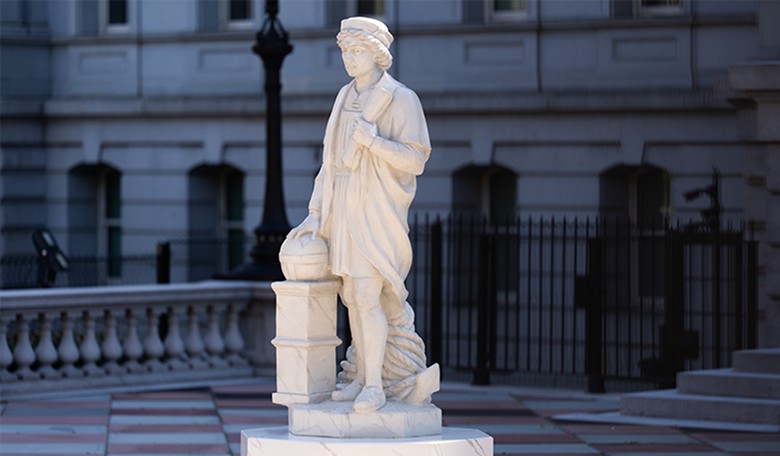
Columbus Day is a holiday worth keeping and honoring as a great American holiday, for Columbus was the first seafaring explorer to cross the Atlantic Ocean from Europe and discover the continent that would later host colonies that became the foundation of the United States.
We know a lot about Columbus — what he thought and what he did — because he kept voluminous diaries and logbooks that have been preserved. From these sources, we know that he was a highly motivated Christian. In fact, he chose to call himself Christopher Columbus because he liked what this name meant. In Latin, Columbus means dove while Christopher means Christ-bearer.
Columbus found identity and purpose in the Bible. He recorded passages from Scripture in his journal that he felt God was pointing him toward, and this became what he called his “Book of Prophecies.” Columbus believed that the Lord spoke to him in Jeremiah 1:5, which he recorded in his Book of Prophecies: “Before I formed you in the womb I knew you, and before you were born, I consecrated you; I have appointed you a prophet to the nations.” Isaiah 42:1-7 also came especially alive to Columbus, as it projected that he would be “a light to the nations, to open blind eyes,” and that the light would go to “the islands” of the sea.
Columbus became a seafarer early in life, serving as crew on many ships, flagged from different countries. On one of the cargo ships on which he served, he encountered and was deeply affected by the militant face of Islam at the eastern end of the Mediterranean that created a blockade to Europe’s important trade with the Orient. It was then that Columbus felt God’s conviction to find a western sea route, knowing it would have far-reaching benefits. In his Book of Prophecies, Columbus records it this way: “I could sense His hand upon me… so that it became clear to me that it was feasible to navigate from here to the Indies, and He gave me the will to execute the idea.”
Modern-day secular revisionist historians have, not surprisingly, sought to discredit Columbus, even taking a chapter out of Lenin in charging him with being an imperialist. Others blame Columbus for unfair treatment of the various indigenous peoples without considering that it wasn’t so much Columbus, but the mix of his Spanish machismo crew encountering ruthless indigenous tribes that included cannibals and the warrior culture of the Aztecs that contributed to the strong force needed to survive.
Columbus never set foot on or even saw any territory that later became part of the continental United States, having made four expeditions to the New World between 1492 and 1504 that were focused exclusively on Caribbean islands and territories which are now Latin America — Central America and South America. The primary legacy of Columbus was that, in discovering the New World, he opened the door to exploration and colonization of those new territories by Europeans who followed.
Columbus faced death numerous times. When the Flemish-flagged ship on which he was crew was attacked and sunk off the coast of Portugal, he survived by sheer determination, clinging to a floating oar and kicking his way to shore some five miles away. For a seafarer with his ambition and vision, there was no better country on which to wash up than Portugal, a nation with the world’s most advanced tools of navigation and map-making. There he learned about celestial navigation, and gained further confidence to sail west “around” the world to India and the Spice Islands.
Recognizing the cost of undertaking such a voyage required state sponsorship, Columbus spent the next six years traipsing across Europe seeking support from sovereigns of the leading maritime countries, only to find rejection and ridicule. Queen Isabella and King Ferdinand of Spain had turned down Columbus several times. But because of his Christian faith, seafaring skills, and conviction about finding a westward passage, and his brave willingness to lead an armed flotilla to rescue the Church of the Holy Sepulcher from Muslim hands in the eastern Mediterranean, they had a change of heart toward Columbus.
Few years in history have been punctuated by such pivotal events as what happened in 1492. It was in that year that Christendom — still suffering from the loss of Constantinople to the Muslim Turks 40 years prior — drove Islam out of Spain and Europe, with Isabella and Ferdinand playing the pivotal role. They then decided to support Christian expansion and finance the exploration and evangelistic expedition of Columbus.
At the beginning of his first voyage with three ships — the Niña, Pinta, and Santa Maria — after being at sea for two months, Columbus faced an anxious crew, who believed landfall should already have been made weeks before. When they became mutinous and threatened to heave Columbus overboard if he did not agree to turn back, Columbus turned to God. In his diary, Columbus recorded that God inspired him to make a deal with his Spanish crew and stake his life on it. He asked for three days, and if land was not sighted, the crew could do with him as they wished.
As Providence would have it, in the early morning hours of the third day, October 12, under the light of the moon and the stars, the lookout from the ship Pinta shouted out the sighting of land. Assuming it was an island to the east of India or China, Columbus had no idea that he was about to discover a new part of the world — the island outskirts of a massive continent — far from the Orient.
Columbus’s perseverance and courage in this first transatlantic crossing and three subsequent crossings inspired successors from northern Europe who had been transformed by the Protestant Reformation with the ideas of equality and freedom. They would set out to pursue a new life in that New World, establishing thirteen different colonies in coastal North America.
Suffering injustice from Great Britain many years later, those colonists reluctantly banded together to fight for independence. Over the eight years of the Revolutionary War, they lost more battles than they won. But like the course of Columbus, George Washington’s persistence, courage, and faith in God empowered an under-equipped and underfunded colonial army to get to final victory and achieve independence. That in turn enabled the founding of a new nation, unlike any other — one based on the revolutionary idea that people’s life, liberty, and pursuit of happiness were inviolable because those rights came from God and not the state.
Seen from the big picture, Columbus Day is worth keeping and honoring because it remains foundational to the establishment of a new nation by people who shared the core beliefs, and the qualities of character exhibited by Columbus.
In short, Columbus Day commemorates the qualities of character and spirit of freedom and adventure that are unique to America.
Scott S. Powell is a senior fellow at Discovery Institute, the Institute for Faith and Culture and a member of the Committee on the Present Danger-China. His forthcoming book, 1776 Rising: America’s Second War for Independence, is scheduled for release at the end of October. https://www.amazon.com/dp/1637581599. Reach him at scottp@discovery.org