
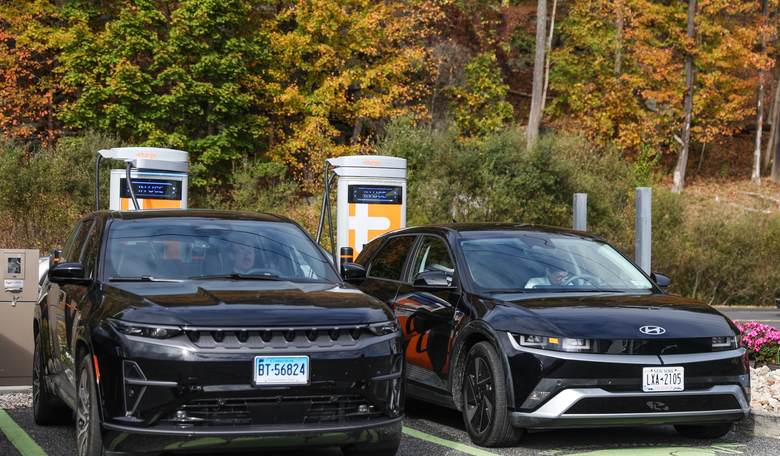
In a far-reaching move, on September 28, President Donald Trump’s Environmental Protection Agency (EPA) rescinded a rule enacted under President Biden to force drivers into electric vehicles.
As part of Biden’s “whole of government approach” to fight climate change, the EPA effectively banned whole classes of cars and trucks by imposing stronger fuel economy standards that would have been impossible to meet for most automobiles powered by internal combustion engines.
As written, Biden’s rule would have required vehicle fleets to get more than 50 miles per gallon (MPG) equivalent by 2031, up from the 30.1 MPG standard today. By the Biden EPA’s own estimate, the rule would effectively have required 26 percent in 2027, and 56 percent of new vehicles sold in 2032 to be EVs.
Yet, even with government subsidies for the purchase of EVs and for EV infrastructure like charging stations, currently, EVs only account for 7.3 percent of new car sales. EPA projected that the rescinded rule would have drastically reduced the availability of gasoline- and diesel-fueled cars and trucks, hybrids, and plug-in hybrids, which together currently make up 92.7 percent of the market, to just 29 percent of sales by 2032.
Aside from the loss of choice, the Biden rules would have increased the costs of remaining vehicles dramatically. EVs already cost thousands more than comparable fossil fuel-powered vehicles. That rule wouldn’t have made EVs cheaper, but it would have added thousands of dollars to the cost of new non-electric vehicles.
Trump’s action changes all that. It did not rescind CAFE standards entirely; he couldn’t do that if he wanted to because they are codified into law. So, EPA under Administrator Lee Zeldin dramatically reduced future increases in fuel economy standards, from 50.4 MPG by 2031 to 34.9 MPG.
This is a good start. It should maintain consumer choice concerning the types of features cars and trucks have and the types of vehicles sold. Under Trump’s rule, if fuel economy is not one’s most important factor when buying a new car or truck, they can still purchase an SUV, car, or truck.
Congress should never have gotten into the business of setting fuel economy standards. It was an inept attempt to reduce dependence on foreign oil, primarily from the Middle East, in response to the 1973 Arab oil embargo. The belief was that if you forced automakers to produce more fuel-efficient cars, people would use less gas, and oil imports would fall.
What happened was that automakers began to make fuel-efficient cars and ended production of certain types of vehicles that people liked, like muscle cars, station wagons, and hybrid trucks/cars. Those who purchased fuel-efficient cars wound up driving more miles because driving became cheaper, and a new class of vehicles was born: minivans and four-door trucks. Imported oil did not fall but rather increased, until nearly 40 years later during Trump’s first term when he took steps to expand production and put America on the path to energy dominance.
Station wagons virtually disappeared from the market, replaced by the newly created CAFE minivan, which was counted as a light truck with lower fuel economy standards. Truck appearances also dramatically changed, with two-door trucks declining and four-door trucks topping the sales charts virtually overnight, as people voted with their wallets for vehicles with power, utility, comfort, and amenities, regardless of fuel economy.
To the extent that fuel economy is a person’s prime consideration when they buy a vehicle, there are more than 40 models sold in the United States available today that get 40 mpg or more. Only two of those vehicles are in the Top 10 in sales. None of the vehicles that get more than 50 mpg are in the top 10 in sales. On the other hand, five of the top 10 are full-sized pickup trucks and three are SUVs or crossovers.
Worse than the government substituting its judgment of what people should care about when they choose a vehicle was the fact that the government’s CAFE standards wound up killing people. To improve fuel economy, automakers primarily reduced the size and weight of vehicles. Unfortunately, this downsizing had tragic consequences. Since the laws of physics have not changed, by putting more people in smaller, lighter vehicles, at least tens of thousands of people have been put at risk of injury and death each time CAFE standards are increased.
For example, the National Academy of Sciences estimated 1,300 to 2,600 additional deaths per year were caused by vehicle downsizing. Research by Harvard and the Brookings Institution put that figure higher still, estimating that every 100-pound weight reduction adds 2,200 to 3,900 fatalities per model year over a decade of driving. Whereas the Competitive Enterprise Institute attributed 2,600 to 4,500 deaths each year to fleet weight limits. Over the decades of its existence, the CAFE mandates have killed more Americans than all wars from Vietnam to the present combined.
As a result, by slowing, and one might hope, ending future CAFE standard increases, the Trump administration is not just saving consumers dollars and choices, but it is literally saving lives. Thanks, President Trump, for putting Americans’ freedom of choice and lives first.
H. Sterling Burnett, Ph.D. (hsburnett@heartland.org) is the Director of the Arthur B. Robinson Center on Climate and Environmental Policy at The Heartland Institute, a nonpartisan, non-profit research organization based in Illinois.