
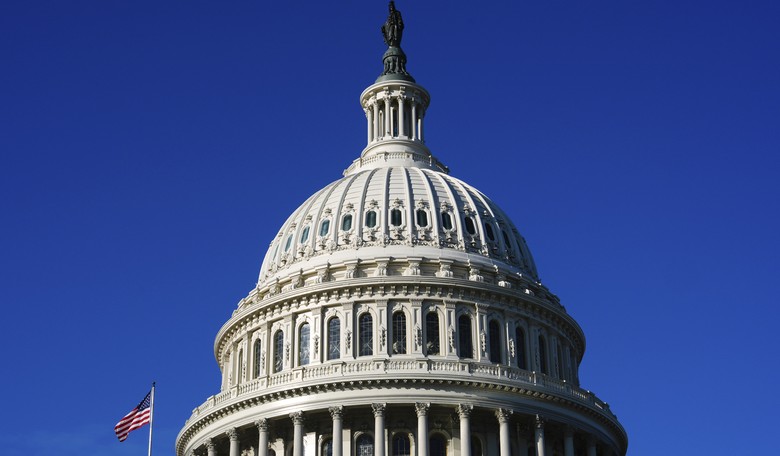
The House voted this week to make President Trump's National Fraud Enforcement Division a permanent fixture of the Justice Department.
352 to 72.
I stared at that number for a minute.
Seventy-two?
More than 140 House Democrats crossed the aisle to vote yes. Minority Leader Hakeem Jeffries among them. A supermajority, bipartisan, on the record, voting to keep a fraud-fighting division in place permanently.
And still. Seventy-two votes against it. Every single one of them Democrats.
The bill itself, H.R. 9576, establishes the National Fraud Enforcement Division of the Department of Justice — codifying into law a division President Trump first announced in January and the Justice Department formally established in April. Its highest-profile early target happened to be Minnesota, where Vice President JD Vance referred Gov. Tim Walz and Attorney General Keith Ellison to the division over a fraud scandal in the state's social welfare programs — a scandal serious enough that both men have already acknowledged taxpayer dollars were exploited, even while insisting Republicans oversold the scope of it.
They didn't deny the fraud happened. They disputed how loudly it should be discussed.
That's Minnesota's problem to sort out in court. Washington's problem is a little simpler: does the federal government keep a dedicated unit chasing fraud, or does it let the position lapse the moment it becomes politically inconvenient?
Raskin voted yes. Sort of.
He called it "tepid support," which is a strange thing to call a yes vote. Then he spent his floor time making sure everyone knew how unimpressed he was — "the least offensive piece of legislative flotsam and jetsam" to wash ashore lately, he said, about a fraud unit he was, at that exact moment, voting to make permanent. He pivoted to presidential pardons, asking whether $1.7 billion meant for fraud victims should land back in the pockets of the people who defrauded them. Fair question. Different bill.
Rep. Jeff Van Drew wasn't having it. "This conversation is about a piece of legislation," he said, one meant to take something that's currently just an executive order and lock it into permanent law. He kept going: people are "getting tired of all the money that has been wasted," tired of being told that a few years ago everything was fine, no corruption, nothing to see. "We know better," he said.
Raskin pushed back at Van Drew directly on the floor, accusing him of making the bill sound partisan. Van Drew's response was flat: "My dear friend from New Jersey wants to make it sound like I'm doing something partisan. I'm joining his bill." Hard to argue with that math. You don't get to vote yes and then complain that the people who wrote the bill are somehow the partisan ones.
Rep. Harriet Hageman went further still, arguing that what's already been exposed in Minnesota is "absolutely criminal in nature," and that whatever comes next out of blue cities and blue states run by Democrats will likely dwarf it "by an order of magnitude."
And this is where I keep getting hung up.
It's fraud.
We're talking about stealing money. Not a policy dispute. Not a values disagreement where reasonable people land in different places. Somebody takes a dollar meant for a kid's school lunch, a disabled veteran's care, or a food-stamp program, and they keep it for themselves instead. DOJ describes the division's actual mission as investigating and prosecuting fraud against Americans, taxpayer-funded programs, businesses, nonprofits, and private citizens. That's the entire subject matter of this bill. A permanent unit whose whole job is finding that person and making them answer for it.
What, exactly, were they voting against?
I don't know, and I'm not going to pretend I do. Van Drew called it "a permanent, nonpartisan commitment," and by his account the public is tired of watching money get wasted while officials insist everything was fine right up until someone got caught looking. Raskin himself admitted a fraud division already existed inside DOJ for decades — so this wasn't even a new concept. Just a permanent one. And still, 72 votes said no.
Maybe some of those 72 have explanations I haven't heard yet.
Fine. I'd like to hear them.
The other 352 members of Congress — a supermajority, both parties, on the record — decided taxpayers deserved a fraud-fighting division that doesn't disappear the moment it becomes inconvenient for whoever's currently in charge. That's not a hard call. It shouldn't have taken this long, and it certainly shouldn't have needed 72 no votes to get there.
What, exactly, did those 72 members believe the federal government would be better off without?