
When American special forces captured Nicolás Maduro, some might have thought it was the beginning of a new chapter for Venezuela. However, Venezuelans and Americans alike should not confuse the capture of a dictator with the destruction of a dictatorship. Maduro is gone. The socialist, anti-American regime he ruled is not.
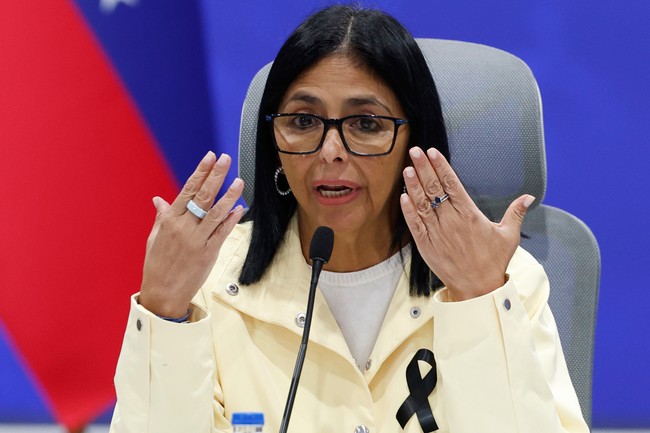
The current Venezuelan leader, Delcy Rodríguez, is not a democratic alternative who came to the rescue after Maduro’s capture. She is no Violeta Chamorro from Nicaragua who was democratically elected after the downfall of the socialist Sandinistas. Instead, Rodríguez had served as Maduro’s illegitimate vice president.
Her father, Jorge Antonio Rodríguez, was a revolutionary Marxist and founder of Venezuela’s Socialist League. He was implicated in the 1976 kidnapping of William Niehous, an American businessman abducted from his home in Caracas and held captive for more than three years.
But let’s let Delcy’s own record speak for itself.
Delcy Rodríguez spent years at the highest levels of the same political structure that destroyed Venezuela, and she helped build and run its apparatus of repression.
She exercised authority over Venezuela’s feared civilian intelligence service. What’s known as “SEBIN” is no ordinary police, but responsible for arbitrary detention, torture, sexual violence, and disappearances of any perceived opponent of the government. That is why, even after Maduro’s capture, Venezuela still leads the region in the risk of torture, according to the World Organisation Against Torture. Delcy created this apparatus of repression, and it did not disappear with Maduro behind bars.
To wit, just days after Maduro’s capture, Delcy ordered police to arrest any Venezuelan who was supporting the American operation. Security forces set up checkpoints and targeted Venezuelans who were publicly celebrating Maduro’s arrest. Fourteen journalists were also detained while covering the unfolding events in Caracas.
The Trump administration successfully pressured the regime to release hundreds of political prisoners, but the violation of human rights has not stopped. At least 87 Venezuelans have been detained for political reasons since Maduro’s capture.
The Venezuelan dictatorship was never about one person. Not just about Maduro or Chavez. It is a system. It is the intelligence service that arrests citizens for criticizing the government; it is the military counterintelligence agency that makes political opponents disappear; and it’s the vast criminal networks tied to the regime that traffic drugs and send gangs into the United States. Those structures remain to this day.
Political transitions inevitably require dealing with regime officials who still want to hold on to power. But some cooperation with remnants of the regime shouldn’t mean we’ve given up on greater freedom for Venezuelans or on greater security for American investment in Venezuela.
That matters especially in the oil industry. Socialists in Venezuela already showed how quickly American investments can become objects of nationalization. Without respect for private property, America’s new investments will never be truly secure.
What the Trump administration did was extraordinary because it understands something too many in Washington, D.C. forget: Venezuela is not a distant problem. It is in our hemisphere, and what happens there directly affects the security and interests of the American people.
The Trump administration’s operation defended American sovereignty and national security against a man already indicted in America for serious crimes against Americans.
Venezuelan officials trafficked drugs, sent criminal gangs into the United States, and developed cozy relationships with governments hostile to the United States. That is why Maduro’s capture mattered. It is also why what comes next matters even more.
America’s long-term interest is a stable Venezuela with legitimate institutions that cannot be captured by a dictator, a criminal network, or a hostile foreign power. Maduro’s capture removed a dictator. Now Americans need the socialist dictatorship dismantled once and for all.
Franklin Camargo is a Venezuelan-born PragerU personality, host of “Man on the Street,” and co-author of After Socialism, Freedom.