
Have we reached the point where the “your enemy’s enemy is your friend” philosophy of the progressive media is at breaking point? In the last month, multiple mainstream press outlets in Germany, Greece, and Poland have argued that Armenia should think carefully as to whether it would be safer to keep a Russian military base in its country than demand that it leave. Yes, that’s correct: Russia is, apparently, being touted by media broadly viewed as credible as a reliable guarantor of a European country’s security. Take all the time you need to think that logic through.
There is, naturally, a cause for this madness — and it is Trump Derangement Syndrome. The underlying message as to why Armenians should keep a base full of Russian military occupiers is that doing so would make it less likely that Trump’s most substantial (but too little acknowledged) foreign policy triumph — peace between Armenia and its neighbor Azerbaijan — will ultimately succeed.
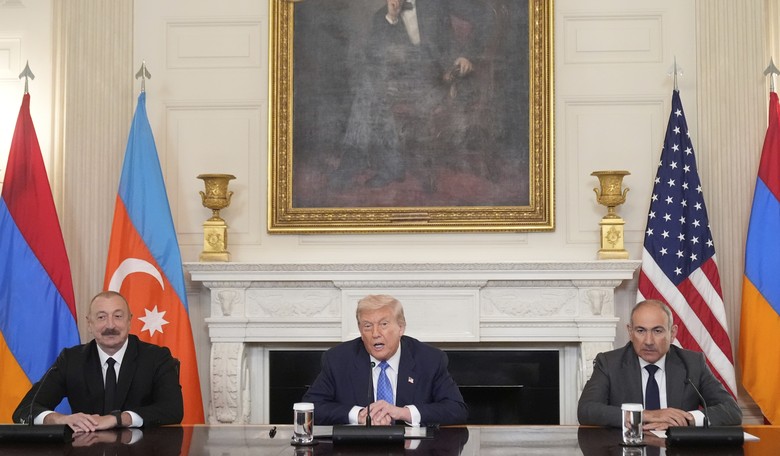
It is abundantly clear that the governments of Azerbaijan and Armenia want peace very much. In 2023, some 30 years after an Armenian invasion in 1992 and a generation-long occupation of a fifth of Azerbaijan’s legally recognized territory, Azerbaijan’s sovereign integrity was restored. A truce endured until 2025, when, shortly after his reelection, Trump brought the two former combatants to the table and worked to connect them through TRIPP — the Trump Route for International Peace and Prosperity — a proposed American-led and operated land trade route. This great innovation will enable the transit of goods from the Caspian Sea through Azerbaijan, Armenia, and Turkey to the Mediterranean Sea for the very first time in modern history.
Every year since Armenia’s 1992 invasion and occupation, there have been attempts to bring about a negotiated peace between Azerbaijan and Armenia. Every liberal and internationalist body of our generation, from the United Nations to the European Union, has tried. Even an entirely new organization called the Minsk Group, created by the Organization for Security and Cooperation in Europe expressly for the purpose of delivering a negotiated settlement, has attempted it. So, of course, when Trump achieves what these liberal internationalist bodies had not, it means that achievement must be opposed at all costs. If the choice is between acknowledging a Trump success and doing everything possible to pull it down — even if that means promoting the "benefits" of the most unhinged alternative — then that alternative will win out every time.
These attacks on Trump and his policy initiatives, by necessity, extend to the leadership of the two countries he and his administration are trying to bring together. On the Armenian side, successive traditional international media outlets have given voice to Ruben Vardanyan, a major political opponent of Nikol Pashinyan, the current prime minister of Armenia — and a sworn enemy of Azerbaijan.
Vardanyan is a Russian-Armenian oligarch who, in 2023, with the direct assistance of the Kremlin, was parachuted into Armenian-occupied Azerbaijani territory to take charge. It was widely believed his true destination was to be Armenia itself, a Russian-guided spoiler to stop Pashinyan from making peace with Azerbaijan, something that would consequently reduce Russian influence over both countries. Despite being dubbed “Putin’s wallet,” his funding of the Kremlin’s pet high-tech project Skolkovo, and his being lauded on the Kremlin’s website in honor of that work, none of this seemed to matter: he was given airtime to attack the democratically elected prime minister of Armenia and criticize Azerbaijan’s offer of peace. We have been encouraged by the progressive media glossing over the fact that he is a Ukrainian-sanctioned, Russian-made oligarch, when instead they place emphasis on his philanthropy.
On the Azerbaijani side, progressive Western media outlets have run to the defense of Ali Karimli, a self-styled Azerbaijani "opposition leader" who is currently on trial in Azerbaijan, charged with involvement in an attempted coup plot. The fact that the plot was — according to the prosecutorial charge-sheet — being planned with the support of Russia is, inexplicably, never mentioned. Instead, we are encouraged to believe through articles published in Britain, France, and the United States that Karimli is some sort of modern-day Azerbaijani Mahatma Gandhi.
Does this represent an organized conspiracy amongst the mainstream liberal media? Most likely there is a conspiracy of laziness — of one article feasting on the contents of another, whereby negative tropes over Azerbaijan and fantastical suggestions that Russia can be a trustworthy security guarantor are repeated. What is opinion in one progressive media outlet is regurgitated by another progressive media outlet as lore. European articles on Armenia’s Russian military base all repeat the same trope about the need for Armenia to continue to be protected from Azerbaijani aggression, when it was Azerbaijan that was attacked and occupied by Armenia, not the other way around.
Unfortunately, it seems facts don’t get in the way of a good story, nor does fact-checking. Doing the latter — and worse, publishing what was found – would be to admit that Trump has achieved a success no one thought possible: a nascent peace between two of the modern world’s most significant opponents. Highlighting the fact that Azerbaijan was attacked by Armenia would make nonsense of suggestions that an aggressor needs Russian protection from its neighbor. Reporting accurately on the background of a Russian-created oligarch would immediately undermine the credibility of anything he has said. Simply stating the prosecutorial charges of involvement in a Russian-backed coup plot would raise serious doubts over a person’s claims to be a "democratic opposition" leader. Instead, breaking point is reached where it is better to attack Trump and demean and undermine two countries attempting peace by elevating their internal and external opponents.
Mat Whatley is Managing Director of Okapi Train. Previously, he was a British Army Officer and later held senior positions within the EU Monitoring Mission in Georgia and as Head of the OSCE Monitoring Mission in Donetsk.