
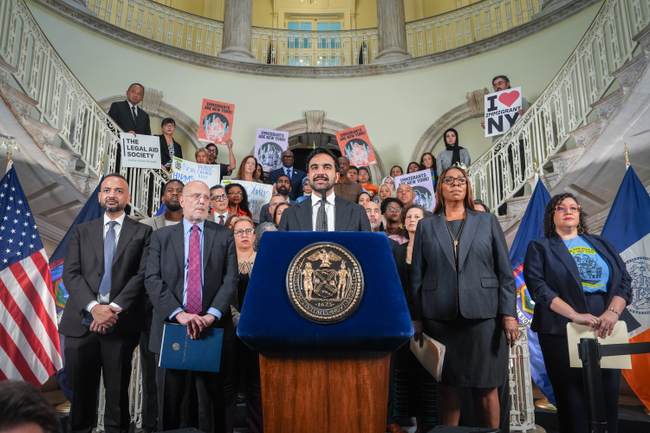
New York City Mayor Zohran Mamdani stood before cameras this week and accused the federal government of waging a "campaign of violence and terror" against immigrants.
Not a policy disagreement.
Not a legal dispute.
Terror.
That's the word a sitting American mayor chose to describe the enforcement of federal immigration law by his own country's government. I'll give him this much — it's certainly a word. Not an accurate one. But a word.
What produced it?
The Department of Homeland Security and U.S. Citizenship and Immigration Services issued an updated public charge rule, set to take effect this week, expanding what officers may weigh when deciding whether a green card or visa applicant is likely to become dependent on government assistance. The new rule lets officers factor in noncash benefits — Medicaid, food stamps, housing vouchers — alongside the cash benefits the Biden administration had narrowed the standard to in 2022.
In plain English: if you're applying to immigrate here, the government wants to know whether you can actually support yourself, or whether American taxpayers will be picking up the tab.
That's not new.
That's not radical.
The same basic principle has existed in American immigration law for well over a century — going back to the Immigration Act of 1882, self-sufficiency has been part of the bargain for the privilege of joining this country. Somehow the Chester A. Arthur administration figured this one out without anyone accusing it of terrorism.
Mamdani, along with New York Attorney General Letitia James and five other sanctuary jurisdictions — Chicago, San Francisco, Seattle, Santa Clara County, and King County — are now suing to block it.
Why?
Why is the default legal reflex of Democratic leadership, the instant a rule requires immigrants to demonstrate they won't become "primarily dependent" on the American taxpayer, to run to federal court?
Mamdani called the rule "a gross illegality" that will cause "irreparable damage," and warned that families — including U.S. citizen children — are already avoiding SNAP and Medicaid out of fear that using them could jeopardize a future here.
Maybe.
A meaningful number of the people this lawsuit is defending are, in fact, currently relying on the exact benefits the rule is designed to weigh. That's not really the rebuttal Mamdani seems to think it is.
Citizenship, and the pathway toward it, has never been a blank check.
It's a bargain — protection, opportunity, access to the most prosperous, freest economy on the planet, in exchange for a reasonable expectation that new arrivals will work toward standing on their own.
USCIS spokesman Zach Kahler put it plainly: the administration is "protecting American taxpayers from subsidizing aliens who may become dependent on public benefits."
That's not cruelty.
That's the same standard any responsible household would apply to a long-term guest — welcome, but not indefinitely at somebody else's expense, and not still raiding the fridge at month 11 while calling the homeowner a fascist for asking about groceries.
Which brings me back to Mamdani.
He didn't argue the rule is factually wrong, or that self-sufficiency is an unreasonable standard. He argued it's terrifying, illegal, an "assault on our civic fabric."
If the concern were genuinely about protecting legitimate refugees and hardworking future citizens from an overly broad net, that's a debate worth having on the merits.
Instead, we got a mayor comparing federal law enforcement to terrorism, standing alongside a state attorney general who has made a career out of suing this administration on nearly every front simultaneously — at this point, Letitia James should just get a standing table reserved at the federal courthouse with her name on a little brass plaque.
But I've got another question.
What happens to public trust in an immigration system when people stop believing the people being admitted are coming to contribute rather than draw down a system funded by people who are already here, already paying, and already stretched thin?
Every dollar of benefits directed toward someone not yet self-sufficient is a dollar that isn't available for the elderly widow on a fixed income, the veteran waiting on VA care, the American family one bad month from needing that same safety net themselves.
Citizenship used to mean something specific.
A mutual commitment.
Not a one-way transfer.
And that's what keeps bothering me about this.
If we've reached the point where asking whether someone coming here can support himself produces accusations of "terror," what exactly are we allowed to ask?
Seriously.
Citizenship is supposed to mean something.
So is becoming an American.
What exactly are we allowed to ask?
Because apparently that one is too much.