
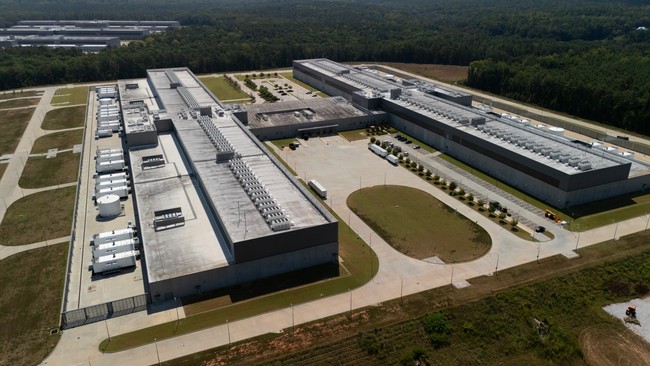
Seneca wrote a whole letter to his friend Lucilius titled “On Groundless Fears.” His point, roughly 2,000 years before cable news existed, was that we suffer more often in imagination than in reality, and that most of what torments us never actually arrives. Seneca never saw a data center, but he would recognize this fall's political ad campaigns instantly. Voters in Georgia, Virginia, and a dozen other swing districts are being told that a warehouse full of computers is about to drain their aquifer and double their power bill. The claim is loud, it is bipartisan, and it is mostly wrong.
Start with water, since that is where the scariest numbers travel fastest. A widely made claim held that a single ChatGPT prompt drinks a bottle of water. Google's own measured figure for a typical prompt is about a quarter of a milliliter, roughly five drops. The bottle-sized number came from a 2023 academic estimate that bundled in the water used generations away at a power plant, under assumptions nobody's actual usage matches. At the national level, American data centers directly consumed about 17 billion gallons of water for cooling in 2023, according to Lawrence Berkeley National Laboratory. Agriculture, by USDA's own count, accounts for more than 80 percent of the nation's consumptive freshwater use, dwarfing anything a server farm draws. Add in the water used to generate the electricity data centers draw, and the indirect total climbs to around 211 billion gallons, a real number worth tracking, but still a rounding error next to farms and lawns.
Electricity is where the fear campaign really overreaches. Multiple independent studies, including work from Lawrence Berkeley National Lab, the nonprofit research group EPRI, and the consultancy E3, have looked at whether data centers are driving up residential electric bills. The consistent finding is that they are not the primary cause, and in many states the opposite has happened. EPRI found data center growth associated with retail rates roughly 6 percent lower on average between 2019 and 2024, because a bigger customer helps spread the fixed cost of wires and substations across more kilowatt-hours. The states with the fastest data center growth, including North Dakota and Nebraska, saw real, inflation-adjusted rates fall. What has actually pushed bills up is grid modernization spending, storm recovery costs, natural gas price swings, and state renewable mandates. Energy Secretary Chris Wright put it bluntly this year: “Americans are not paying higher prices because of data centers. There's a perception there, and I get the perception, but it's not actually true.”
National averages can hide real local pain, and Seneca would want me to be honest about that, too. A single evaporative-cooled facility can pull millions of gallons a day, which matters a great deal in a drought-stressed county in Arizona or the Southeast. Parts of the PJM grid in Virginia's “Data Center Alley” have seen genuine congestion and rate pressure tied to rapid, concentrated load growth. Newer facilities are shifting to closed-loop cooling that cuts water use by 90 percent or more, and future demand growth could strain the grid if permitting stays slow. These are legitimate local planning problems. They are not evidence of a national crisis.
President Trump's Ratepayer Protection Pledge, announced in his February 2026 State of the Union and signed weeks later by Amazon, Google, Meta, Microsoft, OpenAI, Oracle, and xAI, is the right instinct even if the premise behind it is overstated. Under the pledge, hyperscalers agree to build, bring, or buy the power their facilities need and cover the infrastructure costs themselves, rather than passing the cost to the consumers next door. That is a sound, market-based answer to a problem that is mostly local and mostly future tense, which is a very different thing from the national emergency showing up in campaign mailers.
Because that is what this is, at bottom: a bipartisan affordability message built on a kernel of real local anxiety and inflated into a nationwide villain story, because “your bill went up a little due to 15 different factors” does not fit on a yard sign. Democrats have leaned into it hardest ahead of the midterms, tying data centers to the broader cost-of-living argument, but plenty of Republicans have found the same script useful in their own districts. Seneca's advice to Lucilius was to ask, before you panic, whether the danger is close, whether it is certain, and whether it is even a danger at all. Ask that about your power bill before you ask your county commission to block the next data center, and you will usually find the fear was doing more work than the facts.
The opposition side of this fight deserves the same scrutiny as the political ads. An April 2026 American Energy Institute report found that 12 U.S. groups actively fighting data-center projects had collectively taken in more than $39 million from foreign donors, chiefly Swiss billionaire Hansjorg Wyss and British and Danish foundations, not Beijing. Separately, Senate Intelligence Committee Chairman Tom Cotton has asked the Justice Department to investigate a Shanghai-based donor's nonprofit network and Chinese state media outlets for producing years of content opposing American AI infrastructure. Those remain open allegations, not proven coordination, and the distinction matters: European money is not Chinese money, and aligned messaging is not the same as state direction. But the supposedly organic grassroots case against data centers, including the Sanders-Ocasio-Cortez bill to freeze construction nationwide, has real foreign money behind its microphone even where the underlying local complaints are genuine.
The solution here is not slogans in either direction. It is permitting reform so power generation can keep pace with real demand, honest local review in the water-stressed and grid-constrained places where the concern is genuine, and a press corps and political class willing to say “roughly a rounding error” when that is what the data shows. Groundless fears make for good ads. They make for bad policy.
Jay Rogers is a financial professional with more than 30 years of experience in private equity, private credit, hedge funds, and wealth management. He has a BS from Northeastern University and has completed postgraduate studies at UCLA, UPENN, and Harvard. He writes about issues in finance, constitutional law, national security, human nature, and public policy.