
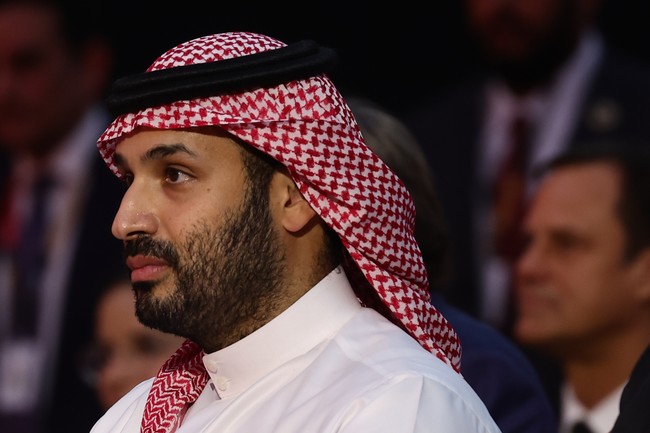
The kingdom in the sand shows that it has no ability to defeat the drug-addled Houthis in Yemen.
The American relationship with Saudi Arabia goes back over 80 years. In 1945, President Roosevelt met with King Saud aboard a U.S. naval vessel in the Suez Canal. The meeting started the strategic relationship between the countries, as the U.S. wanted guaranteed access to Saudi oil for its growing military and economy. King Saud expressed his opposition to any Jewish homeland in the region and told Roosevelt to put the Jews in the soon-to-be former Axis countries. Roosevelt promised not to support any effort in creating a Jewish homeland in the region.
So is Saudi Arabia a good ally of the United States? The question is not merely a rhetorical one: Mohammed bin Salman (MBS) apparently asked Donald Trump TWICE recently to bomb Houthi fighters that have overrun Saudi-supported positions in Yemen. The Houthis are both crushing the Saudi-backed forces and also flinging missiles into Saudi Arabia proper, causing serious damage to their oil infrastructure.
When I was a kid, Saudi Arabia actually came up frequently when there was a suggested arms sale to the kingdom. Since we didn’t have to deal with trans, DEI, and Islamic terrorism, the question of selling advanced weapons that could harm Israel was the stuff of Senate hearings and nightly news. So what do the Saudis have from the U.S. today? The Saudi air force has 917 planes and 30,000 soldiers. Their inventory includes:
- 232 F-15s of several variations
- 16 U.S. tankers of various makes
- 6 AWACS
- 80 Helicopters, half of them Apache Attack Helicopters
These numbers do not include over 150 Eurofighters and Tornadoes that round out their fighter wings. The Saudis are awaiting their F-35s, and did I mention the 300 Abrams tanks that the Saudi army fields?
With so much advanced American firepower, why are the Saudis having such fits with the Iranian-backed, khat-chewing Houthi fighters? The main reason is that it’s not the equipment but the men using them. Israel knows it needs to win on the battlefield in order to exist. It takes American tech and often modifies it with “Blue & White” systems. It also trains its pilots, sailors, and soldiers to win: there is no alternative. But the modern Saudis have never really been threatened. Saddam said that he would take them after Kuwait but made no real effort to conquer his neighbor to the south. The Saudis may have U.S. tech, but they no longer have a warrior mentality. Israel, out of necessity, flew thousands of kilometers to bomb the Houthis and succeeded in wiping out many of their commanders. The Saudis are far closer but are feckless on the battlefield and thus turned to Donald Trump to send some American firepower. The president declined to help them.
So is Saudi Arabia a real friend of the U.S.? It is interesting to note that in a lawsuit brought by 9/11 families against the country, Judge George Daniels of the Southern District of New York refused to throw the case out. He said that there is credible evidence to suggest Saudi involvement in the terror attacks, allowing the case to move forward. Were the Saudis actively involved in helping their nationals get to the United States? If they were not involved, were they aware of the plot but did not provide the U.S. with information prior to the destruction? The Saudis see their relationship with the Americans as transactional: we sell them oil and get rich, and we get from them military and other assistance. Their only true commitment is to Allah and jihad. They knew how to stick it to the U.S. in 1973 during the Arab Oil Embargo, and they have made no effort to join the Abraham Accords, though Donald Trump has said their receipt of F-35s will be dependent on their doing the same.
The Wahhabi version of Islam practiced in the country is extreme, even by Islamic standards. Christian and Jewish soldiers sent to Saudi Arabia in the buildup to Desert Storm were told not to show religious symbols openly. I mentioned previously that a sitting U.S. senator was at the time denied entry due to his passport having an Israeli entry stamp in it. MBS does the minimum in order to get the West off his back: let Israeli commercial flights overfly the country and give women the steering wheel to drive. When push comes to shove, he will never abandon Islamic principles for the sake of improved relationships with the West, and certainly not with Israel. There have been murmurs that Israel could help the Saudis with the Houthis but only if the kingdom joins its neighbors in the Abraham Accords. The Saudi leadership would rather lose men, equipment, money, and face than make a deal with the Yahud. Their Jew hatred has been strong since before Roosevelt’s meeting with Faud. They were for years the financial backers of Hamas and were opponents of the fake peace-making between Arafat and Israel.
George W. Bush made a massive blunder when he helped repatriate top Saudis, including Bin Laden family members, at a time when there were no commercial flights. He also failed as a leader when he whitewashed Islamic thinking behind the murder of 3,000 Americans when he called Islam a “religion of peace.” For years, al-Qaeda/Islam had been attacking: the USS Cole, several embassies in Africa, the first World Trade Center bombing. After the massive attacks that brought down the Twin Towers, Bush should have invoked a new crusade: to crush the threat of Islam against the West. There should be far fewer Muslims in the U.S. today than there were in 2001; the opposite is true. And we see Muslims running for office who are cool with 9/11 and have made it clear that their allegiance is to Sharia and not U.S. law. Mark Steyn spent 20 years screaming from the rooftops: how can the Global War on Terror succeed if you are importing into Manchester, Paris, and New York the same folks you are trying to kill in Kandahar? Islam by default is anti-Christian, anti-West, anti-Jewish and anti-Israel. Sure, their politicians know how to smile and how to shake a hated hand when required. But their goals are the same as the hijackers who murdered American citizens in cold blood: to end the West and “Christendom” as realized in Europe and the U.S.
Good on Donald Trump for blowing off MBS. President Trump is the most loyal friend one can have; he also has a good memory. If the Saudis interfered with U.S. efforts against Iran, he will be in no hurry to bail them out against the drugged-out Houthis. Trump likes performance, and when the Saudis show that they are losers with the best fighters in the world, then he has no need to either respect or help them. They turned him down several times over the Abraham Accords, one of his signature foreign policy successes. Why rush to save the Saudis when they can’t save themselves against a ragtag enemy? The problem for us all is that the Saudis' failures have allowed the Houthis to better position themselves to harm international shipping in the Red Sea.
The U.S.-Saudi partnership has gone on for decades. The U.S. having large hydrocarbon resources has removed one trump card that the Saudis have had over Americans for decades: they could close the spigot or raise prices. The U.S. does not need the Saudis as much as it once did. The Saudis still refuse to violate their religious views to make peace with Israel or even make war together against the Houthis. The Saudis are losers on the battlefield, and Donald Trump does not suffer losers.