
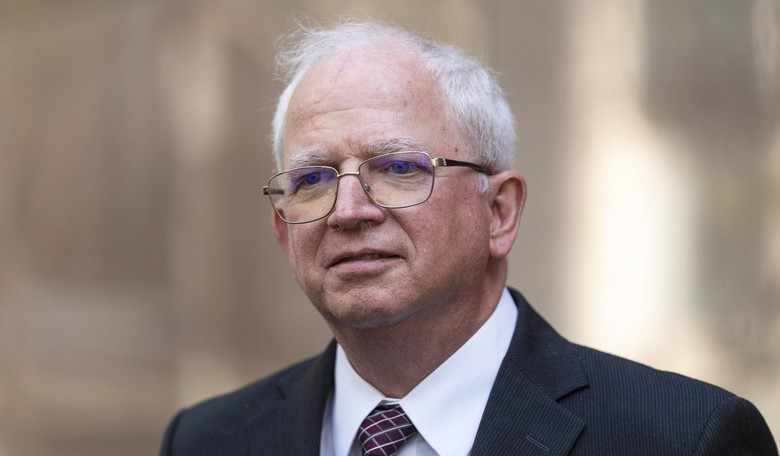
President Donald Trump’s former attorney, top constitutional legal scholar John Eastman, filed a petition for certiorari with the Supreme Court last week, appealing his disbarment by the California Supreme Court. Eastman was stripped of his law license for his work assisting Trump in challenging election anomalies and wrongdoing in the 2020 election. The California Supreme Court upheld the disbarment order of the State Bar of California’s disciplinary judge — who donated to Democrats as a sitting judge — finding that Eastman supposedly made false statements about election wrongdoing.
Eastman, whose resume is over 100 pages long, merely drafted a memo for Trump listing various outcomes dealing with the alternate slates of electors from the battleground states. In some of his scenarios, then-Vice President Mike Pence would not accept the alternate slates, resulting in Joe Biden becoming president. Eastman also filed an amicus curiae brief on behalf of Trump in the election lawsuit Texas v. Pennsylvania. He made public statements, such as stating that “dead people” voted. Official reports confirm that ballots were cast in the name of deceased people.
California Bar disciplinary judge Yvette Roland found Eastman culpable on the usual vague, broad ethics rules used to target conservatives: dishonesty, fraud and moral turpitude. These words can easily be used to describe any actions someone dislikes. The brief stated, “Eastman’s constitutional arguments does not transform legal advice into moral turpitude just because it departs from a preferred set of ‘experts,’” and “[b]road labels like ‘fraud,’ ‘defraud,’ ‘professional misconduct,’ and ‘conduct not speech’ cannot substitute for First Amendment analysis.” Fraud is a criminal term, and if Eastman committed fraud, then why hasn’t he been convicted in criminal court of fraud?
Authored by the powerful Jay Sekulow of the ACLJ and Alex Haberbush of the Constitutional Counsel Group, the 53-page brief argued that Eastman was disbarred for exercising core political speech.
But first of all, will the court accept the case? Eastman’s brief explained why its review is so imperative: “This Court’s review is crucial to halt the rising trend of politicized bar disciplinary proceedings.” He listed other attorneys who were targeted for their work on election lawsuits, and explained that the court’s intervention is also needed due to “markedly divergent outcomes reached by different jurisdictions for substantially similar advocacy.” Courts in Texas, Utah and Georgia have not disciplined attorneys for similar election work.
The California Supreme Court erred by failing to apply strict scrutiny to Eastman’s speech. The Review Department of the State Bar of California admitted in filings that the standard was strict scrutiny, but then said it was going to use a different standard: whether Eastman’s statements violate the Rules of Professional Conduct. The brief cited the Supreme Court opinion in Chiles v. Salazar, which held that the government may not recast speech as professional conduct.
Strict scrutiny requires a compelling interest in order to punish free speech, which the Review Department never identified. Eastman’s brief cited the Supreme Court case Milkovich v. Lorain Journal Co., which ruled that “a statement of opinion relating to matters of public concern which does not contain a provably false factual connotation will receive full constitutional protection.”
No one has ever proven that Eastman’s statements were false — the presence of election wrongdoing in 2020 remains a highly contested issue, with Trump still looking intensely into it. And whether the vice president has substantive authority to reject slates of alternate electors is hotly debated in the constitutional law realm. Eastman’s brief stated, “They were legal and constitutional opinions at the center of a national political controversy.” In 1960, an alternate slate of electors from Hawaii was accepted after concerns arose about election fraud. No attorneys were disciplined.
In his original appeal to the California Supreme Court, Eastman sarcastically observed, “[I]t must be emphasized that the Hearing Department is the first court in the nation’s history to consider the constitutional question of the Vice President’s authority to resolve disputes over electoral votes. This is a novel and unresolved issue, directly derived from our nation’s highest law, and arguably a non-justiciable political question not subject to judicial review. Nevertheless, the Hearing Department of the State Bar Court of California found itself qualified to authoritatively resolve this issue.”
If Eastman’s actions were so egregious, then why didn’t a single court sanction him? “In re Loney bars a State from independently determining that advocacy in a federal proceeding was sanctionable misconduct where the federal tribunal itself has made no such finding or referral,” his brief pointed out.
The brief noted that the Supreme Court quoted William Shakespeare in its 1985 opinion, Walters v. Nat’l Ass’n of Radiation Survivors. “As a careful reading of that text will reveal, Shakespeare insightfully realized that disposing of lawyers is a step in the direction of a totalitarian form of government,” the highest court said.
The attempted prosecutions of Eastman are going nowhere. Former Fulton County District Attorney Fani Willis was removed from her prosecution of Eastman, Trump and other officials, and the case was dropped. Two courts have thrown out Arizona Attorney General Kris Mayes’ prosecution of Eastman, Arizona’s alternate electors for Trump and their associates.
Since all nine justices are attorneys themselves, this issue is deeply personal to them. Like Eastman, they are legal scholars. What is so alarming about this case is that the Left didn’t just disbar any old attorney; they disbarred the premier constitutional legal scholar on the right. Eastman knows constitutional law and ethics rules better than anyone. Letting this decision stand would create a frightening precedent that would make it a cinch to disbar any conservative attorney.
I always say that every conservative election attorney I know in Arizona has been disciplined, is in the process of being disciplined, or is facing bar complaints. If Eastman’s disbarment is allowed to stand, no one will dare to take on these important cases anymore.