
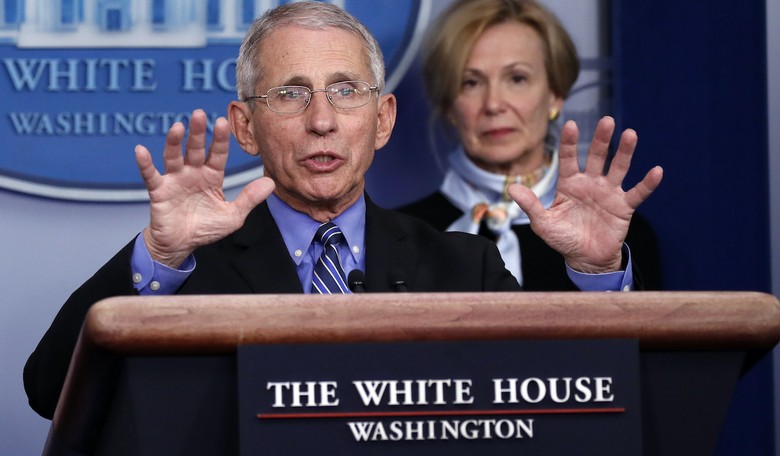
In October 2020, from inside the White House, I stopped attending the Coronavirus Task Force meetings. I wrote to the vice president’s office in frustration that I had no time to spend teaching people who were “refractory to facts.” I did not yet understand that this was not confined to that room or that time.
Six years later, Anthony Fauci sat before the Senate and invoked the Fifth Amendment rather than explain his actions when he commandeered the destructive pandemic policies. They referred him to the Justice Department for contempt. As expected, he has conceded no error.
Like Fauci, there will be no admission of failure by those who led the response with him. Deborah Birx, the official leader of the medical recommendations as Task Force Coordinator, wrote all the federal guidance and sent it to the governors and local health officials. She visited the states, cajoling them to mandate pseudoscience, like six-foot spacing and masks, while villainizing the few governors who didn't listen.
Part of the problem can be traced to the delusion of omniscience by those typically in the background, suddenly given unprecedented fame and power. Public health officials are bureaucrats, not normally sought after by major media outlets and gracing magazine covers. And the susceptibility to this is nothing new. The powerful force of delusion has been known for thousands of years. In Homer's "Iliad," delusion descended on a person via the daughter of Zeus to cloud their thinking. It was an irresistible external force then, not attributed to any character flaw that the person bore.
No doubt, Birx's silence is also due to embarrassing exposure of her hypocrisy of epic proportions in December 2020, when she held her own Thanksgiving family gathering, despite admonishing on Meet the Press then that “We cannot go into the holiday season — Christmas, Hanukkah, Kwanza — with the same kind of attitude that: ‘Those gatherings don’t apply to me.’ They apply to everyone, if you don’t want to lose your grandparents, your aunt.”
For the others in positions of leadership and influence who backed policies that defied evidence and common sense, one might assume that their justifications — panic, peer pressure, media propaganda, or “the data changed” — would have dissipated when the pandemic ended and the mismanagement was exposed. But they have not, and what remains is probably permanent. This is a biological survival mechanism, not just vanity.
Leon Festinger of Stanford described that mechanism in 1957 as cognitive dissonance. It is usually reduced to a truism: people dislike being wrong. But cognitive dissonance is a physiologic state, and the brain handles it like a threat. In brain imaging studies, people most resistant to changing a belief tied to their identity show the greatest activity in the amygdala and dorsal anterior insula, the circuitry of physical danger.
That’s what makes changing the original belief almost impossible, psychologist Elliot Aronson established — the threat is to the self-identity of being competent, moral, and rational. The force of that resistance increases with how public the commitment was and, perversely, with how much harm it did. The media coverage of that era made those commitments extraordinarily public.
This defense mechanism will not revise the original belief; instead, it revises everything around it. So contrary evidence is dismissed as flawed or avoided, and ambiguous findings are contorted as confirmation. Finally, the recollection itself gets rewritten. That’s why “we followed the science at the time” can be said sincerely. If you confront the person with facts, the response is personal outrage.
But the facts contradicted the Fauci policies from early on. Age-stratified data by spring 2020 showed a thousandfold risk difference between old and young, and targeted protection was urged independently that March by Ioannidis, Katz, and me. Henderson had concluded 15 years earlier that broad lockdowns do not stop respiratory viruses and cause severe social and medical harm. Despite that, lockdowns were imposed, then extended for months.
Frightened people demanded action, any action, and politicians obliged. They ordered playgrounds and parks closed — outdoors, where transmission was least likely — while families were confined indoors with high-risk elderly parents. That violation of common sense was obvious, but people were doing what trusted authorities told them, promoted emotionally by relentless media fear. Because it defied common sense, it required something stronger that would last longer — a firm psychological commitment.
That commitment then escalated, because once you comply, you defend the compliance and justify its cost. When data showed lockdowns had not stopped the spread and kids were being harmed, those who advocated lockdowns could not absorb the failure. That “sunk cost” was already paid, in many cases by their own children. Corrections to previous beliefs work only on those not fully committed; they cannot impact anyone who’s already paid the price. Every new finding of harm — learning loss, youth self-harm, skipped cancer treatment, economic destruction — raises the cost of admitting error. People reacted by shaming friends, reporting neighbors, cutting off family, and demanding that dissenting physicians be deplatformed. All those actions maintained the dominance of their original belief.
That’s why we should not expect most people to admit anything — that would ask them to demolish a self they have defended for five years. That leaves deterrence, and deterrence means public accountability. But I fear we have a disastrous void in courage. Those with the power to demand accountability have, with few exceptions, declined to use it.
Accountability, therefore, must be built into the system, beginning with correcting the record.
First, HHS, CDC, and FDA should issue statements of fact on lockdowns, school closures, and mandates. When the next crisis comes, a transparent review should be mandatory, including publishing original uncertainties.
Second, we citizens who lend power to elected officials must limit that power. Since constitutionally “guaranteed” freedoms apparently can be removed, let’s at least make it more difficult — shutdowns should be explicitly forbidden by law. And formalize term limits on all agency positions; 30-year tenures let power and perverse incentives accumulate beyond challenge.
Whatever the reforms, institutions and their defenders do not correct their own failures. Correction comes only from individuals willing to insist publicly, at cost to themselves — these are the people who never mistook consensus for truth. Those who got this catastrophically wrong will die certain they were right. The record can still be set straight, because truth does not require their permission.
Scott W. Atlas, MD, is the Robert Wesson Senior Fellow at Stanford University’s Hoover Institution, former Special Advisor to the President from August to November 2020, and former Chief of Neuroradiology at Stanford University Medical Center.